

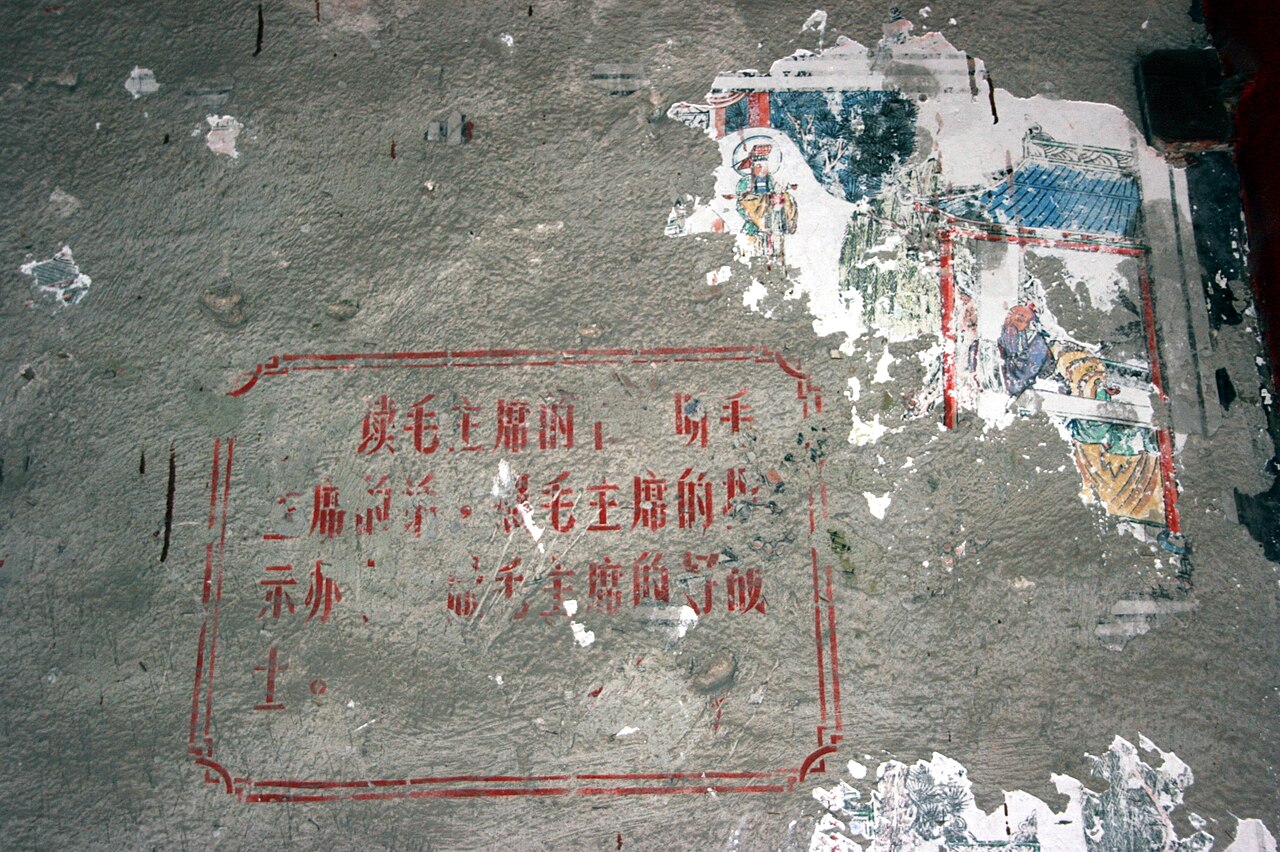
In the Cultural Revolution the campaign against the Four Olds fell on Daoism as on every religion in China. Temples were closed, looted, or turned to other uses, statues and scriptures were destroyed, and priests and monks were laicized, denounced, and sent to labour in the countryside. The White Cloud Temple in Beijing survived as an emptied shell while its community was dispersed. A tradition carried by temples and ordination lines for eighteen centuries came within a decade of being broken.
Tagged: Persecution Celestial Masters and Zhengyi Daoism Quanzhen
The Event
- Date
- 1966-1976 (exact)
- Era
- Suppression and Revival; Standard periodization of Daoist history
- Location
- China; today China
- Traditions
- Daoism
- Streams
- Celestial Masters and Zhengyi, Quanzhen
- Key texts
- Daodejing
How the Tradition Tells It
The suppression fell unevenly. Famous temples were emptied and many were destroyed, while household practice and village ritual persisted in places beyond the campaigns' reach. The record here names the national experience; local histories differ in how much was lost and how much was hidden and kept.
Primary Sources
- Chinese state records of the Cultural Revolution.
Secondary Sources
- Kirkland, Russell. Taoism: The Enduring Tradition. Routledge, 2004.
- Robinet, Isabelle. Taoism: Growth of a Religion. Translated by Phyllis Brooks, Stanford University Press, 1997.
Provenance: HIST-0815; confidence 0.95; accessed 2026-10-28.
Related on This Site
 History Event
Daozang catalogued
748
 History Event
Laozi canonized as Tang imperial ancestor
666
 History Event
Laozi deified
166 CE
 History Event
Post-Mao revival
1980s
 History Event
Qiu Chuji meets Genghis Khan
1222
 History Event
Quanzhen founded
12th century
 History Event
Wang Chongyang
1113-1170
 History Event
Zhang Daoling; Celestial Masters
142 CE