

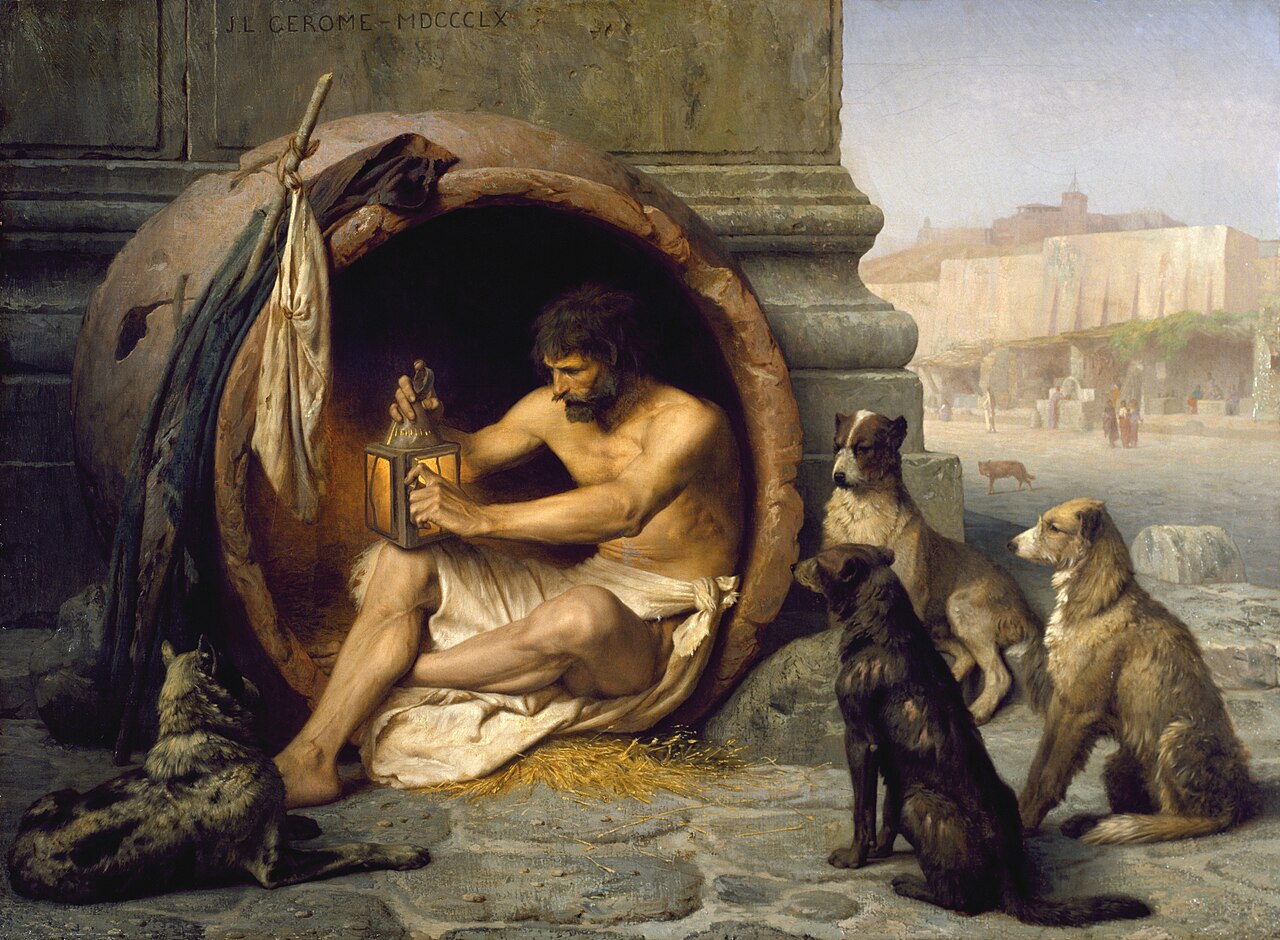
Cynicism is the philosophy enacted, not argued: Diogenes in his barrel, defacing the currency of convention, needing nothing, owning nothing, and calling himself a citizen of the world.
Cynicism began with Antisthenes, a pupil of Socrates, and became immortal in Diogenes of Sinope, who lived in a storage jar in Corinth, carried a lamp in daylight looking for an honest man, and told Alexander the Great to step out of his sunlight. The school's texts are anecdotes — philosophy as performance — and its heirs are the Stoics, who professionalized its ethics, and every later movement of holy poverty and deliberate simplicity.
Ultimate Reality
The Cynic's metaphysics is a refusal: nature (physis) is the only real standard, and convention (nomos) — money, rank, fashion, reputation — is counterfeit coin, to be defaced, in the school's founding pun. Behind the refusal stands a rough providence: the gods need nothing, and the human ideal is to need as little, approaching the divine by independence rather than by doctrine.
The Human Condition
Human beings are enslaved by their own acquisitions and opinions, mistaking the cage's gilding for freedom. The diagnosis is delivered by shamelessness (anaideia): the Cynic performs in public what convention does in private, forcing the audience to see that their necessities are choices — and that the choosing was done by others.
Knowledge and Truth
Truth is known by living it. The Cynic distrusts definitions spun in schools — Plato's 'featherless biped' was answered with a plucked chicken — and offers the deed as the argument: the shortest road to virtue is the enacted life, and the body trained by hardship (askesis) is the only reliable commentary on the doctrine.
Right and Wrong
Virtue is self-sufficiency (autarkeia) practiced as poverty, frankness (parrhesia), and endurance. The Cynic owns a cloak, a staff, and a wallet, eats what the day gives, and speaks the truth to kings and mobs at the same volume. Vice is not rule-breaking but need: every unnecessary want is a master, and freedom is counted in masters dismissed.
Human Destiny
The Cynic claims the only citizenship that cannot be revoked: kosmopolites, citizen of the cosmos, is Diogenes' coinage. Death holds no terror for one who owns nothing it can take; asked how he wished to be buried, Diogenes answered face down, since everything would shortly be turned upside down anyway — the school's eschatology in a single joke.
The Conversation
Cynicism asks every comfortable worldview to show its barrel: what can your adherents actually do without? It presses the religions of renunciation — the Franciscans, the sadhus, the desert fathers — on how much institution a poverty movement can carry before the lamp becomes a logo, and it hears, from the schools it mocked, the fair reply that performance too can become a convention.