

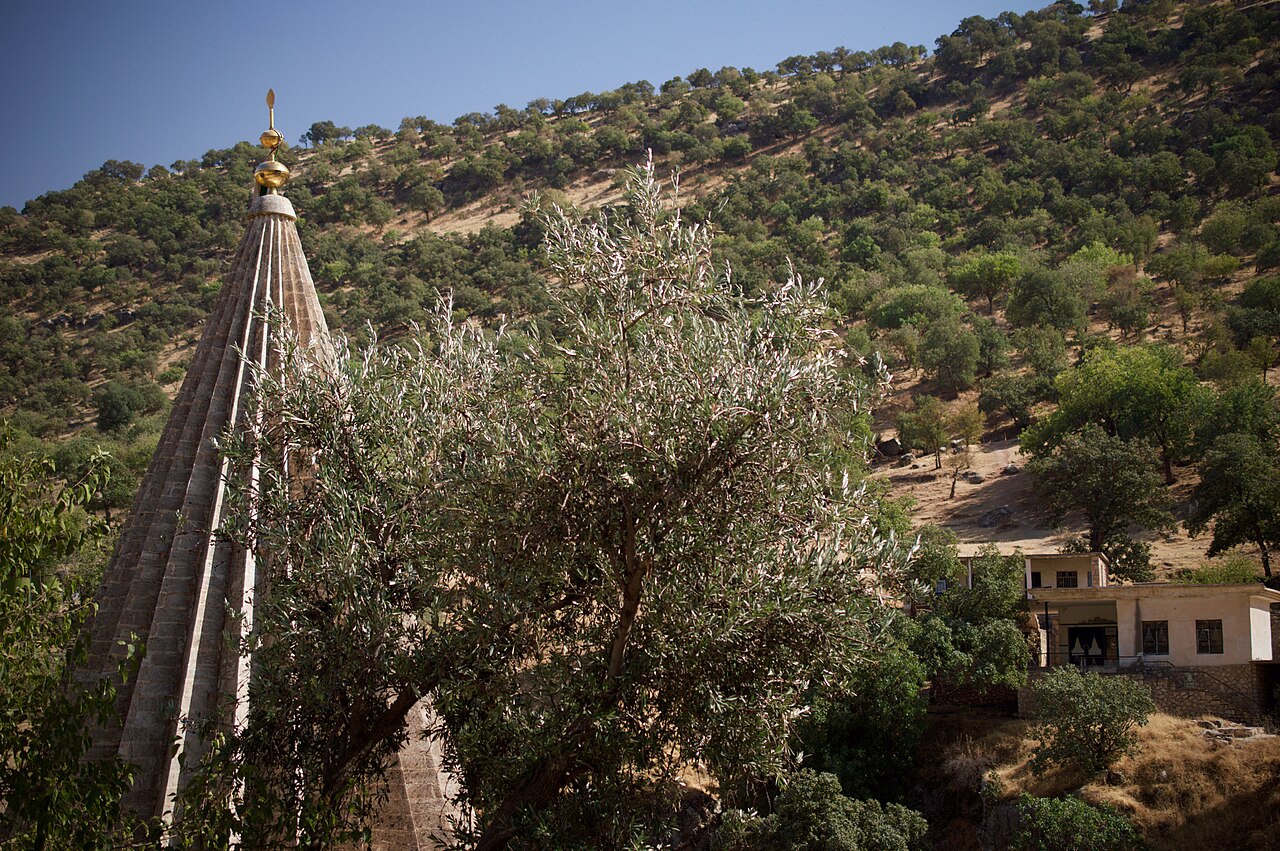
Yazidism is the ancient monotheistic faith of the Yazidi people of northern Iraq: one God, Xwedê, who entrusted the world to seven angels headed by Melek Taus, the Peacock Angel; chief of angels, not a fallen one.
Yazidism is an endogamous, orally transmitted faith of great antiquity, centered on Lalish in northern Iraq, where the shrine of Sheikh Adi ibn Musafir; the Sufi preacher of the twelfth century whom the faith venerates as an incarnation of the divine; anchors the holy valley. Yazidis have survived, by their own count, seventy-four genocides (firmans); the seventy-fourth, ISIS's 2014 assault on Sinjar, scattered tens of thousands and murdered thousands, and the diaspora; largest in Germany; now carries the faith's future alongside the survivors of the homeland.
Ultimate Reality
God, Xwedê, is one, remote, and the creator of the universe from the White Pearl; having created, he entrusted the world's government to a heptad of angels, the Seven Mysteries, whose chief is Melek Taus, the Peacock Angel. The single most important correction the faith asks of outsiders: Melek Taus is not Satan and not a fallen angel. In the Yazidi telling he refused, alone among the angels, to bow to Adam; because he would bow to none but God; and God vindicated his loyalty with the chiefdom of the world.
The Human Condition
Humans live under the angels' government and their own deeds' weight; Yazidis observe their condition through a dense web of taboos and endowments; food and dress rules, the sanctity of earth, fire, water, and air, and a caste order of sheikhs, pirs, and murids into which one is born, since the faith accepts no converts. The human problem is thus less rebellion than forgetfulness: of the Pearl, of the covenant, of whose one is.
Knowledge and Truth
The faith's scriptures are hymns: the qewls, sacred poems carried in memory by the qewwals, hereditary singers whose recitation at Lalish and in the villages is the canon in performance. Two short books, the Kitab al-Jilwa and the Mishefa Resh, circulated in manuscript in modern times and their status is debated even among Yazidis; the living archive is the trained memory, which is why the killing of elders in 2014 was a library burning as well as a massacre.
Right and Wrong
Righteousness is purity kept: the taboos observed, the feasts attended, the dead buried facing the rising sun, marriage kept within the faith and the caste. The angels are honored at their festivals; the autumn Assembly at Lalish (Jema) is the year's summit; and wrong is pollution and breach: to break the taboos is to loosen the weave that holds a small people together under a large sky.
Human Destiny
The soul is reborn; transmigration (kiras guhorin, 'changing the garment') carries it through lives until purification; and the world's end is awaited with Sheikh Adi's return and the angels' final ordering. The destiny the community guards most fiercely is nearer: survival itself, the return to Sinjar, and the recovery of the still-missing women and girls of 2014, which the faith counts among its unfinished sacred duties.
The Conversation
Yazidism asks the world a question it has earned the right to ask: how many times must a people be exterminated for a misidentification; 'devil-worshippers,' the slander Melek Taus's vindication story exists to refute; before the world corrects the record? Scholarship has corrected it; the conversation now is with the survivors, about what a shattered oral archive can still be taught, and by whom.