

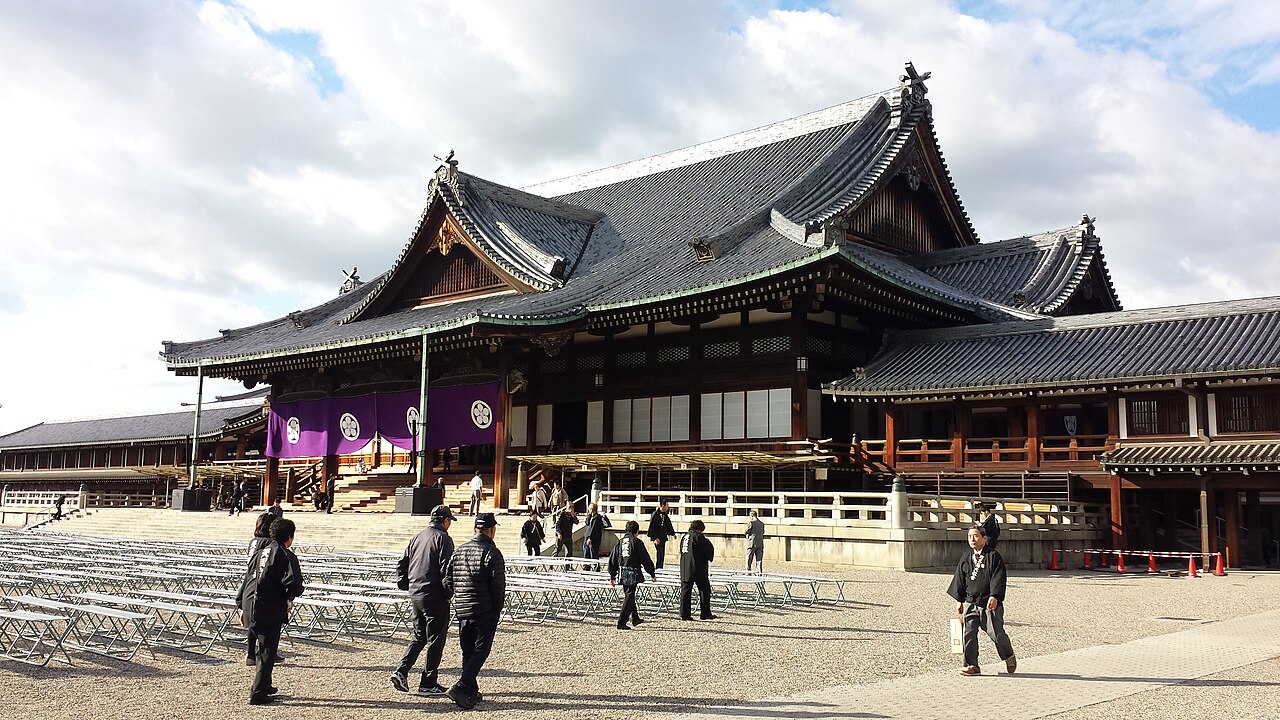
Tenrikyo is the Japanese faith founded in 1838 through Nakayama Miki, the Shrine of God the Parent, whose teaching; that human beings are lent their bodies by God and owe a life of joyous service; radiates from the Jiba at Tenri.
Tenrikyo began on October 26, 1838, when God the Parent (Tenri-O-no-Mikoto) is held to have entered Nakayama Miki, a farmer's wife in Shoyashiki village, declaring: 'I am the God of Origin, God in Truth. This Residence is the stage for the creation of humankind.' Miki became Oyasama, the ever-living Shrine of God; her village became Tenri, a pilgrim city built around the Jiba, the spot of human conception. Long classified under Sect Shinto by the Meiji state, the faith became independent after 1945 and now counts adherents across Japan and abroad, with churches, a university, and one of Japan's great religious libraries.
Ultimate Reality
God the Parent is one, perfect, and parental in the literal sense the name asserts: humankind's creator and continuing lender of life. Every human body is a thing lent, a thing borrowed (kashimono-karimono) from God; only the mind is one's own. The doctrine sounds mild and proves radical: the body was never yours, so its use is a tenancy whose rent is gratitude.
The Human Condition
Suffering and illness arise from the dusts (hokori) of the mind; the accumulations of miserliness, covetousness, anger, and the rest of the eight dusts Oyasama named; which cloud the borrowed body's workings. There is no fall and no inherited sin; there is housekeeping neglected. Sickness, accordingly, is guidance: God's urging the tenant to sweep.
Knowledge and Truth
The scriptures are Oyasama's three writings: the Ofudesaki (the Tip of the Divine Writing Brush, her seventeen-part verse revelation), the Mikagura-uta (the Songs for the Service, danced at the Jiba), and the Osashizu (Divine Directions, her spoken guidance). Truth is verified in the sweeping: a teaching proves itself as the mind clears and the body, God's property, responds; the faith's epistemology is a landlord's inspection, conducted in joy.
Right and Wrong
The ethic is hinokishin: daily labor offered in gratitude for the loan of the body; sweeping a street, serving a stranger; performed with the Joyous Life (yōkigurashi) as both means and end. Wrong is dust: the self-centered uses of the mind that cloud it. The faith's famous works; hospitals, relief after disasters, the city of Tenri itself; are hinokishin institutionalized.
Human Destiny
The world's destiny is the Joyous Life World: when minds are swept clear, God and humankind will rejoice together at the Jiba, and the Service (Tsutome) performed there hastens the day. The individual soul returns its borrowed body and is reborn (denaoshi, 'a fresh start'); Oyasama, having withdrawn from physical life in 1887, remains ever-living at the Residence, still working; the faith's destiny is thus anchored in a person who, on its account, never left.
The Conversation
Tenrikyo asks Buddhism and Christianity what doctrine could be simpler than a lent body and a dusty mind; and it asks Japan's religious establishment whether a faith founded by a farmer's wife in a tenant-farming village can be told apart, by its fruits, from the great traditions. Scholars answer that the hardest test is the one the faith sets itself: the Service at the Jiba is performed for a world whose sweeping remains visibly incomplete.