

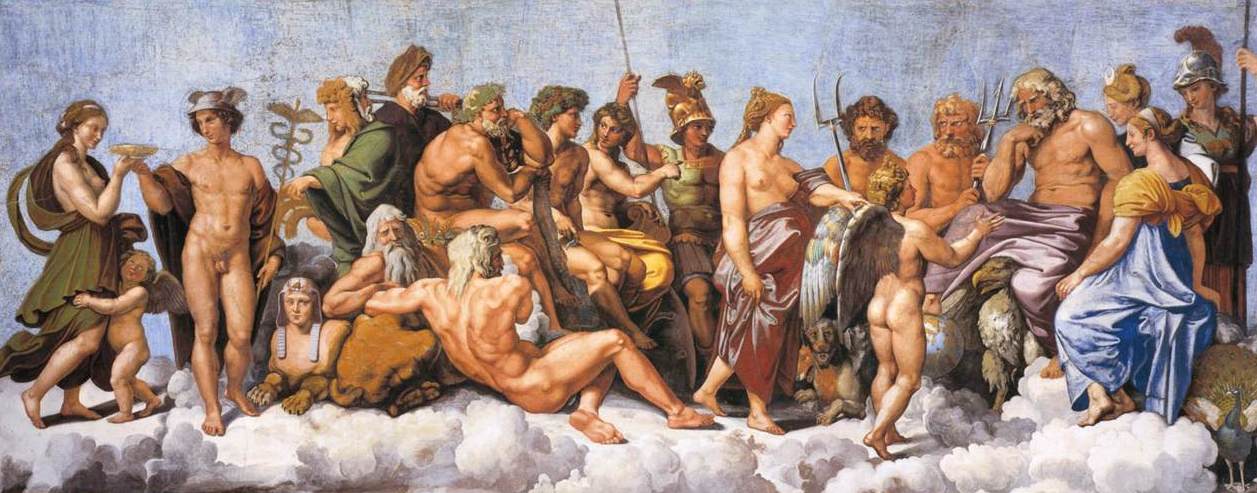
Polytheism worships many gods, each with a domain and a character; henotheism exalts one god above the rest without denying the rest, and monolatry worships one alone while granting that others exist.
Most religion in human history has been polytheistic: the Olympians and the Aesir, the kami's eight million, the orishas and the devas' thirty-three million. The three terms on this page grade the many-gods world by devotion's focus, not by belief's census: henotheism (Max Müller's coinage for the Vedic hymns, where each addressed god is, for that hymn, supreme) and monolatry (the practice of early Israel on many scholarly readings — one God worshipped, others acknowledged) mark stages and stances inside polytheism's house, not exits from it.
Ultimate Reality
Reality is populated: the divine is plural because the world's powers are plural — storm and sea, harvest and war, love and death do not feel like one personality, and polytheism declines to pretend otherwise. The gods are within the cosmos, born, embodied, and limited; above them may stand fate, or a first principle, but worship addresses the persons, not the abstraction.
The Human Condition
The human problem is exposure: to forces that are powerful, interested, and not reliably just. The gods must be honored, fed, and kept in right relation — do ut des, I give so that you may give — and misfortune is diagnostic before it is mysterious: some relation, some neglected altar, some crossed domain. Tragedy, the form polytheism's Greece invented, is what happens when the domains collide in one life.
Knowledge and Truth
Knowledge of the divine comes by myth, cult, and divination: the stories carry the gods' characters, the calendar their seasons, the oracle and the omen their current dispositions. Truth here is not a system but a repertoire — the accumulated case law of relations with powers — and its pluralism is principled: foreign gods are candidates for identification or adoption, not automatic falsehoods.
Right and Wrong
Piety is the master virtue: give each god, each ancestor, each place its due. Ethics and cult are not separate departments; the Roman pietas and the Confucian li alike bind family, city, and heaven in one fabric of performed respect. Wrong is hubris and neglect — the overreach that insults a domain, the offering skipped — and its punishment arrives inside the same world that defines it.
Human Destiny
Destiny is modest in most polytheisms: a shadow's afterlife (Hades, the Duat's judgment for Egypt's more developed hope, Hel) or rebirth's wheel, with apotheosis reserved for emperors and culture heroes. The system's consolation is not escape but company — a cosmos full of persons, in which death changes one's address more than one's world.
The Conversation
Polytheism asks monotheism whether one will behind storm and harvest, plague and mercy, creates a theodicy problem that many wills dissolve — and it asks the modern neopagans, its revivers, how a tradition is rebuilt from books and longing. Monotheism answers that the many gods always tended toward one — henotheism is its Exhibit A — and the polytheist answers that the tendency looks, from inside, like ordinary courtesy among powers.