

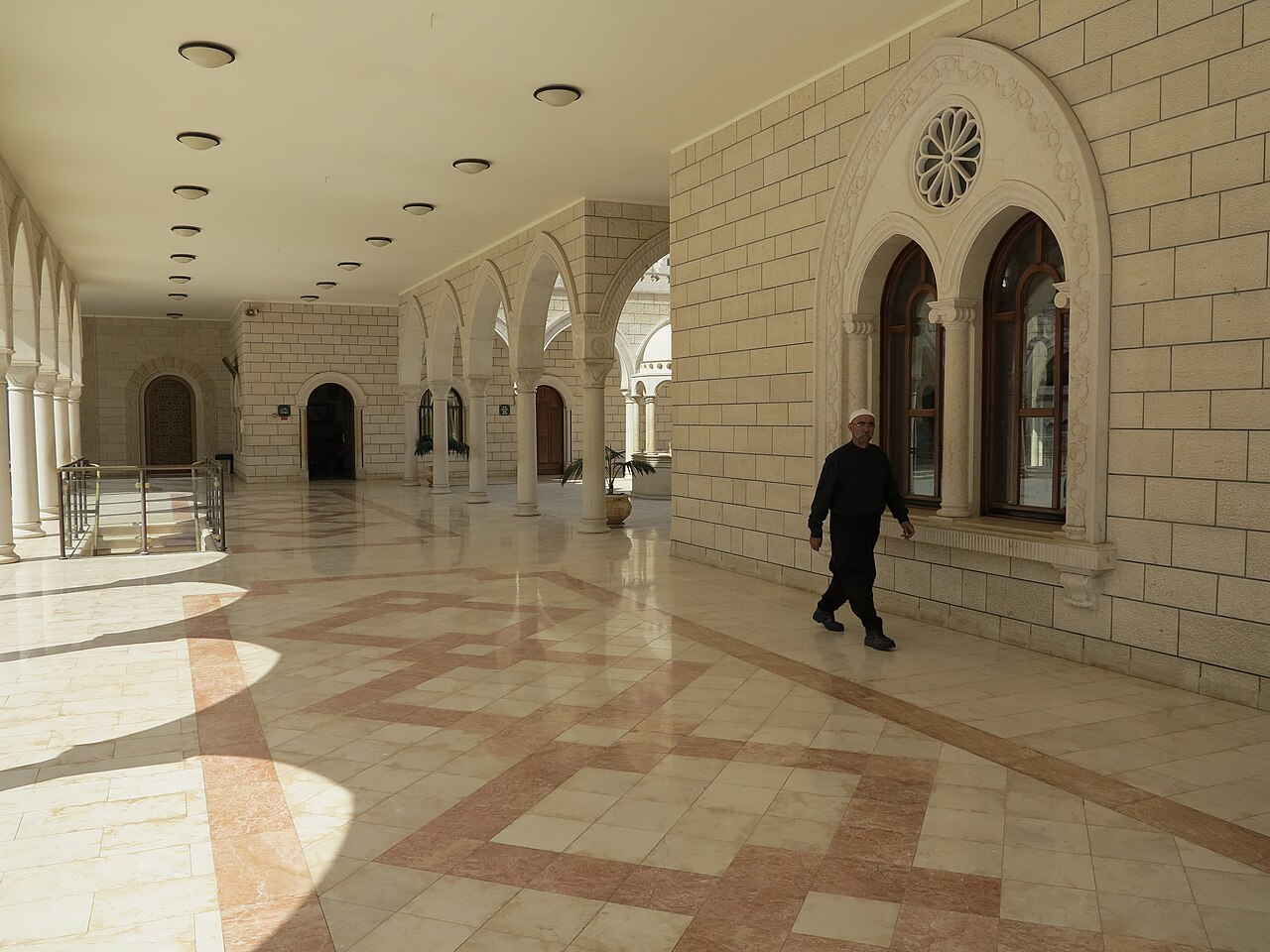
The Druze faith (Muwahhidun, the Unitarians) is a closed, monotheistic tradition born in eleventh-century Cairo, which keeps its doctrine within an initiated minority and asks of the world chiefly to be let alone in its mountains.
The Druze call themselves al-Muwahhidun, the Unitarians; proclaimers of God's absolute unity; and their faith emerged in Cairo during the Fatimid caliphate of al-Hakim bi-Amr Allah (reigned 996–1021), preached by Hamza ibn Ali and closed to new adherents in 1043, when the call was sealed and has never reopened. The community; today perhaps a million, in Lebanon, Syria, Israel, and Jordan, with a wide diaspora; does not proselytize, does not accept converts, and marries within itself; what follows therefore describes the faith's public outline, which the community itself publishes, and not the guarded doctrine of its initiates.
Ultimate Reality
God is one, utterly transcendent, beyond attributes and comprehension; in the faith's Cairo hour he manifested in al-Hakim, the caliph whose disappearance in 1021 is read not as death but as occultation, from which his return is awaited. The created order proceeds from God's command through a hierarchy of cosmic principles; the Universal Intellect first among them; whose emanation orders everything below, including history itself.
The Human Condition
Souls are fixed in number and reborn immediately at death (taqammus) into new Druze bodies, so the community neither grows nor shrinks in its census of souls; the human task within a life is the recognition of the unity the cosmic order reflects. The community divides between the uqqal, the initiated 'knowers' who receive the doctrine and live under its discipline, and the juhhal, the uninitiated majority, whose piety is loyalty, honesty, and the keeping of the community's ways.
Knowledge and Truth
The scriptures are the Epistles of Wisdom (Rasa'il al-Hikma), Hamza's and his successors' letters, which circulate only among the uqqal; the juhhal do not read them, and outsiders are not the books' audience. Truth is therefore guarded by design, and the faith adds to guarding a permission history made necessary: taqiyya, the protective concealment of belief under persecution, which centuries of endangerment turned from doctrine into instinct.
Right and Wrong
Hamza's seven commandments bind the initiated and shape the whole community's reputation: truthfulness in speech above all, mutual protection among the brethren, renunciation of false religions, dissociation from error, acknowledgment of God's unity in every age, contentment with God's acts, and submission to them. The Druze are famous in the Levant for the first two; the word of a Druze is a regional proverb; and for a hospitality and martial loyalty that the mountains rewarded.
Human Destiny
Destiny is the wheel of rebirth turning within the community until the awaited return: when al-Hakim comes again, the faith's hidden order is vindicated publicly, and the unitarians' long patience is the plot's point. Individuals advance or regress across lives by their recognition and conduct; the community's collective destiny is survival intact; which, given its geography between empires, it has practiced as a sacred art for a thousand years.
The Conversation
The Druze conversation with the world is deliberately short, and its brevity is the message: a faith may decline the missionary age's terms entirely; no converts sought, no doctrine exhibited, no argument offered; and still flourish as a people. The scholarship that studies the Epistles does so from manuscripts the community never released; the community notes this, and goes on keeping its counsel, which is perhaps the tradition's most consistent teaching.