

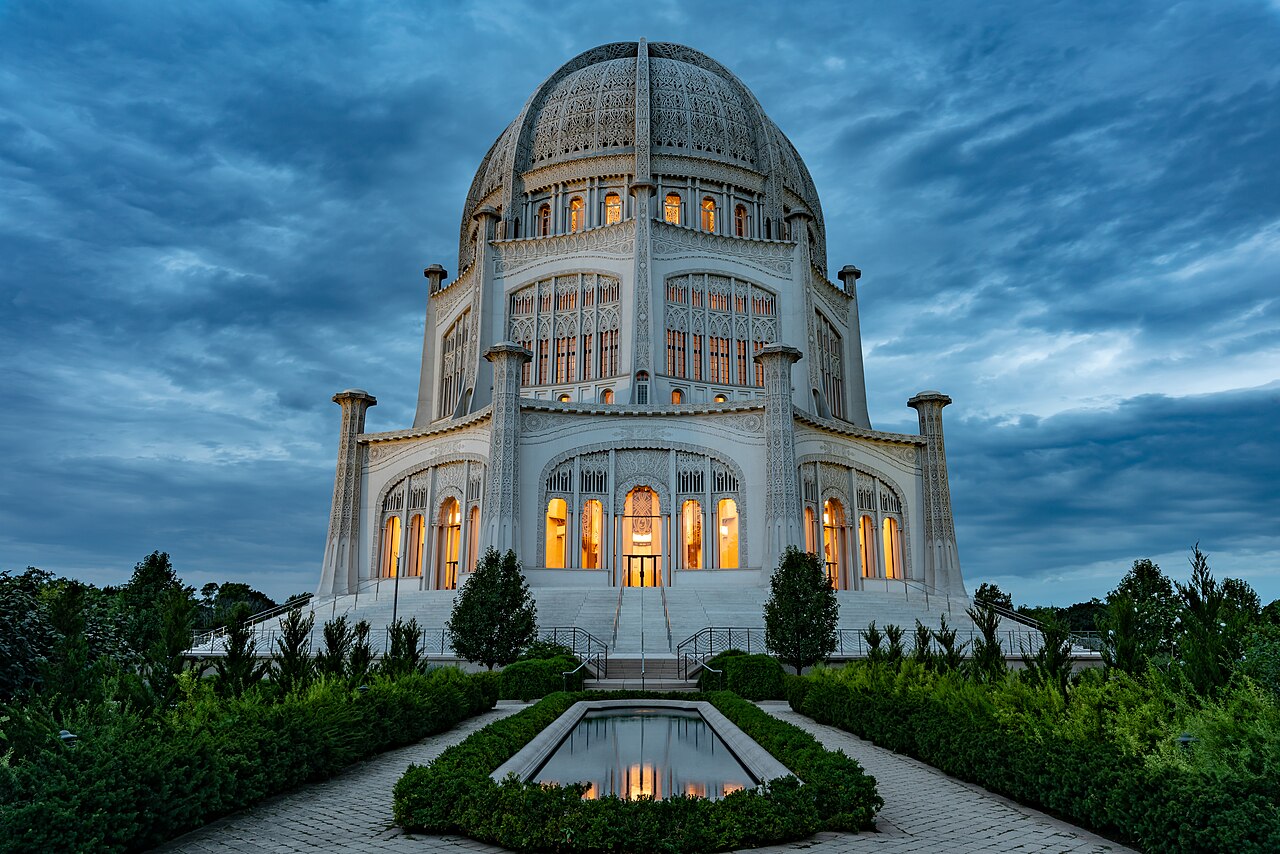
The Bahá'í Faith teaches that God is one, religion is one unfolding revelation, and humanity is one family now coming of age — its task is to build a just and peaceful world civilization.
The Bahá'í Faith began in nineteenth-century Persia with the Báb (1819–1850), who announced a coming messenger, and Bahá'u'lláh (1817–1892), who declared himself that messenger — the latest in a line of Manifestations of God that includes Abraham, Moses, Krishna, Zoroaster, Buddha, Jesus, and Muhammad. From prison and exile, Bahá'u'lláh wrote the laws and teachings his followers now carry to nearly every country on earth.
Ultimate Reality
God is one, unknowable in his essence, and known through his Manifestations, who reflect his attributes as mirrors reflect the sun. Creation is his gift and sign; the human soul, created in his image, carries capacities for love, knowledge, and justice that no other creature carries in the same measure.
The Human Condition
Humanity's sickness is disunity: prejudice of race, nation, class, and religion, and the conflict it breeds in an age when the world has materially become one. Each person also fights the lower nature — the self that must be educated by the Manifestations' teachings into a spiritual being. The remedy is recognition of the oneness of humankind and obedience to the covenant.
Knowledge and Truth
Truth comes by progressive revelation: God educates humanity age by age, each Manifestation renewing religion and giving laws fitted to the time, so religions are chapters of one book rather than rivals. Bahá'ís also affirm the harmony of science and religion — truth is one, and a reading of scripture that contradicts established fact is a reading to be reconsidered. Each soul must investigate truth independently, without clergy.
Right and Wrong
The moral law centers on unity: the abolition of prejudice, the equality of women and men, universal education, the elimination of extremes of wealth and poverty, and work performed in a spirit of service, which is worship. Bahá'u'lláh's laws for individuals include daily prayer, a nineteen-day fast, and abstinence from alcohol; his administrative order — elected councils without clergy — carries the community's affairs.
Human Destiny
The soul survives death and journeys through spiritual worlds, growing forever toward God; heaven and hell are nearness to and distance from him, not places. History also has a destiny: the Lesser Peace of political order and then the Most Great Peace, when the oneness of humanity is recognized in fact and a world civilization, material and spiritual, is built.
The Conversation
The Bahá'í Faith asks the older religions whether their own scriptures' promises of a coming age point beyond their present divisions, and it asks them to test its central claim — that revelation is progressive — against their histories. It presses secular world views on their plans for unity: if humanity is one, what institution, and what spiritual motive, will ever make it act as one?