

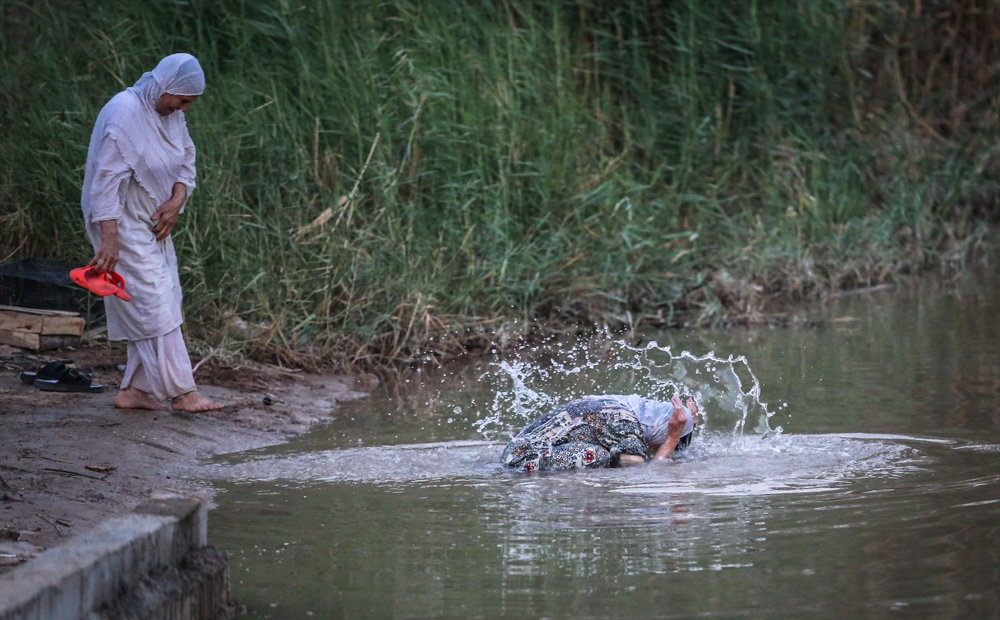
Mandaeism is the last surviving Gnostic religion: the faith of the Mandaeans of Iraq and Iran, who revere John the Baptist as their great prophet and seek the soul's return to the World of Light through baptism in living water.
The Mandaeans; called Sabians in the Qur'an, one of the Peoples of the Book; are the only Gnostic tradition to survive from antiquity into the present, carried by a small people of southern Iraq and Khuzestan and, since 2003's war scattered them, by diaspora communities from Sydney to San Diego. Their canon, the Ginza Rabba (the Great Treasure), is written in Mandaic, a dialect of Aramaic the site's Languages section also treats; their liturgy centers on masbuta, baptism by immersion in flowing water, repeated because the world keeps soiling the soul.
Ultimate Reality
The World of Light is ruled by Hayyi Rabbi, the Great Life, from whom emanate uthras, beings of light in graded splendor. Opposite stands the World of Darkness, ruled by Ruha and her brood, from whose matter and malice the material world was cobbled; by the demiurge-like Ptahil; with the human body as darkness's snare for a soul that is, in origin, a drop of light: Adam's hidden soul, smuggled into the body, is the faith's whole plot.
The Human Condition
The condition is exile in matter: the soul of light is imprisoned in a body ruled by the planets and their appetites, and it forgets its origin precisely as the darkness intends. Mandaeans read the other religions of their neighborhood through this plot; Jesus, in the Mandaean books, is a deceiver who perverted John's teaching, and John the Baptist is the true prophet, the uthra Enosh-Uthra's disciple and the baptizer of light.
Knowledge and Truth
Manda means knowledge; gnosis; and the name is the program: salvation comes by knowing where the soul is from and how it returns. The Ginza's two halves, the Right Ginza of doctrine and myth and the Left Ginza of the soul's ascent, are copied by priestly scribes whose colophons chain each manuscript to its copyists across seventeen centuries; one of the longest unbroken scribal traditions on earth, and the faith's evidence department.
Right and Wrong
The ethic is purity in the service of ascent: baptism repeated, ritual meals for the dead (masiqta, which raises the soul), almsgiving, truthfulness, and the keeping of the community's boundaries in diet, dress, and marriage. Wrong is whatever thickens the darkness's hold; lying is treated with special severity; and the priesthood's own purity laws are correspondingly strict, since the instruments of ascent must be clean.
Human Destiny
At death the soul ascends through the purgatories (mataratas) where its deeds are weighed, aided by the masiqta rites its family performs, toward the World of Light from which it fell. The journey is the faith's map and its funeral liturgy at once; the diaspora's terror is logistical as much as theological; a soul's ascent requires priests, flowing water, and books, and exile endangers all three.
The Conversation
Mandaeism asks the baptizing religions where their rite came from, and it asks the world to notice that the last Gnostics are disappearing in plain sight; their priests few, their river polluted and dammed, their language near extinction. Scholarship's answer has been a race: record the priests, photograph the manuscripts, and learn Mandaic while there is still anyone for whom it is a mother tongue.