

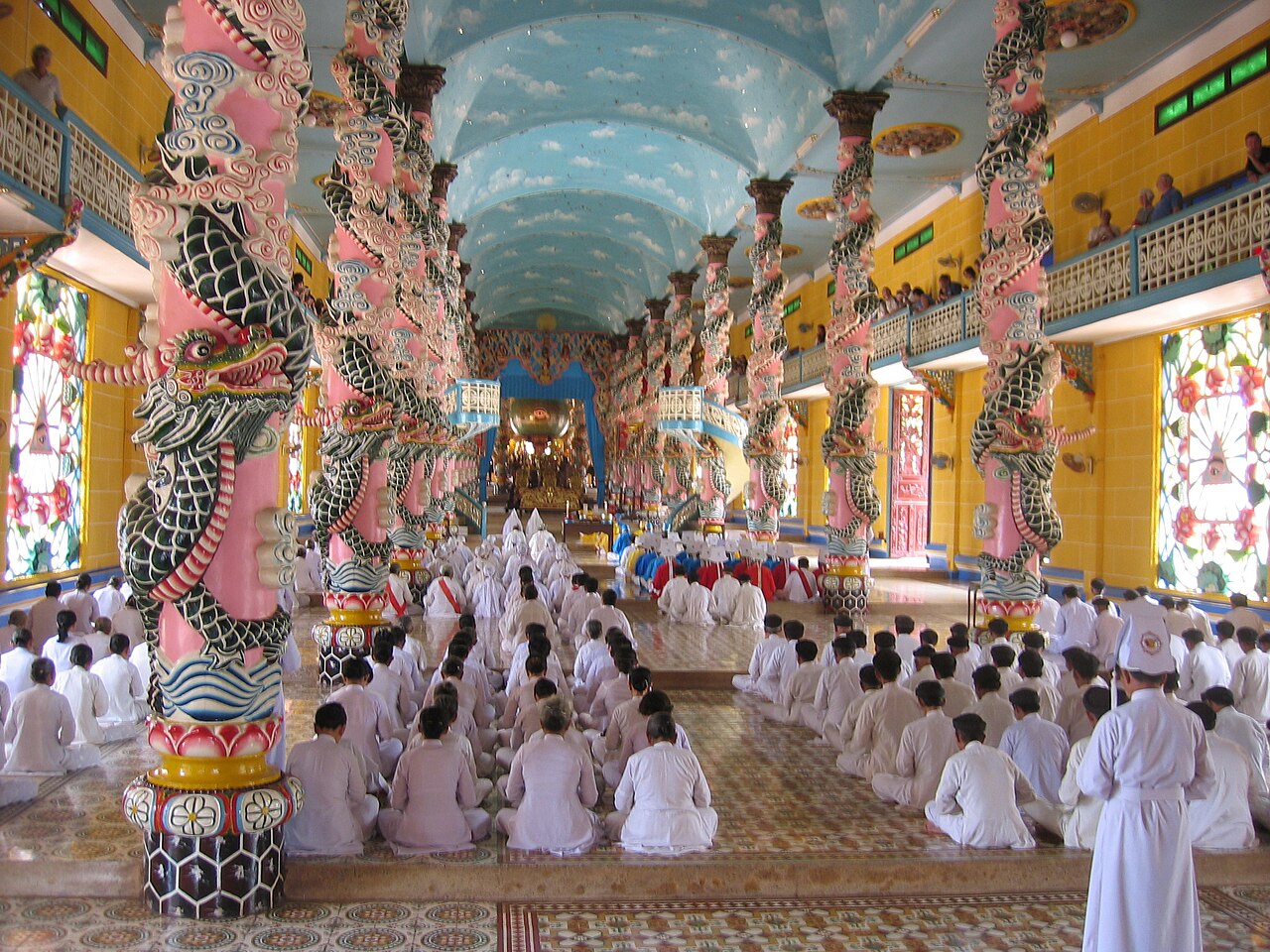
Cao Dai is Vietnam's syncretic faith, founded in 1926, which worships the one supreme God; symbolized by the Divine Eye; and honors Jesus, the Buddha, Laozi, Confucius, and a heaven of saints together in one temple.
Cao Dai (Caodaism) began with séances in 1920s Saigon, where a spirit identifying as Cao Đài, the Supreme Being, instructed the civil servant Ngô Văn Chiêu and then a widening circle; the Holy See at Tây Ninh was inaugurated in 1926, and the faith became one of Vietnam's great religions, with its own army, state, and near-death under unification before its legal revival. Its white-robed processions and dragon-horse liturgy present the Third Universal Amnesty of God: the age in which God teaches directly, through the spirits, because the earlier ways have divided mankind.
Ultimate Reality
One God stands at the summit; Cao Đài, the Supreme Being, imaged not in a human face but in the Divine Eye, which watches from the great globe of the Tây Ninh temple. Beneath God a heavenly hierarchy administers creation: the Divine Mother (Diêu Trì Kim Mẫu) alongside buddhas, immortals, and saints of every tradition, all rays of one light; the faith's founding claim is that East and West's religions were partial deliveries of a single mail.
The Human Condition
Humanity suffers because the messages came piecemeal and hardened into rival houses: each age's teaching fit its age, and the divisions of religions are God's own pedagogy misunderstood as competition. Karma governs the soul's long journey upward through lives; the present dispensation, the Third Amnesty, opens a shortened road for an age that has no time left for pride.
Knowledge and Truth
Revelation continues: the faith was founded by spirit messages received through the corbeille à bec and the planchette, and its scriptures are those séance transcripts, systematized by the Holy See. Truth is therefore democratic across traditions in principle; a teaching is true where it agrees with the one God's unity; while its canon remains emphatically textual, complete with a religious constitution (the Tân Luật) and a pope-like office, the Hộ Pháp.
Right and Wrong
The moral law binds the Three Bonds and the Five Constant Virtues of Confucian ethics to Buddhist compassion and the vegetarian discipline of the higher grades; lay adherents keep the five prohibitions (no killing, stealing, lewdness, false speech, or alcohol), and the dignity of all traditions is itself a duty; to insult another's prophet is to fail Cao Dai's own examination.
Human Destiny
The soul ascends by merit and purification through the heavens' ranked realms, toward reunion with the Supreme Being; the sacraments of the Holy See; including its celebrated funerary rites, which chart the soul's passage; exist to speed the ascent. History has the same shape: the world's religions converge toward the unity Tây Ninh performs daily, and the faith reads its own survival under persecution as the convergence's evidence.
The Conversation
Cao Dai asks the older religions what their founders would say to each other if the meeting were actually arranged; and then arranges it, in one sanctuary, with Victor Hugo at the door. The traditions answer variously: admiration for the hospitality, doubt about the séance as a foundation, and the standing question every young religion faces; whether the synthesis is a revelation or a mirror of the century that produced it.