

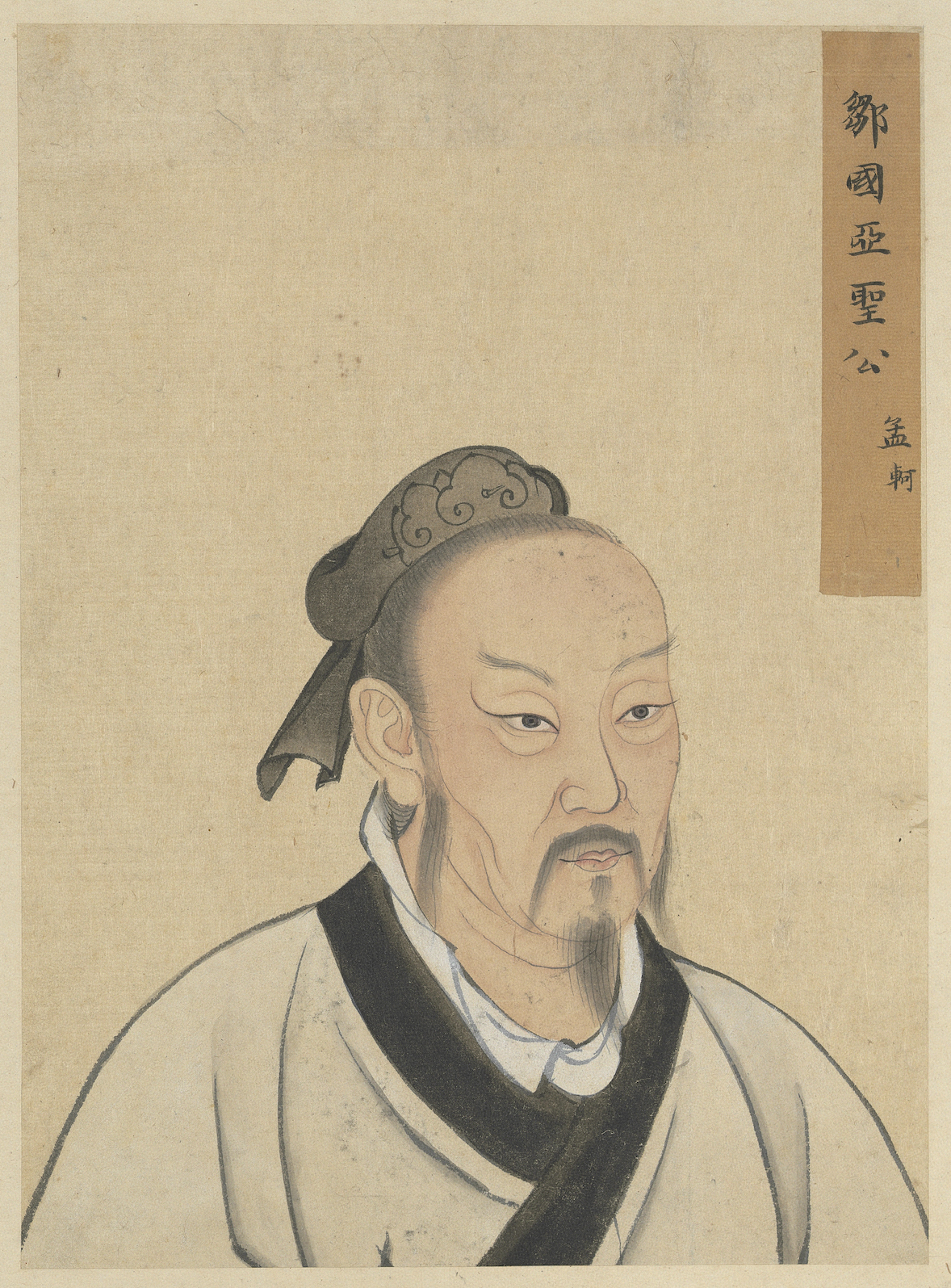
Mencius, Meng Ke, defended Confucius's teaching a century after the master's death and gave it its doctrine of the heart: human nature is good, and its four sprouts, compassion, shame, deference, and approval, grow into the virtues as a seed grows. He taught kings that a ruler who starves his people forfeits the Mandate of Heaven, and his book became the second pillar of the classical tradition.
Tagged: Classical Confucianism Confucianism
The Event
- Date
- 372-289 BCE (exact)
- Era
- The Classical Age; Standard periodization of Confucian history
- Location
- The state of Zou; today Zoucheng, Shandong, China
- Traditions
- Confucianism
- Streams
- Classical Confucianism
- Key figures
- Mencius, King Xuan of Qi
- Key texts
- Mencius
How the Tradition Tells It
The classical school divided over Mencius's own ground. Xunzi taught the opposite doctrine of human nature in the same tradition, and the later orthodoxy followed Mencius; the Han Feizi line that came through Xunzi's students rejected the master's way outright. That the Mencian line won is a fact about the Song settlement, not about the classical age.
Primary Sources
- The Analects of Confucius.
Secondary Sources
- Ivanhoe, Philip J., and Bryan W. Van Norden, eds. Readings in Classical Chinese Philosophy. 2nd ed., Hackett, 2005.
- Yao, Xinzhong. An Introduction to Confucianism. Cambridge University Press, 2000.
Provenance: HIST-0702; confidence 0.95; accessed 2026-10-27.
Related on This Site
- The Hanging Temple Art Entry
- Daoism and Confucianism Art Tradition
- Confucius History Event
- Dong Zhongshu History Event
- Han imperial academy established History Event
- Qin unification; book burning History Event
- Xunzi History Event
- Confucianism World View