

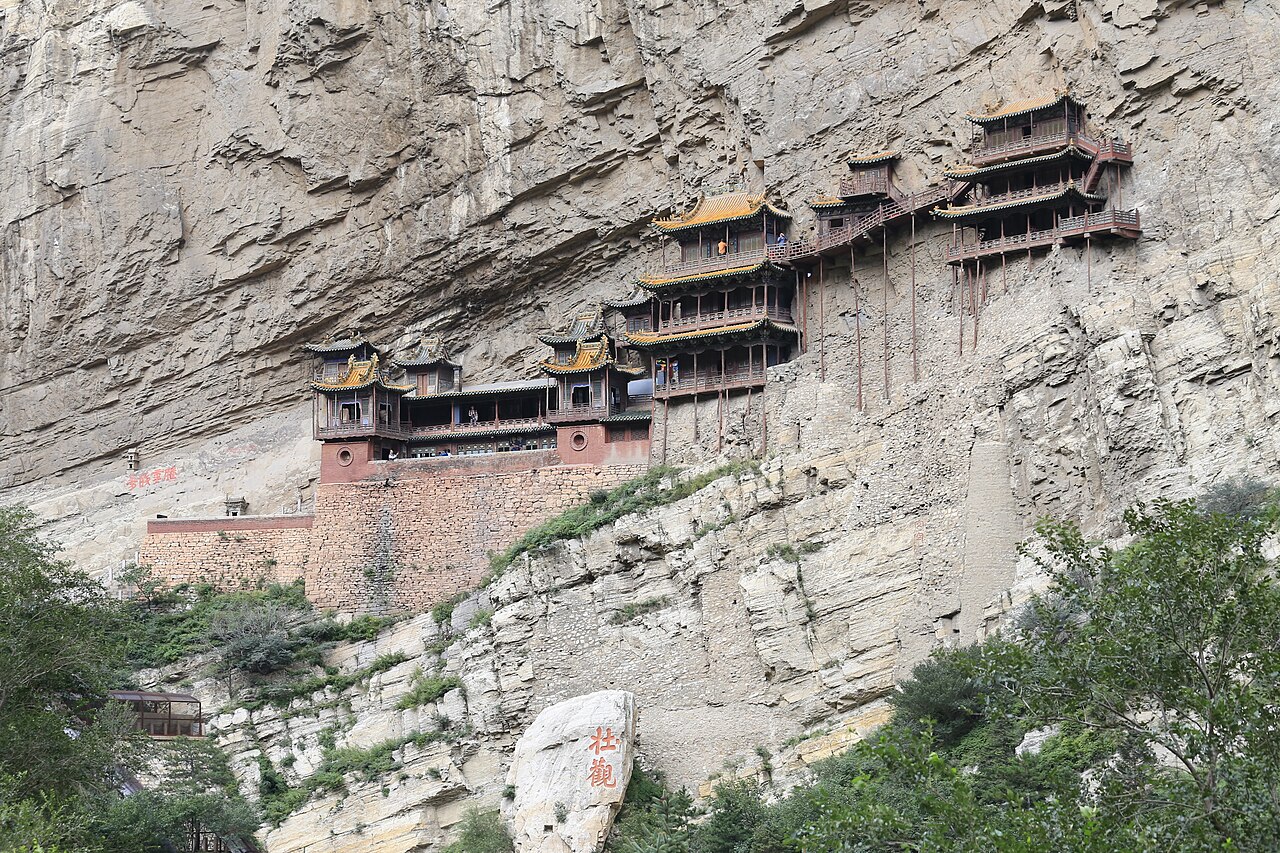
A monastery of forty halls pinned to a cliff face on Mount Heng, holding altars to Confucius, Laozi, and the Buddha under one roof — the Three Teachings in a single building.
Tagged: Architecture Temple/Shrine Medieval Devotional Extant Cliff Architecture Three Teachings Buddhist Confucianism Daoism
Why It Stands Here
The Hanging Temple is the section's standing counterexample to every tidy boundary: a Daoist foundation by origin and setting that enshrines the founders of all three teachings together, in a building whose drama is its engineering.
Built into the cliffs of Jinlong Canyon from the 6th century onward and largely Ming and Qing in its present fabric, Xuankong Temple stands on oak beams socketed into the rock, its halls connected by walkways over a drop of some fifty meters. Local tradition credits the founding to a Daoist monk; a 17th-century traveler recorded the saying that the temple is held by a horsehair.
Its Sanjiao hall sets statues of Confucius, Laozi, and Shakyamuni side by side — in a China where the three teachings argued for two thousand years, one small cliff monastery simply housed them together. The building survives as both temple and monument.
References
Related Across the Site
- Brihadeeswara Temple Art Entry — Rajaraja Chola's temple at Thanjavur (completed 1010): a granite mountain of sculpture raised over one of India's great lingas, and the Chola bronze tradition's home ground.
- The Dilwara Temples Art Entry — Five Jain temples on Mount Abu whose plain exteriors open into marble interiors carved to the thinness of lace — the summit of Jain temple art.
- The Dome of the Rock Art Entry — The oldest surviving monument of Islamic architecture (Jerusalem, 691–692): a shrine of mosaic, marble, and inscription, whose entire decorative program argues aniconism's positive case.
- The Golden Temple Art Entry — A gilded sanctum standing in the middle of a sacred pool, reached by one causeway and entered by doors on all four sides — open to every direction and every caste.
- The Great Stupa at Sanchi Art Entry — The oldest stone stupa in India, begun under Ashoka and crowned with four carved gateways: the reliquary mound as Buddhism's first monumental art, and its first aniconic center.
- The Ise Grand Shrine Art Entry — The most sacred shrine in Shinto is a plain cypress building that is torn down and rebuilt, identically, every twenty years — and has been for some thirteen centuries.
- The Sand Mandala Art Entry — Monks lay down a palace of the deities grain by grain in colored sand, contemplate it for days — and then sweep it away and pour it into running water.
- The Tibetan Thangka Art Entry — A portable scroll painting of a Buddha or deity in exact iconometric proportion — a meditation support, a teaching diagram, and a presence, rolled for the road and unrolled for the rite.