

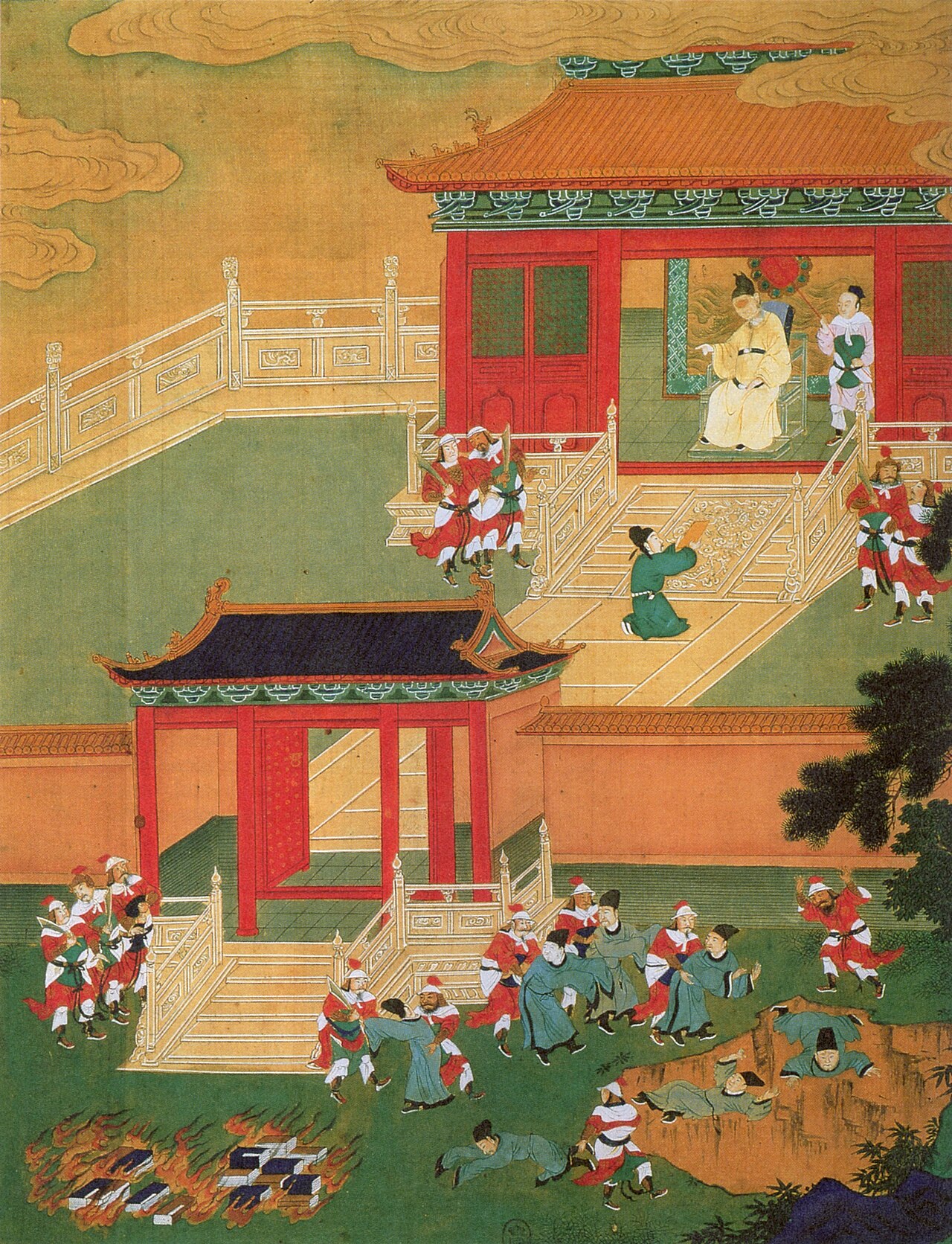
In 221 BCE the king of Qin conquered the last rival state and took the title First Emperor, and in 213 BCE his chancellor Li Si persuaded him to burn the privately held copies of the classics and the histories of the defeated states, keeping only the imperial library's set. Tradition adds the burying of scholars to the burning of books. The Confucian texts survived in hiding and in memory, and the dynasty that tried to erase them fell within fifteen years.
Tagged: Persecution Classical Confucianism Confucianism
The Event
- Date
- 221 BCE (exact)
- Also called
- the burning of books and burying of scholars
- Era
- The Classical Age; Standard periodization of Confucian history
- Location
- Xianyang, the Qin capital; today Xi'an, Shaanxi, China
- Traditions
- Confucianism
- Streams
- Classical Confucianism
- Key figures
- Qin Shi Huang, Li Si
- Key texts
- Analects
Primary Sources
- The Records of the Grand Historian (Shiji) of Sima Qian.
Secondary Sources
- de Bary, Wm. Theodore, and Irene Bloom, eds. Sources of Chinese Tradition. 2nd ed., Columbia University Press, 1999.
- Yao, Xinzhong. An Introduction to Confucianism. Cambridge University Press, 2000.
Provenance: HIST-0704; confidence 0.95; accessed 2026-10-27.
Related on This Site
- Confucius History Event
- Decian Persecution History Event
- Diocletian Persecution History Event
- Martyrdom of Polycarp History Event
- Mencius History Event
- Nero's Persecution History Event
- Persecution at Lyons History Event
- Xunzi History Event