

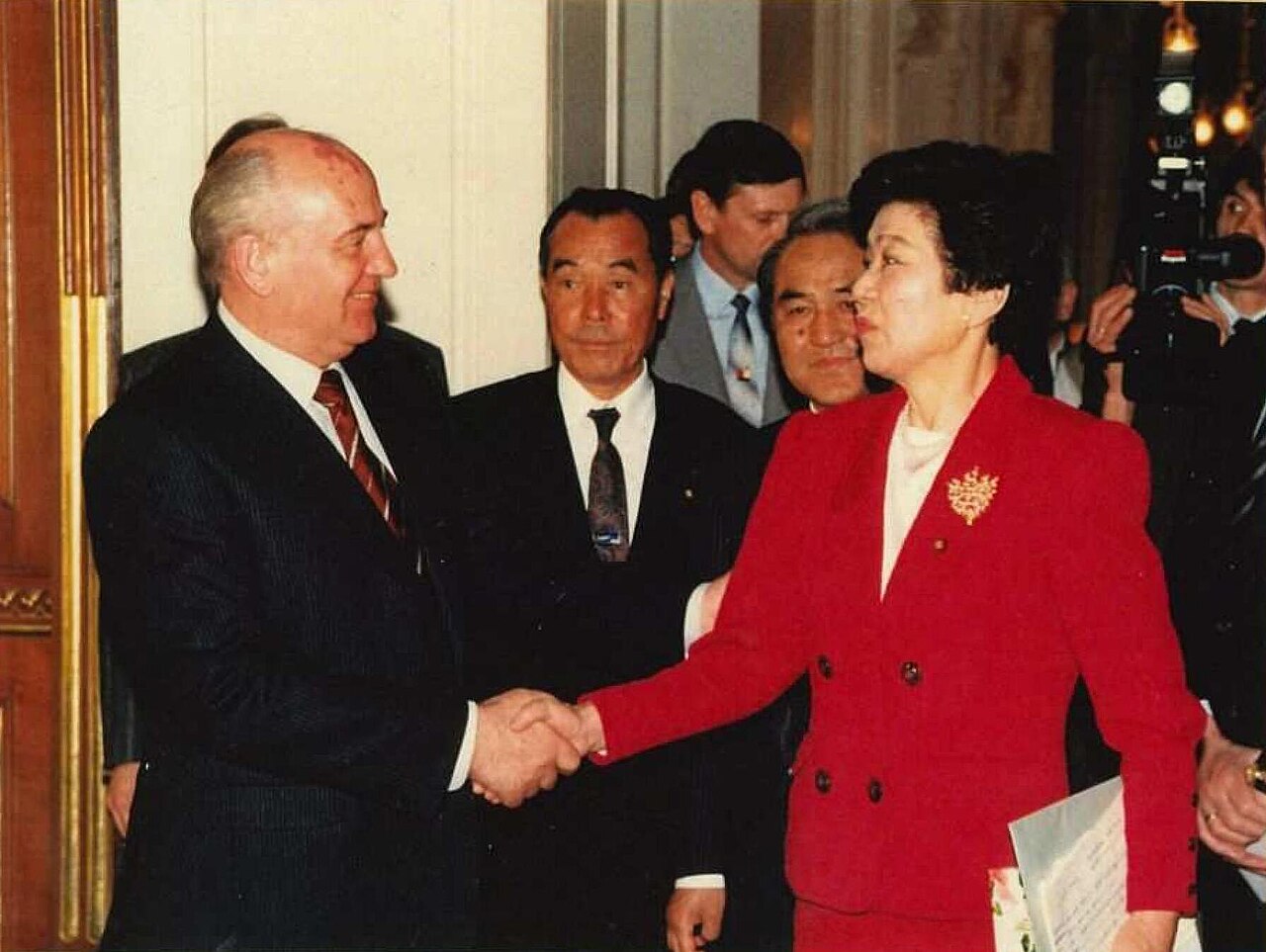
On 25 December 1991 Mikhail Gorbachev resigns and the Soviet Union, the state founded by the October Revolution and the tradition's world center for seventy four years, is dissolved. Marxism continues as theory, as the doctrine of surviving party-states, and as an opposition tradition; the era in which it governed a third of mankind is closed.
Tagged: Marxism
The Event
- Date
- 1991 (exact)
- Era
- Crisis and After; Standard periodization of Marxist history
- Location
- Moscow; today Moscow, Russia
- Traditions
- Marxism
- Streams
- Marxism
- Key figures
- Mikhail Gorbachev, Boris Yeltsin
Connections
Primary Sources
- The Belovezha Accords, 8 December 1991, and the resignation address of Mikhail Gorbachev, 25 December 1991.
Secondary Sources
- Anderson, Perry. Considerations on Western Marxism. London: New Left Books, 1976.
- Kolakowski, Leszek. Main Currents of Marxism. Oxford: Clarendon Press, 1978.
- McLellan, David. Karl Marx: A Biography. London: Palgrave Macmillan, fourth edition, 2006.
Provenance: HIST-1468; confidence 0.95; accessed 2026-10-30.
Related on This Site
 History Event
Bernstein's Evolutionary Socialism opens the revisionist controversy
1899
 History Event
Engels's Anti-Dühring
1878
 History Event
Lenin's What Is to Be Done?
1902
 History Event
Marx's Capital, volume one
1867
 History Event
Marx's Preface of 1859 states the materialist conception
1859
 History Event
Marx's Theses on Feuerbach
1845
 History Event
The Paris Commune
1871
 World View
Marxism
Marxism explains history as the struggle of classes over material production, and aims at a classless society in which exploitation and alienation are ended.