

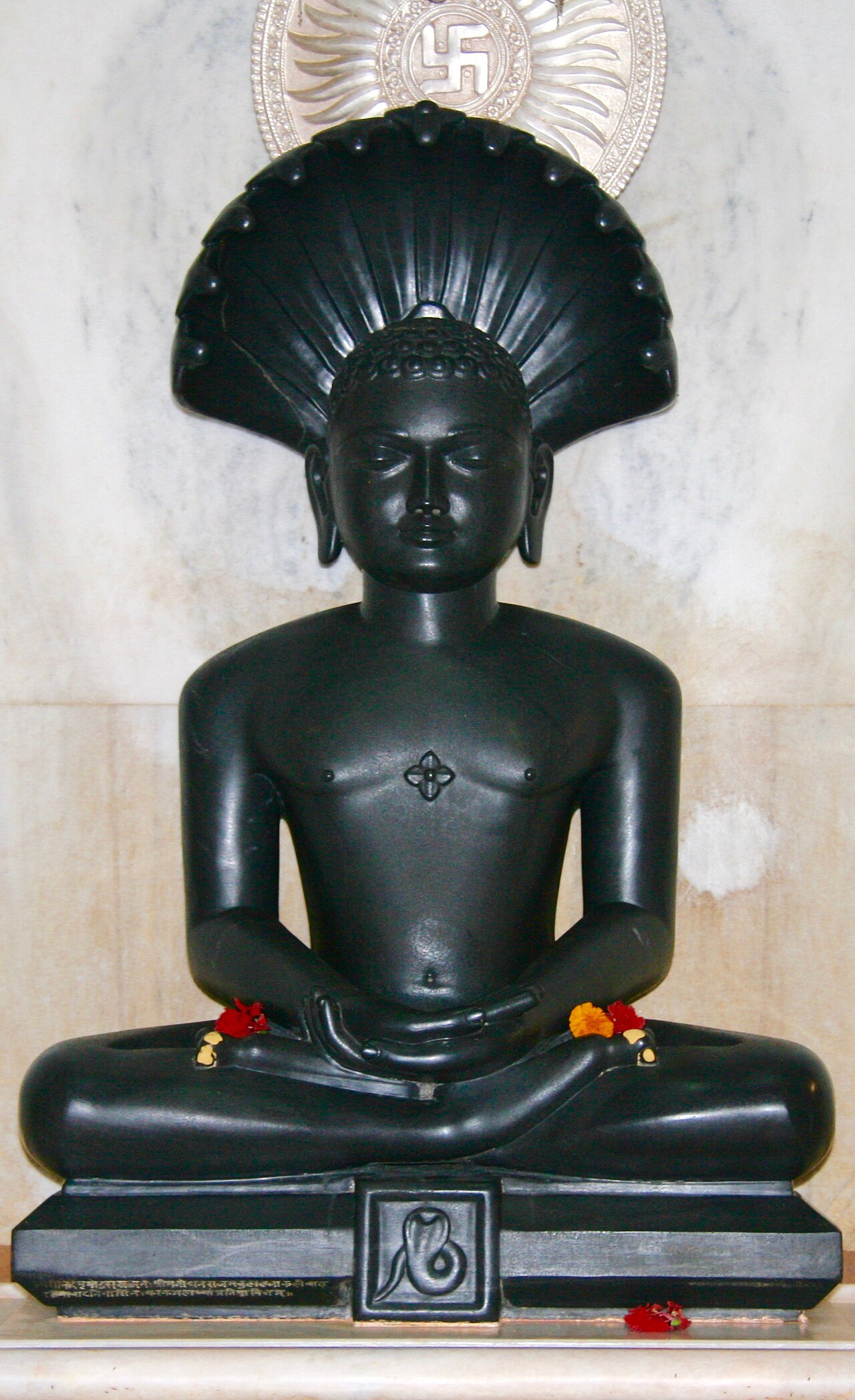
Parshvanatha, the twenty-third Tirthankara, is the earliest Jain teacher whose historical existence scholars broadly accept. Tradition places him at Varanasi some two and a half centuries before Mahavira. His teaching turned on four restraints, nonviolence, truthfulness, non-stealing, and non-possession, which Mahavira's five great vows later extended. Both great Jain lineages honor him, and his emblem, the serpent, marks his images across India.
Tagged: Digambara Jain Shvetambara
The Event
- Date
- c. 9th-8th century BCE (traditional)
- Also called
- Parshva, Parasnath
- Era
- The Tirthankara Age; Standard periodization of Jain history
- Location
- Varanasi, on the Ganges; today Varanasi, India
- Traditions
- Jainism
- Streams
- Digambara, Shvetambara
- Key figures
- Parshvanatha
- Key texts
- Acaranga Sutra, Kalpa Sutra
Primary Sources
- The Kalpa Sutra account of the Tirthankaras.
- The Agamas of the Shvetambara canon.
Secondary Sources
- Dundas, Paul. The Jains. 2nd ed., Routledge, 2002.
- Jaini, Padmanabh S. The Jaina Path of Purification. University of California Press, 1979.
Provenance: HIST-0601; confidence 0.8; accessed 2026-10-27.
Related on This Site
- A Kalpasutra Folio Art Entry
- The Dilwara Temples Art Entry
- The Gujarat Manuscript Ateliers Artist
- Digambara–Shvetambara split History Event
- First Council at Pataliputra History Event
- Jain community recognized in US History Event
- Jain diaspora established History Event
- Mahavira (24th Tirthankara) History Event