

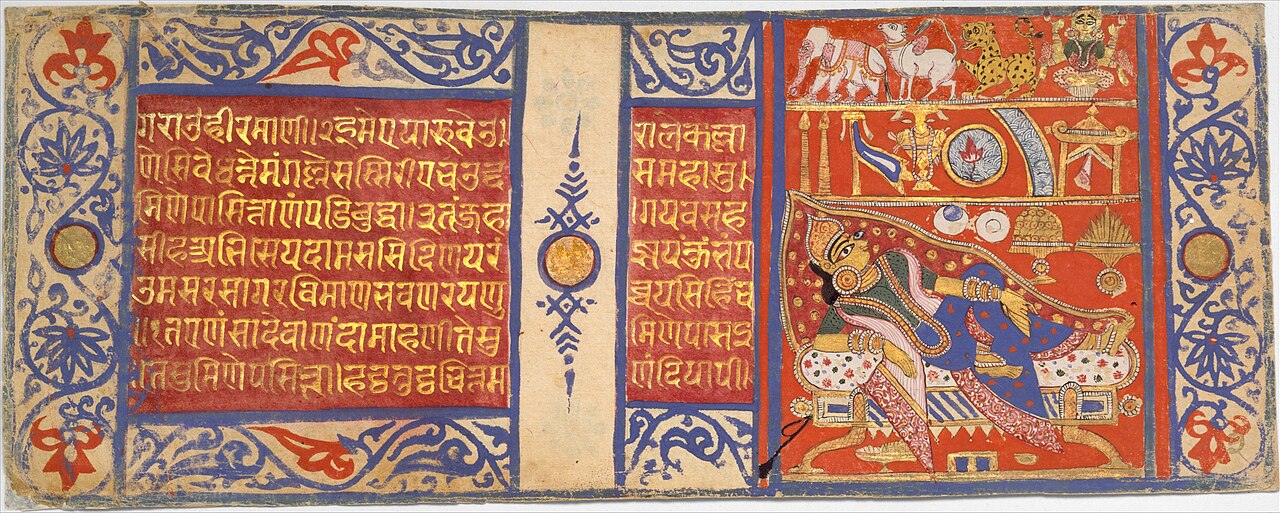
One painted page from the most copied book in Jainism: the lives of the Tirthankaras in gold and ultramarine, read aloud and shown to the congregation during Paryushana.
Tagged: Manuscript Illumination Museum Early Modern Devotional Extant Manuscript Veneration Paryushana Jain Shvetambara
Why It Stands Here
The Kalpasutra is where Jain image-making and Jain book-making meet: the folio is venerated as well as read, carried in procession and displayed during the festival reading, so the manuscript functions as icon and text in a single object.
The Kalpasutra recounts the lives of the last Tirthankaras — above all Mahavira and Parshvanatha — and the monastic rules for the rainy-season retreat. From the 15th century, western Indian ateliers produced hundreds of illustrated copies on paper, their miniatures framed in the text columns: the dreams of Mahavira's mother, his birth, renunciation, and enlightenment.
During Paryushana the manuscript is read publicly over days, honored with offerings, and in some communities processed through the town. Families commissioned copies as acts of merit, and a fine folio — gold leaf, lapis blue, the red ground of the Gujarat page — records a donor's devotion as surely as a temple does.
Recorded Makers
- The Gujarat Manuscript Ateliers — 15th–17th centuries
References
Related Across the Site
- A Gandhara Buddha Art Entry — The Buddha in human form from the workshops of Gandhara (1st–3rd century CE): Apollo's face, a Roman toga's folds, and the lakshanas of the Buddha — the image that changed Buddhist art forever.
- A Kufic Qur'an Folio Art Entry — A parchment leaf of an Abbasid Qur'an in angular Kufic script, its verse endings touched with gold: the page as the supreme religious image of an aniconic faith.
- Rublev's Trinity Art Entry — Andrei Rublev's icon of the three angels at Abraham's table (c. 1411), painted for the Trinity Lavra of St. Sergius — the supreme achievement of Orthodox icon painting and its theology made visible.
- The Dilwara Temples Art Entry — Five Jain temples on Mount Abu whose plain exteriors open into marble interiors carved to the thinness of lace — the summit of Jain temple art.
- The Guru Granth Sahib, Enthroned Art Entry — The Sikh scripture is not shelved but enthroned — installed under a canopy on a raised seat, fanned with the chaur, woken each morning and put to rest each night, because it is the Guru.
- The Mughal Court Miniature Art Entry — The figural painting of the Mughal emperors' atelier — hunts, audiences, lovers, and saints in jewel-like detail — standing as the descriptive practice beside Islam's normative aniconism.
- The Sarajevo Haggadah Art Entry — A Passover Haggadah illuminated in Barcelona around 1350 — thirty-four miniatures of the biblical story in a Jewish book — treasured, hidden from Nazis and from war, and kept in Sarajevo as the city's emblem of itself.
- The Gujarat Manuscript Ateliers Artist — The family workshops of western India that painted the Kalpasutra and the Jain lives in gold, lapis, and red — hundreds of copies, one devotional economy.