

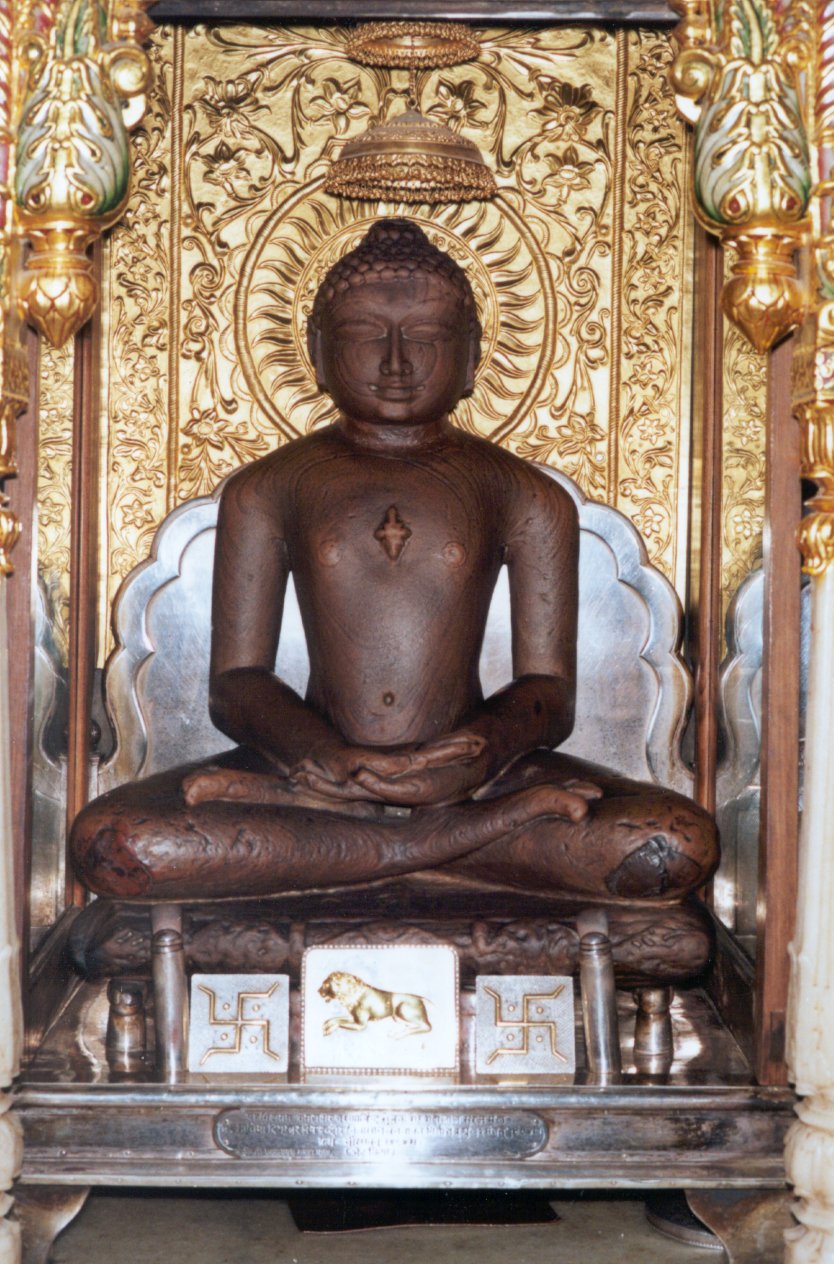
Mahavira, born Vardhamana into a ruling family near Vaishali, renounced the household at thirty, attained omniscience after twelve years of austerity, and taught for thirty more, organizing the fourfold community of monks, nuns, laymen, and laywomen. His five great vows, headed by ahimsa, nonviolence toward every living being, remain the center of Jain life. Tradition dates his liberation at Pavapuri to 527 BCE.
Tagged: Digambara Jain Shvetambara
The Event
- Date
- 599-527 BCE (traditional)
- Also called
- Vardhamana, the Jina
- Era
- The Tirthankara Age; Standard periodization of Jain history
- Location
- Kundagrama, near Vaishali; today Vaishali, Bihar, India
- Traditions
- Jainism
- Streams
- Digambara, Shvetambara
- Key figures
- Mahavira, Indrabhuti Gautama
- Key texts
- Kalpa Sutra, Acaranga Sutra
Primary Sources
- The Kalpa Sutra account of the Tirthankaras.
- The Agamas of the Shvetambara canon.
Secondary Sources
- Dundas, Paul. The Jains. 2nd ed., Routledge, 2002.
- Jaini, Padmanabh S. The Jaina Path of Purification. University of California Press, 1979.
- Wiley, Kristi L. Historical Dictionary of Jainism. Scarecrow Press, 2004.
Provenance: HIST-0602; confidence 0.8; accessed 2026-10-27.
Related on This Site
- A Kalpasutra Folio Art Entry
- The Dilwara Temples Art Entry
- The Gujarat Manuscript Ateliers Artist
- Digambara–Shvetambara split History Event
- First Council at Pataliputra History Event
- Jain community recognized in US History Event
- Jain diaspora established History Event
- Parshvanatha (23rd Tirthankara) History Event