

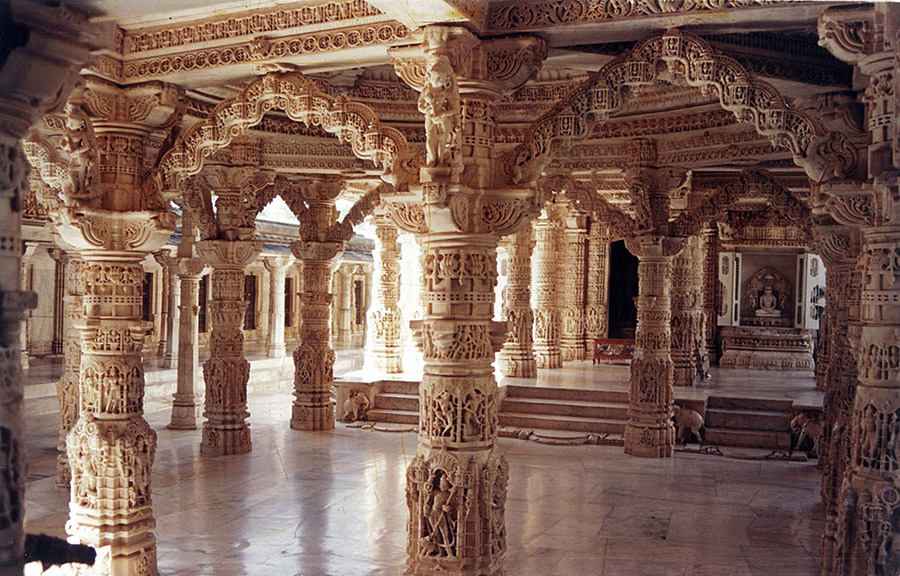
Five Jain temples on Mount Abu whose plain exteriors open into marble interiors carved to the thinness of lace — the summit of Jain temple art.
Tagged: Architecture Temple/Shrine Medieval Devotional Extant Marble Carving Temple Patronage Jain Shvetambara
Why It Stands Here
Dilwara states the Jain position in stone: restraint outside, inexhaustible devotion inside. The carving is not decoration added to the temple; donors and sculptors treated its fineness itself as an act of merit.
The five temples were built between the 11th and 13th centuries under Solanki patronage, in white marble carried up the mountain to Mount Abu in Rajasthan. The Vimal Vasahi (1031) and Luna Vasahi (1230) are the most famous; their ceilings carry concentric rings of carved figures — dancers, musicians, elephants, the lives of the Tirthankaras — around central pendants of astonishing undercut detail.
The temples remain in worship. Photography inside is restricted, and the interiors are experienced as the tradition intends: in person, in silence, at walking pace.
References
Related Across the Site
- A Kalpasutra Folio Art Entry — One painted page from the most copied book in Jainism: the lives of the Tirthankaras in gold and ultramarine, read aloud and shown to the congregation during Paryushana.
- Brihadeeswara Temple Art Entry — Rajaraja Chola's temple at Thanjavur (completed 1010): a granite mountain of sculpture raised over one of India's great lingas, and the Chola bronze tradition's home ground.
- The Dome of the Rock Art Entry — The oldest surviving monument of Islamic architecture (Jerusalem, 691–692): a shrine of mosaic, marble, and inscription, whose entire decorative program argues aniconism's positive case.
- The Golden Temple Art Entry — A gilded sanctum standing in the middle of a sacred pool, reached by one causeway and entered by doors on all four sides — open to every direction and every caste.
- The Hanging Temple Art Entry — A monastery of forty halls pinned to a cliff face on Mount Heng, holding altars to Confucius, Laozi, and the Buddha under one roof — the Three Teachings in a single building.
- The Ise Grand Shrine Art Entry — The most sacred shrine in Shinto is a plain cypress building that is torn down and rebuilt, identically, every twenty years — and has been for some thirteen centuries.
- The Tibetan Thangka Art Entry — A portable scroll painting of a Buddha or deity in exact iconometric proportion — a meditation support, a teaching diagram, and a presence, rolled for the road and unrolled for the rite.
- The Yazd Fire Temple Art Entry — A temple in Yazd whose sacred fire has been kept burning, by the tradition's account, since about 470 CE — carried from shrine to shrine across fifteen centuries and tended daily behind glass.