

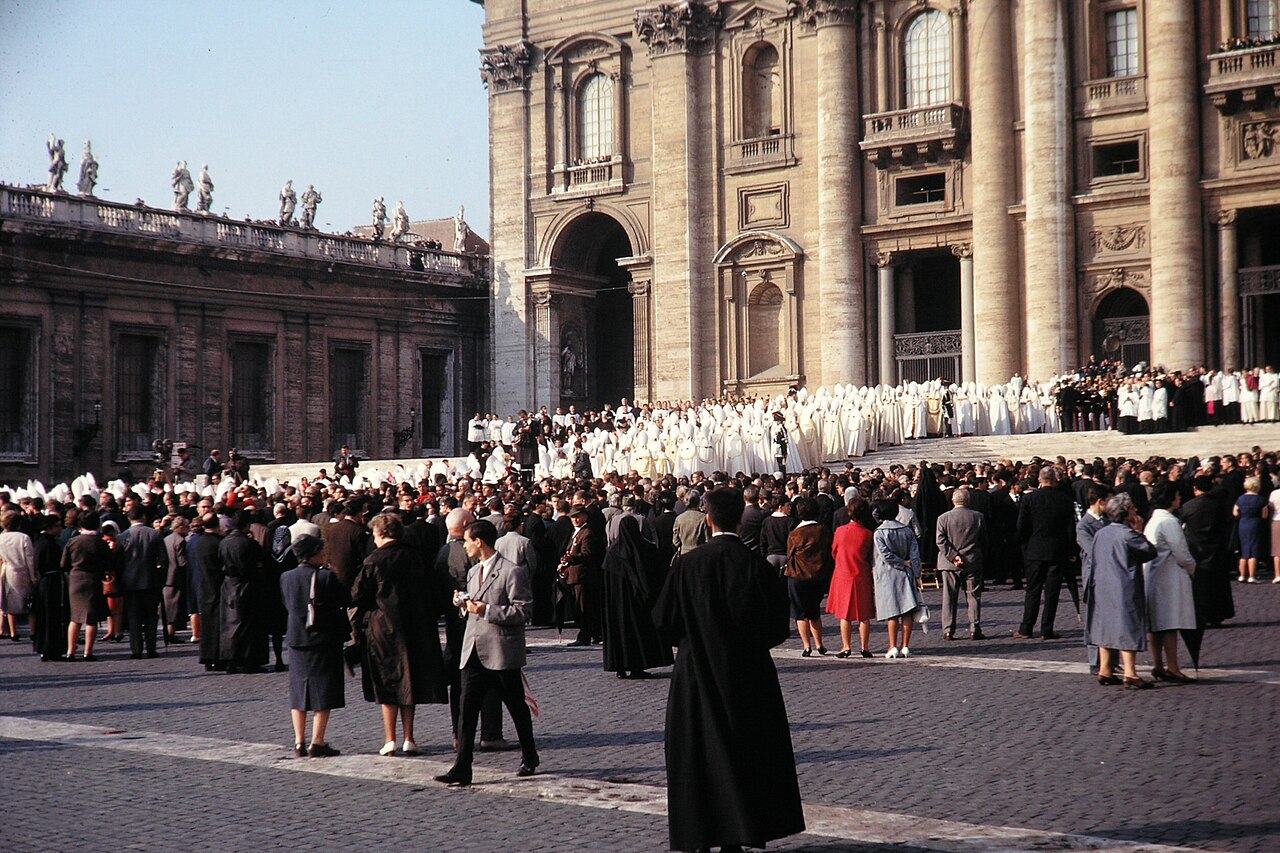
John XXIII's council renews the Catholic Church for the modern world: the liturgy in the vernacular, religious liberty confessed, ecumenism embraced, and the church's posture toward Judaism reversed in Nostra Aetate.
Tagged: Councils Catholic Christian
The Event
- Date
- 1962–1965 (exact)
- Also called
- Vatican II
- Era
- Contemporary; Standard ecumenical periodization
- Location
- Rome
- Traditions
- Christianity
- Streams
- Catholic
- Key figures
- John XXIII, Paul VI
- Key texts
- Sacrosanctum Concilium, Lumen Gentium, Nostra Aetate, Dignitatis Humanae
How the Tradition Tells It
The council's reception is itself contested inside Catholicism, between readings of continuity with tradition and readings of rupture, and its ecumenical decrees are received differently by the Orthodox and Protestant churches it addressed.
Connections
- First Vatican Council; resumed_and_completed
Doctrines in Play
Church Governance, Liturgy and Worship
Primary Sources
- Sacrosanctum Concilium
- Lumen Gentium
- Nostra Aetate
- Dignitatis Humanae
Secondary Sources
- MacCulloch, A History of Christianity (Allen Lane, 2009)
- González, The Story of Christianity, vols. 1–2 (Harper, 2010)
Provenance: HIST-0046; confidence 0.95; accessed 2026-10-26.
Related on This Site
- Council of Chalcedon History Event
- Council of Ephesus History Event
- Council of Jerusalem History Event
- First Council of Constantinople History Event
- First Council of Nicaea History Event
- Second Council of Constantinople History Event
- Second Council of Nicaea History Event
- Third Council of Constantinople History Event