

Religious Art & Worldviews · Artists
The Anishinaabe founder of the Woodland School, who painted the legends of his people in X-ray lines and unmixed color — against the elders' first objections, then with their blessing.
Tagged: Painting Contemporary Commemorative Iconic Woodland School Indigenous and Traditional Native American Religions
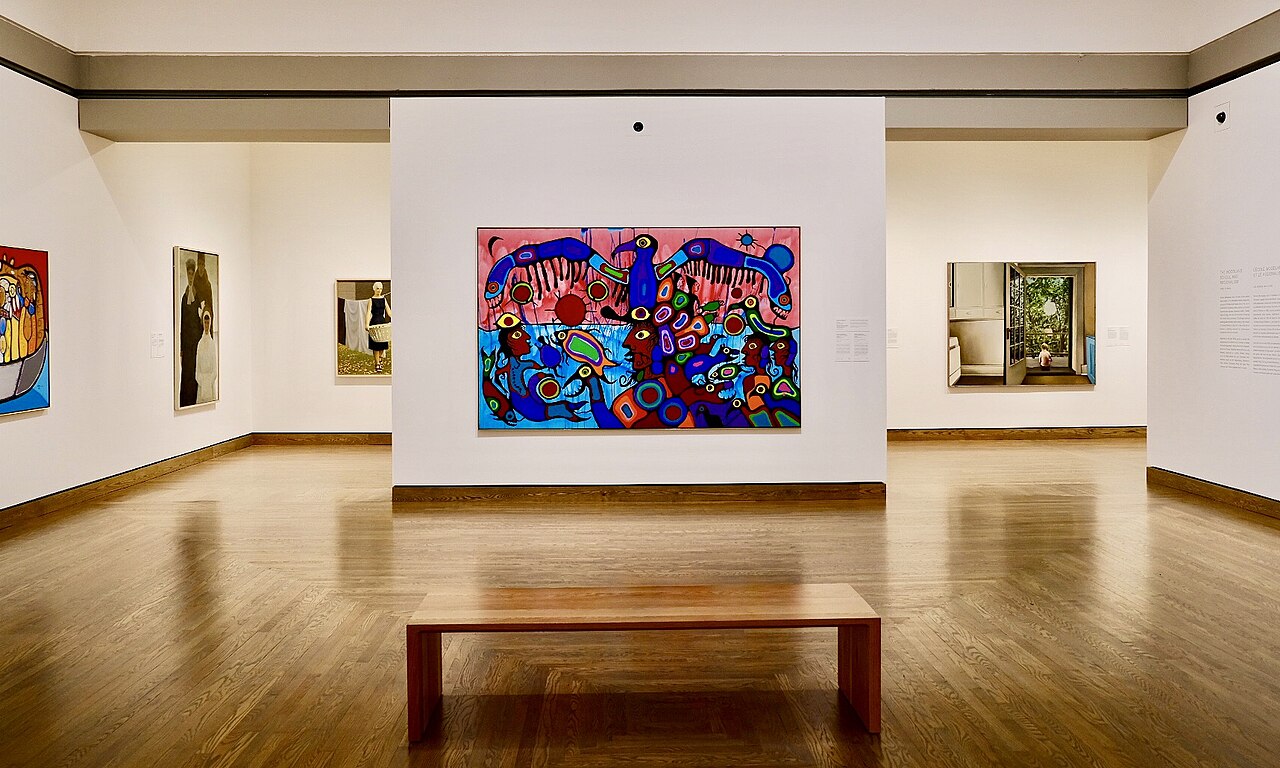
Morrisseau (Copper Thunderbird) broke an Anishinaabe reserve about depicting sacred stories because, he said, the stories were being lost. His Woodland style — black formlines, interior 'X-ray' detail, spirit beings in saturated color — founded a school and a market for Indigenous painting in Canada.
The pictured canvas hangs in a public gallery; his work remains in copyright, and this directory shows a freely licensed photograph of it in its public setting, captioned as such.
References
Related Across the Site
- Northwest Coast Formline and the Crest Pole Art Entry — A visual grammar of ovoids and U-forms that writes family crests in cedar — the pole at Brockton Point, carved by Ellen Neel, stands in public where its predecessors have stood since the 1880s.
- Rublev's Trinity Art Entry — Andrei Rublev's icon of the three angels at Abraham's table (c. 1411), painted for the Trinity Lavra of St. Sergius — the supreme achievement of Orthodox icon painting and its theology made visible.
- The Ganesh Chaturthi Murti Art Entry — A clay Ganesh, modeled and painted by neighborhood artisans, worshipped in streets and homes for up to eleven days, then carried in procession and immersed: the murti as a guest who is honored and bid farewell.
- The Good Shepherd of the Catacombs Art Entry — A young shepherd carrying a lamb across his shoulders, painted and carved across the Roman catacombs: the earliest Christian image of Christ, chosen as a symbol before it was a portrait.
- The Mughal Court Miniature Art Entry — The figural painting of the Mughal emperors' atelier — hunts, audiences, lovers, and saints in jewel-like detail — standing as the descriptive practice beside Islam's normative aniconism.
- The Wittenberg Altarpiece Art Entry — Lucas Cranach the Elder's altarpiece for Wittenberg's town church (1547): the Last Supper with Luther among the apostles — proof that the Reformation's quarrel with images was a family quarrel, not a unanimous verdict.
- Bill Reid Artist — The Haida master carver and jeweler whose Raven and the First Men brought the monumental carving tradition back to full strength.
- Emily Kame Kngwarreye Artist — The Anmatyerre elder who began painting on canvas at about eighty and produced one of the great bodies of work in Australian art — her Country, Alhalkere, in yam, seed, and track.