

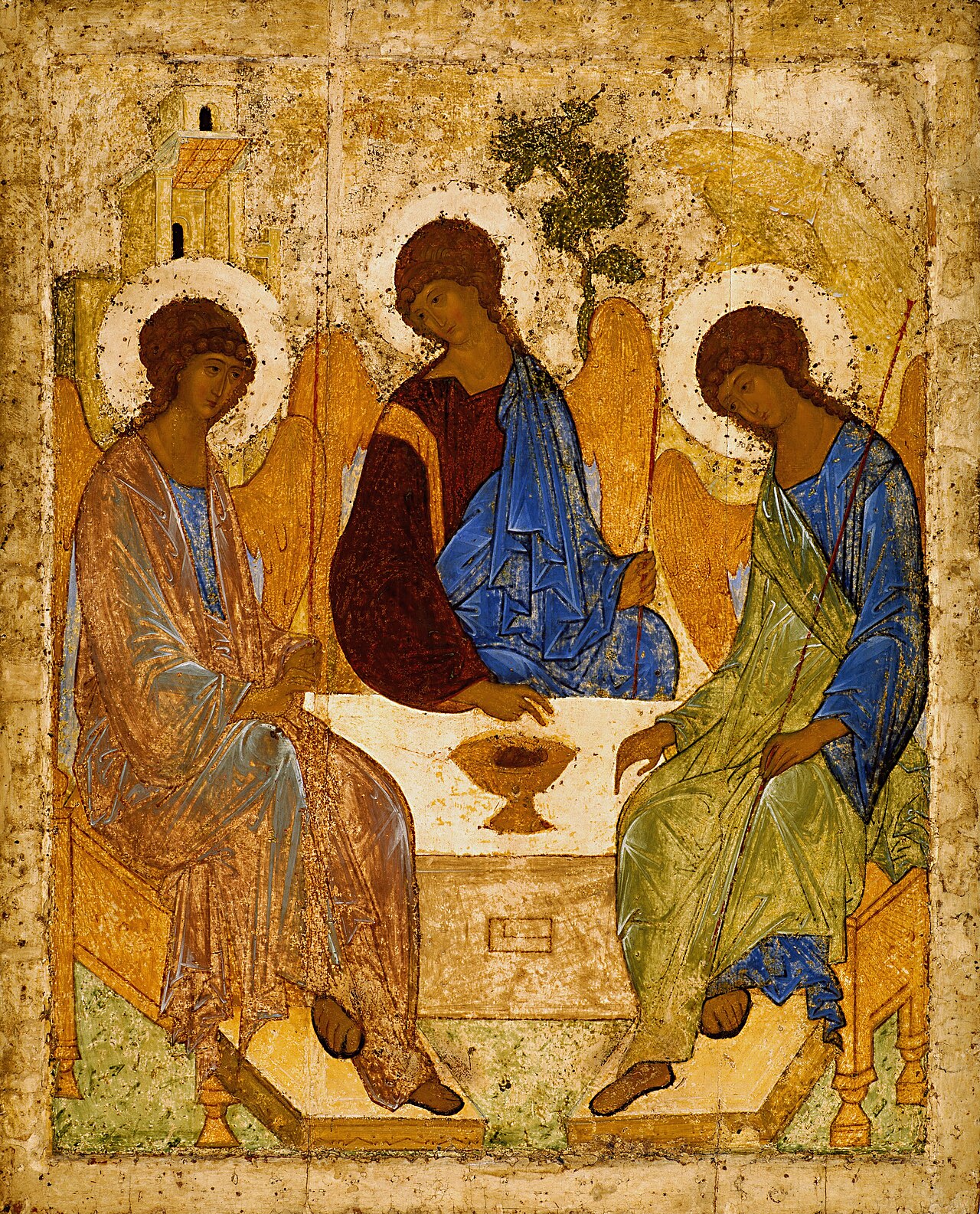
Andrei Rublev's icon of the three angels at Abraham's table (c. 1411), painted for the Trinity Lavra of St. Sergius — the supreme achievement of Orthodox icon painting and its theology made visible.
Tagged: Painting Museum Medieval Devotional Liturgical Iconic Extant Icons Russian Art Eastern Orthodox
Why It Stands Here
Orthodox theology does not depict the Father, whom no one has seen. It depicts the Trinity as Genesis shows it: three angels entertained by Abraham, read as a theophany. Rublev strips the scene to the three figures alone — no Abraham, no servants, no meal preparation — so that the icon becomes a meditation on the triune life itself: three persons in one circular, silent communion around the chalice.
Rublev, a monk of the Andronikov Monastery and the greatest of Russian icon painters, painted the Trinity in praise of St. Sergius for the Trinity Cathedral of the Sergius Lavra, where it hung on the iconostasis until the twentieth century. The composition is a circle: the angels' bowed heads and inclined bodies turn around the table's chalice, and the colors — lapis blue, gold, green, and the famous rublevsky blue — do the theological work of distinguishing the persons without dividing them.
The icon was cleaned of its darkened varnish in 1904 and again after 1917, when its colors startled a Russia that had known it as a somber panel. It is now in the Tretyakov Gallery, its place in the Lavra taken by a copy — a modern version of the old question about where an icon's presence resides.
Recorded Makers
- Andrei Rublev — c. 1360–1430
References
Related Across the Site
- A Kufic Qur'an Folio Art Entry — A parchment leaf of an Abbasid Qur'an in angular Kufic script, its verse endings touched with gold: the page as the supreme religious image of an aniconic faith.
- Brihadeeswara Temple Art Entry — Rajaraja Chola's temple at Thanjavur (completed 1010): a granite mountain of sculpture raised over one of India's great lingas, and the Chola bronze tradition's home ground.
- Hagia Sophia Art Entry — Justinian's great church in Constantinople (532–537), whose dome seemed to contemporaries to hang from heaven — and whose mosaics record, in one building, icon, iconoclasm, conquest, museum, and mosque.
- The Good Shepherd of the Catacombs Art Entry — A young shepherd carrying a lamb across his shoulders, painted and carved across the Roman catacombs: the earliest Christian image of Christ, chosen as a symbol before it was a portrait.
- The Mughal Court Miniature Art Entry — The figural painting of the Mughal emperors' atelier — hunts, audiences, lovers, and saints in jewel-like detail — standing as the descriptive practice beside Islam's normative aniconism.
- The Sarajevo Haggadah Art Entry — A Passover Haggadah illuminated in Barcelona around 1350 — thirty-four miniatures of the biblical story in a Jewish book — treasured, hidden from Nazis and from war, and kept in Sarajevo as the city's emblem of itself.
- The Wittenberg Altarpiece Art Entry — Lucas Cranach the Elder's altarpiece for Wittenberg's town church (1547): the Last Supper with Luther among the apostles — proof that the Reformation's quarrel with images was a family quarrel, not a unanimous verdict.
- Andrei Rublev Artist — The monk-iconographer whose Trinity became the measure of the Russian icon: stillness, humility, and gold held in perfect balance.