

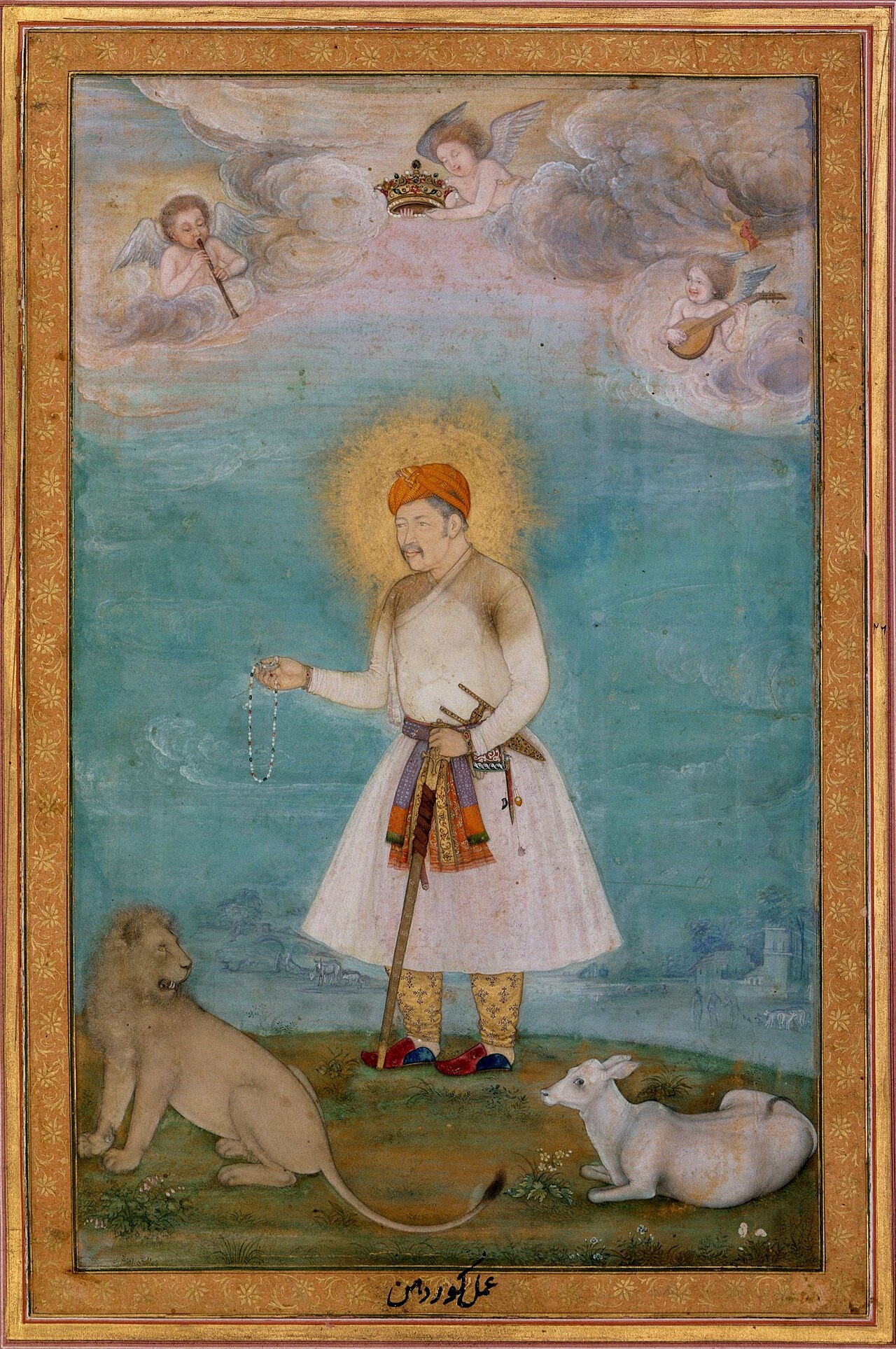
The figural painting of the Mughal emperors' atelier — hunts, audiences, lovers, and saints in jewel-like detail — standing as the descriptive practice beside Islam's normative aniconism.
Tagged: Painting Museum Private Collection Early Modern Decorative Iconic Extant Court Painting Mughal Art Muslim
Why It Stands Here
The Islam profile holds two facts together: the mosque's aniconic norm and the court's figural splendor. The Mughal miniature is the second fact's finest form. Akbar's atelier employed Hindu and Muslim painters side by side; Jahangir's connoisseurship made natural history a court art. No account of Islamic art that omits the miniature is honest, and none that omits the norm is either.
The imperial kitabkhana at Fatehpur Sikri and Lahore gathered more than a hundred painters, many of them Hindu, to illustrate the epics and memoirs of the dynasty: the Hamzanama's fourteen hundred vast folios, the Razmnama (the Mahabharata in Persian), the Akbarnama's documentary battle pieces. Under Jahangir the style turned to the observed world — zebra, turkey-cock, and Siberian crane recorded with a naturalist's patience — and to allegorical portraits in which the emperor embraces a shah or stands on a globe.
The miniature was private art: made for the album and the emperor's hand, never for the mosque wall. Its existence inside one of history's most self-consciously Islamic courts is the permanent qualification on every simple statement about Islam and images, and this site keeps it on the record for exactly that reason.
References
Related Across the Site
- A Kufic Qur'an Folio Art Entry — A parchment leaf of an Abbasid Qur'an in angular Kufic script, its verse endings touched with gold: the page as the supreme religious image of an aniconic faith.
- Rublev's Trinity Art Entry — Andrei Rublev's icon of the three angels at Abraham's table (c. 1411), painted for the Trinity Lavra of St. Sergius — the supreme achievement of Orthodox icon painting and its theology made visible.
- The Good Shepherd of the Catacombs Art Entry — A young shepherd carrying a lamb across his shoulders, painted and carved across the Roman catacombs: the earliest Christian image of Christ, chosen as a symbol before it was a portrait.
- The Sarajevo Haggadah Art Entry — A Passover Haggadah illuminated in Barcelona around 1350 — thirty-four miniatures of the biblical story in a Jewish book — treasured, hidden from Nazis and from war, and kept in Sarajevo as the city's emblem of itself.
- The Wittenberg Altarpiece Art Entry — Lucas Cranach the Elder's altarpiece for Wittenberg's town church (1547): the Last Supper with Luther among the apostles — proof that the Reformation's quarrel with images was a family quarrel, not a unanimous verdict.
- Kamal ud-Din Behzad Artist — The master of the Timurid miniature, head of the royal atelier at Herat, whose building sites, gardens, and crowds set the Persian standard.
- Riza-i Abbasi Artist — The Safavid court painter who turned the Persian miniature toward the single figure — youths, lovers, and readers alone on the page.
- Tawaraya Sotatsu Artist — Founder of the Rinpa school, painter of the Wind God and Thunder God screens — gold ground, divine weather, design as devotion.