

Religious Art & Worldviews · Artists
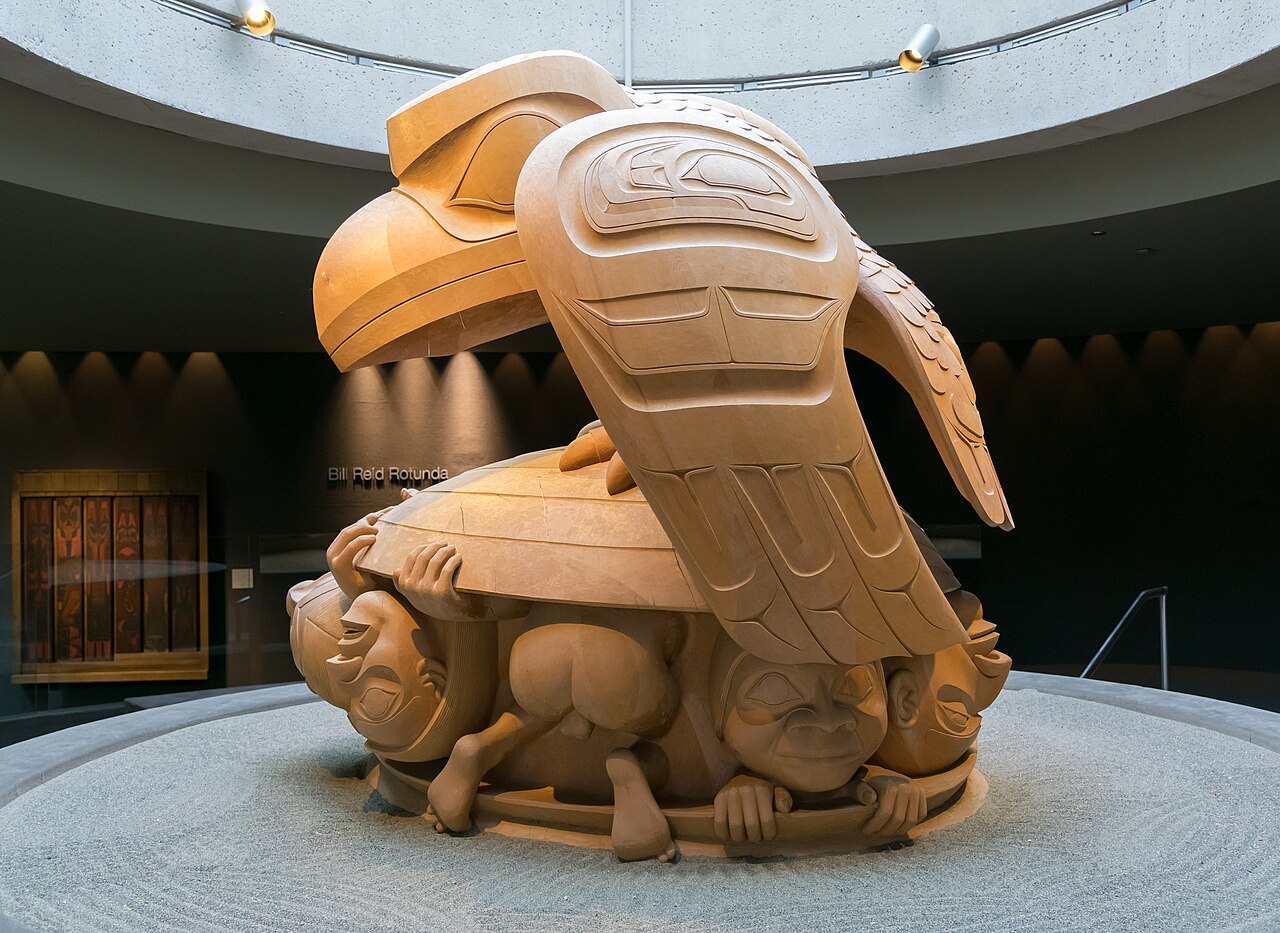
The Haida master carver and jeweler whose Raven and the First Men brought the monumental carving tradition back to full strength.
Tagged: Sculpture Contemporary Commemorative Formline Haida Art Indigenous and Traditional Native American Religions
Reid, of Haida and Scottish descent, learned his ancestors' formline as a jeweler in gold and silver before scaling it to cedar. Working with Haida carvers and apprentices, he returned monumental Haida art to public space.
The pictured sculpture at the Museum of Anthropology in Vancouver — Raven prying open the clamshell of the first humans — is his most loved work, and appeared on Canada's twenty-dollar bill.
References
Related Across the Site
- Northwest Coast Formline and the Crest Pole Art Entry — A visual grammar of ovoids and U-forms that writes family crests in cedar — the pole at Brockton Point, carved by Ellen Neel, stands in public where its predecessors have stood since the 1880s.
- The Fravahar Art Entry — A bearded figure in a winged disc, carved over temple doors and printed on calendars from Mumbai to Toronto — the Zoroastrian emblem whose original meaning scholars still argue about.
- The Ganesh Chaturthi Murti Art Entry — A clay Ganesh, modeled and painted by neighborhood artisans, worshipped in streets and homes for up to eleven days, then carried in procession and immersed: the murti as a guest who is honored and bid farewell.
- The Great Stupa at Sanchi Art Entry — The oldest stone stupa in India, begun under Ashoka and crowned with four carved gateways: the reliquary mound as Buddhism's first monumental art, and its first aniconic center.
- The Shiva Linga Art Entry — A polished stone shaft rising from its base, bathed daily in water, milk, and flowers: the aniconic murti of Shiva, worshipped not as a symbol of an absent god but as the god's own form.
- Doris Salcedo Artist — The Colombian sculptor of political violence's traces — her Fragmentos floor in Bogotá is a counter-monument hammered from surrendered weapons by women victims of the conflict.
- Emily Kame Kngwarreye Artist — The Anmatyerre elder who began painting on canvas at about eighty and produced one of the great bodies of work in Australian art — her Country, Alhalkere, in yam, seed, and track.
- Norval Morrisseau Artist — The Anishinaabe founder of the Woodland School, who painted the legends of his people in X-ray lines and unmixed color — against the elders' first objections, then with their blessing.