

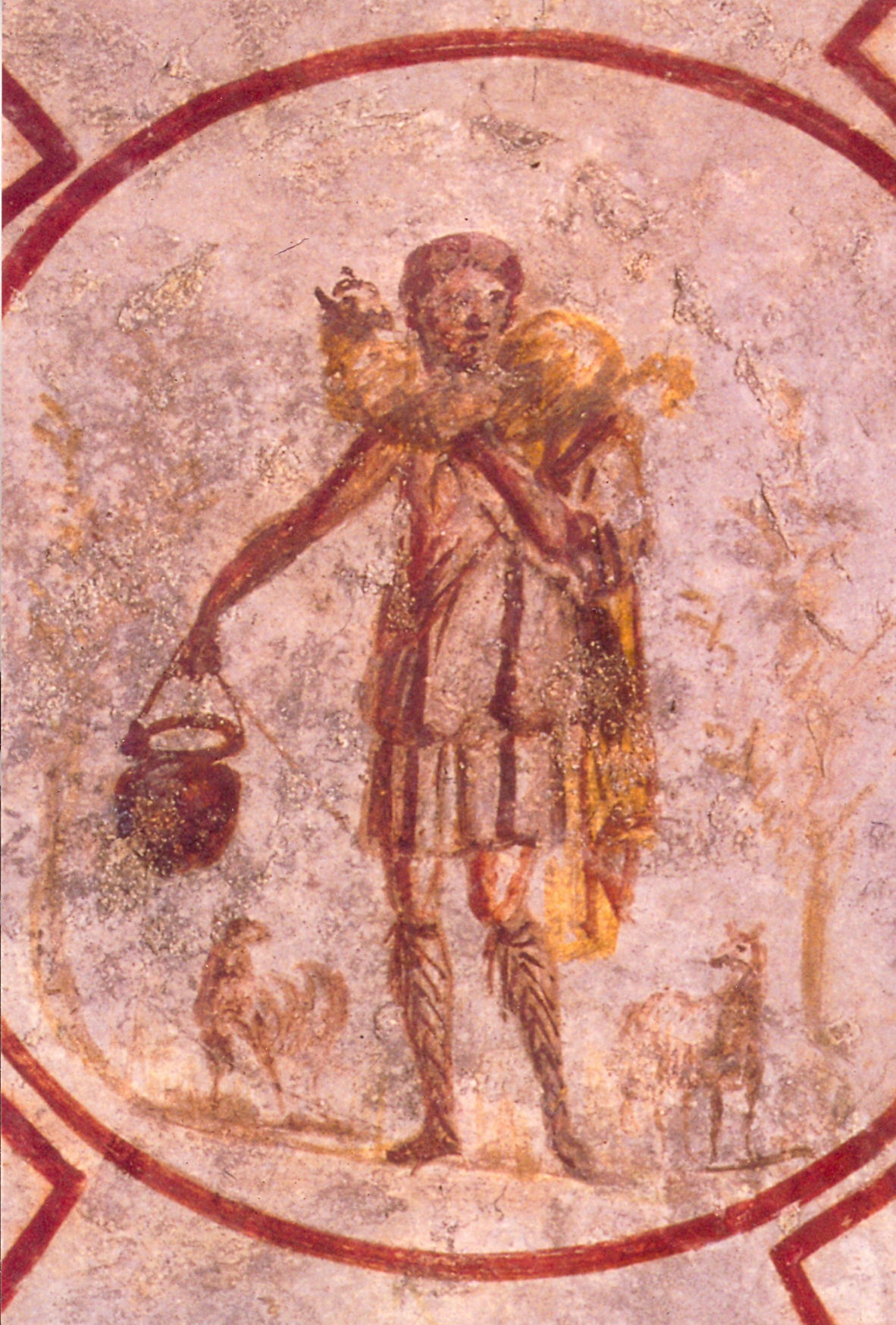
A young shepherd carrying a lamb across his shoulders, painted and carved across the Roman catacombs: the earliest Christian image of Christ, chosen as a symbol before it was a portrait.
Tagged: Painting Church Ancient Devotional Iconic Extant Early Christian Art Symbols Catholic Christian
Why It Stands Here
The Good Shepherd is early Christian art's characteristic move — a figure borrowed from the shared visual language of the Roman world and filled with Christian meaning, at a time when the church's public stance toward images was still cautious. It shows the young tradition teaching in symbols: the shepherd is Christ, and everyone in the community knew, while the image remained deniable to outsiders.
The figure appears in the Catacomb of Callixtus and across the burial chambers of third-century Rome, in fresco and on sarcophagi: a beardless youth in a short tunic, a lamb across his shoulders, often standing between sheep with a milk pail at his feet. The type descends from the classical kriophoros, the ram-bearer, and from Hermes the protector of flocks; Christians took it up for the Shepherd of Psalm 23 and of John's Gospel, who lays down his life for the sheep.
With the fish, the anchor, and the dove, the Shepherd formed the symbolic vocabulary of a church that had not yet begun to make cult images. When Christian art becomes frankly figural after Constantine, the Shepherd survives — on baptistery walls and sarcophagi — as the beloved emblem of the church's first centuries.
References
Related Across the Site
- A Gandhara Buddha Art Entry — The Buddha in human form from the workshops of Gandhara (1st–3rd century CE): Apollo's face, a Roman toga's folds, and the lakshanas of the Buddha — the image that changed Buddhist art forever.
- Rublev's Trinity Art Entry — Andrei Rublev's icon of the three angels at Abraham's table (c. 1411), painted for the Trinity Lavra of St. Sergius — the supreme achievement of Orthodox icon painting and its theology made visible.
- The Shiva Linga Art Entry — A polished stone shaft rising from its base, bathed daily in water, milk, and flowers: the aniconic murti of Shiva, worshipped not as a symbol of an absent god but as the god's own form.
- The Wittenberg Altarpiece Art Entry — Lucas Cranach the Elder's altarpiece for Wittenberg's town church (1547): the Last Supper with Luther among the apostles — proof that the Reformation's quarrel with images was a family quarrel, not a unanimous verdict.
- Caravaggio Artist — The painter who dragged sacred history into a Roman tavern's light — saints with dirty feet, apostles recruited from the street.
- Fra Angelico Artist — The Dominican friar whose frescoes for his brothers' cells at San Marco were painted as instruments of prayer, one mystery per monk.
- Giotto di Bondone Artist — The Florentine who gave biblical figures weight, grief, and ground to stand on — the hinge between medieval symbol and Renaissance story.
- Michelangelo Buonarroti Artist — Sculptor of the Pietà and the David, painter of the Sistine ceiling — the Renaissance's defining sacred artist, shown here in del Conte's portrait.