

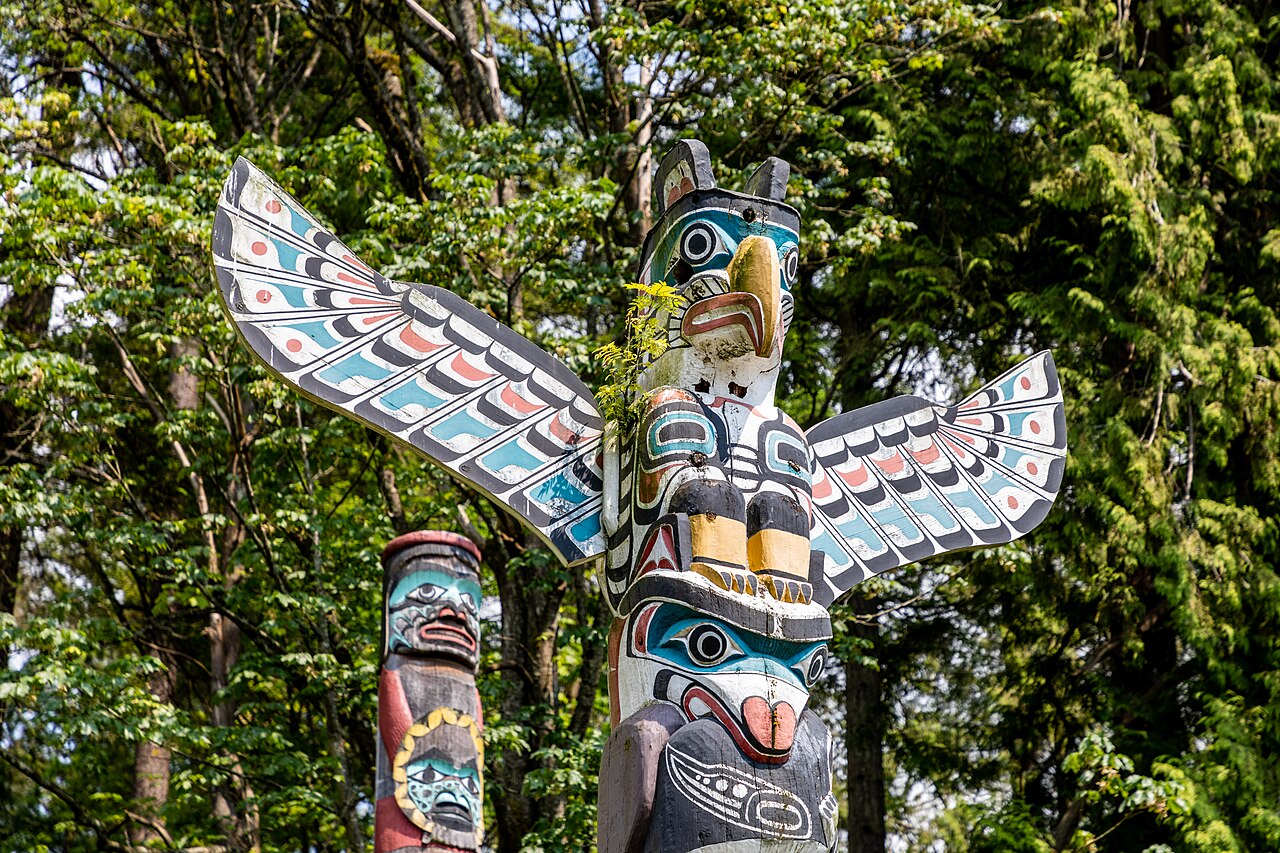
A visual grammar of ovoids and U-forms that writes family crests in cedar — the pole at Brockton Point, carved by Ellen Neel, stands in public where its predecessors have stood since the 1880s.
Tagged: Sacred Landscape Sculpture Modern Commemorative Extant Crest Rights Formline Indigenous and Traditional Native American Religions
Why It Stands Here
Formline is a complete design system with rules as strict as perspective, and the crest pole is its public document: a family's rights and histories, carved to be read. This entry uses a public, much-photographed pole and no restricted material, and says so.
Formline is the design language of the Indigenous peoples of the Northwest Coast: swelling and tapering lines built from ovoids, U-forms, and split-U forms, composing animals and beings whose bodies are maps of crest ownership. Carved in red cedar as poles, house posts, and frontal screens, the works record at.oow — owned crests, names, and histories — with legal force in their own societies.
The Kakaso'Las pole at Brockton Point in Stanley Park, Vancouver — the pole pictured — was carved in 1955 by Ellen Neel (Kwakwaka'wakw) with her uncle Mungo Martin's lineage of work behind it; the site has held poles since the 1880s and is among the most visited Indigenous art sites in Canada. Raised poles are renewed, replicated, and repatriated under community direction, and the system's grammar continues in contemporary painting, print, and silverwork.
References
Related Across the Site
- Potlatch Masks — Image Withheld Art Entry — Masks danced at the potlatch open and transform as the ancestor arrives. This page shows no image: the masks are community-governed regalia, and their photographs are published here only with the owning community's consent, which has not been sought for specific pieces.
- The Fravahar Art Entry — A bearded figure in a winged disc, carved over temple doors and printed on calendars from Mumbai to Toronto — the Zoroastrian emblem whose original meaning scholars still argue about.
- The Great Stupa at Sanchi Art Entry — The oldest stone stupa in India, begun under Ashoka and crowned with four carved gateways: the reliquary mound as Buddhism's first monumental art, and its first aniconic center.
- The Shiva Linga Art Entry — A polished stone shaft rising from its base, bathed daily in water, milk, and flowers: the aniconic murti of Shiva, worshipped not as a symbol of an absent god but as the god's own form.
- The Torah Ark and Its Ornaments Art Entry — The ark that houses the scroll, and the silver that dresses it — crown, shield, pointer, and finials: ceremonial art at the center of synagogue worship, governed by the principle of beautifying the commandment.
- Bill Reid Artist — The Haida master carver and jeweler whose Raven and the First Men brought the monumental carving tradition back to full strength.
- Käthe Kollwitz Artist — The German artist of grief: her Pietà, enlarged in Berlin's Neue Wache, is Germany's central memorial to the victims of war — a mother holding her dead son, made by a mother who lost hers.
- Norval Morrisseau Artist — The Anishinaabe founder of the Woodland School, who painted the legends of his people in X-ray lines and unmixed color — against the elders' first objections, then with their blessing.