

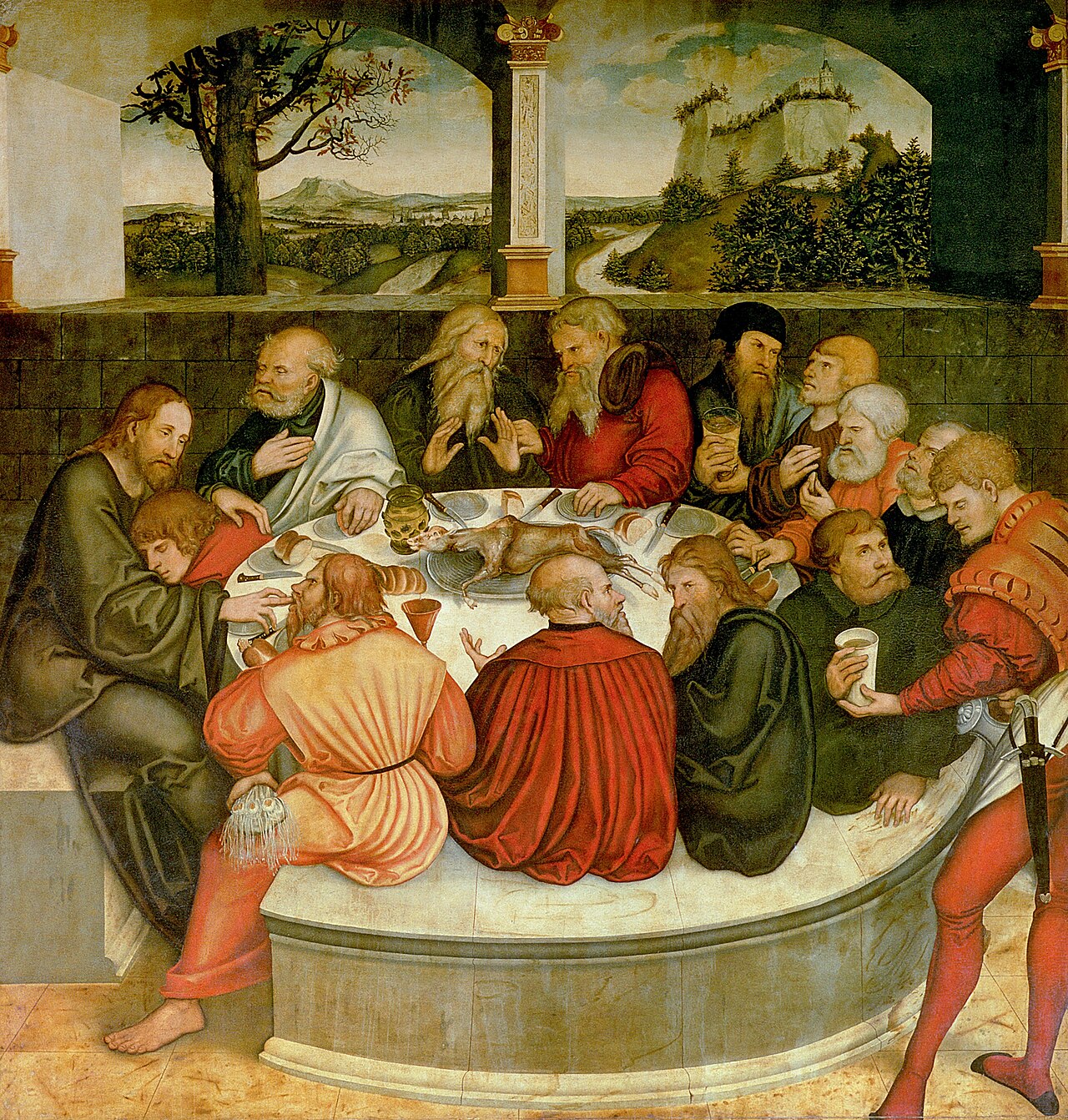
Lucas Cranach the Elder's altarpiece for Wittenberg's town church (1547): the Last Supper with Luther among the apostles — proof that the Reformation's quarrel with images was a family quarrel, not a unanimous verdict.
Tagged: Painting Church Liturgical Iconic Extant Lutheranism Reformation Reformation Art Lutheran
Why It Stands Here
Luther rejected the abuse of images, not images. Cranach, his friend and the Reformation's visual propagandist, painted this altarpiece for the church where Luther preached: Christ's Supper in the center, Luther himself receiving the cup; baptism and confession on the wings; the Crucifixion preached to a congregation in the predella. Doctrine that Geneva expressed by removal, Wittenberg expressed by painting.
The altarpiece was completed in 1547, the year after Luther's death, by Lucas Cranach the Elder with his son Lucas the Younger. Its program is a Lutheran catechism in panels: the Last Supper distributed in both kinds to the apostles, among whom the bearded Luther sits as a Junker; Melanchthon baptizing; Bugenhagen hearing confession and holding the keys; and below, Luther preaching before the crucifix to the Wittenberg congregation — word and image deliberately composed together.
The work is the standing counterweight in this section to the Reformed entry beside it. Two reformations, two image policies, one century: the evidence that 'the Protestant position on images' does not exist.
Recorded Makers
- Lucas Cranach the Elder — 1472–1553
References
Related Across the Site
- Brihadeeswara Temple Art Entry — Rajaraja Chola's temple at Thanjavur (completed 1010): a granite mountain of sculpture raised over one of India's great lingas, and the Chola bronze tradition's home ground.
- Rublev's Trinity Art Entry — Andrei Rublev's icon of the three angels at Abraham's table (c. 1411), painted for the Trinity Lavra of St. Sergius — the supreme achievement of Orthodox icon painting and its theology made visible.
- The Beeldenstorm and Reformed Iconoclasm Art Entry — In the summer of 1566 a wave of image-breaking swept the churches of the Low Countries, and the Reformed territories of Europe methodically emptied their churches: the most sustained Christian iconoclasm since Byzantium.
- The Good Shepherd of the Catacombs Art Entry — A young shepherd carrying a lamb across his shoulders, painted and carved across the Roman catacombs: the earliest Christian image of Christ, chosen as a symbol before it was a portrait.
- The Mughal Court Miniature Art Entry — The figural painting of the Mughal emperors' atelier — hunts, audiences, lovers, and saints in jewel-like detail — standing as the descriptive practice beside Islam's normative aniconism.
- The Sarajevo Haggadah Art Entry — A Passover Haggadah illuminated in Barcelona around 1350 — thirty-four miniatures of the biblical story in a Jewish book — treasured, hidden from Nazis and from war, and kept in Sarajevo as the city's emblem of itself.
- The Shuilu (Water-Land) Paintings Art Entry — Sets of hanging scrolls that assemble the whole cosmos — Buddhas, Daoist gods, ancestors, and the hungry dead — for the Water-Land rite, Chinese religion's most inclusive ceremony of deliverance.
- Lucas Cranach the Elder Artist — Luther's friend and the Reformation's image-maker, whose workshop put the evangelical message into altarpieces, portraits, and prints.