

Religious Art & Worldviews · Artists
The Abbasid vizier who gave Arabic writing its proportional system — the calligrapher's geometry on which a thousand years of Qur'an copying rests.
Tagged: Calligraphy Medieval Devotional Aniconic (Calligraphic/Geometric) Proportional Script Muslim
Abu Ali Muhammad ibn Muqla, three times vizier of the Abbasid caliphs, systematized the cursive scripts: letterforms measured in rhombic dots, the alif as module, the circle as the generative figure. His system made beautiful writing teachable, checkable, and transmissible.
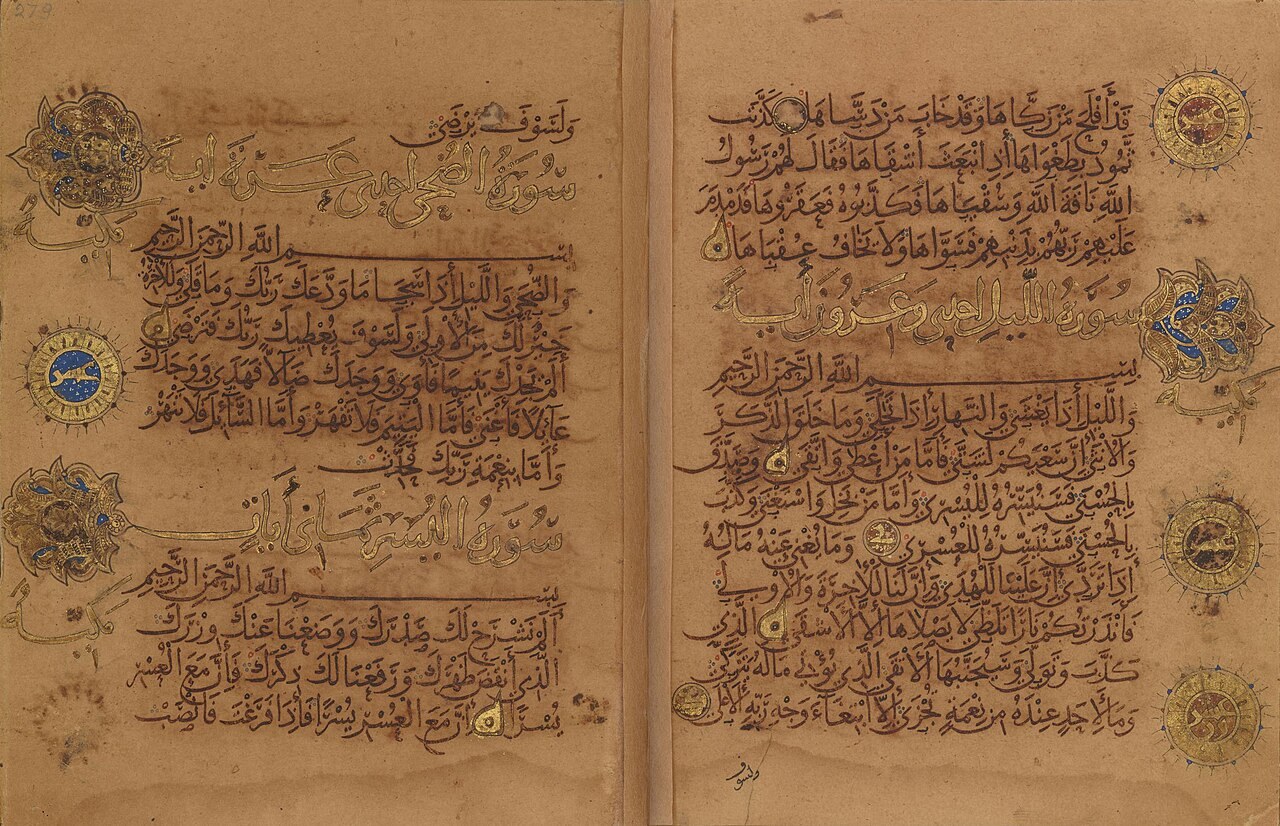
No page in his own hand survives. The pictured folio is from Ibn al-Bawwab's Qur'an of 1000–1001, the earliest dated manuscript written in the cursive system Ibn Muqla devised — his work surviving, as systems do, in other men's hands.
References
Related Across the Site
- A Kufic Qur'an Folio Art Entry — A parchment leaf of an Abbasid Qur'an in angular Kufic script, its verse endings touched with gold: the page as the supreme religious image of an aniconic faith.
- Rublev's Trinity Art Entry — Andrei Rublev's icon of the three angels at Abraham's table (c. 1411), painted for the Trinity Lavra of St. Sergius — the supreme achievement of Orthodox icon painting and its theology made visible.
- The Dilwara Temples Art Entry — Five Jain temples on Mount Abu whose plain exteriors open into marble interiors carved to the thinness of lace — the summit of Jain temple art.
- The Dome of the Rock Art Entry — The oldest surviving monument of Islamic architecture (Jerusalem, 691–692): a shrine of mosaic, marble, and inscription, whose entire decorative program argues aniconism's positive case.
- The Greatest Name in Calligraphy Art Entry — The Bahá'í invocation rendered as calligraphy by Mishkin-Qalam, the tradition's master penman — the sacred name made visible as pattern, in a faith that declines to depict its Manifestations.
- The Tibetan Thangka Art Entry — A portable scroll painting of a Buddha or deity in exact iconometric proportion — a meditation support, a teaching diagram, and a presence, rolled for the road and unrolled for the rite.
- Islam Art Tradition — Calligraphy, geometry, and architecture under the norm of aniconism, with a figural courtly tradition beside it.
- Mishkin-Qalam Artist — The Bahá'í master calligrapher whose rendering of the Greatest Name became the faith's most reproduced image — a word, beautifully written, in place of a face.