

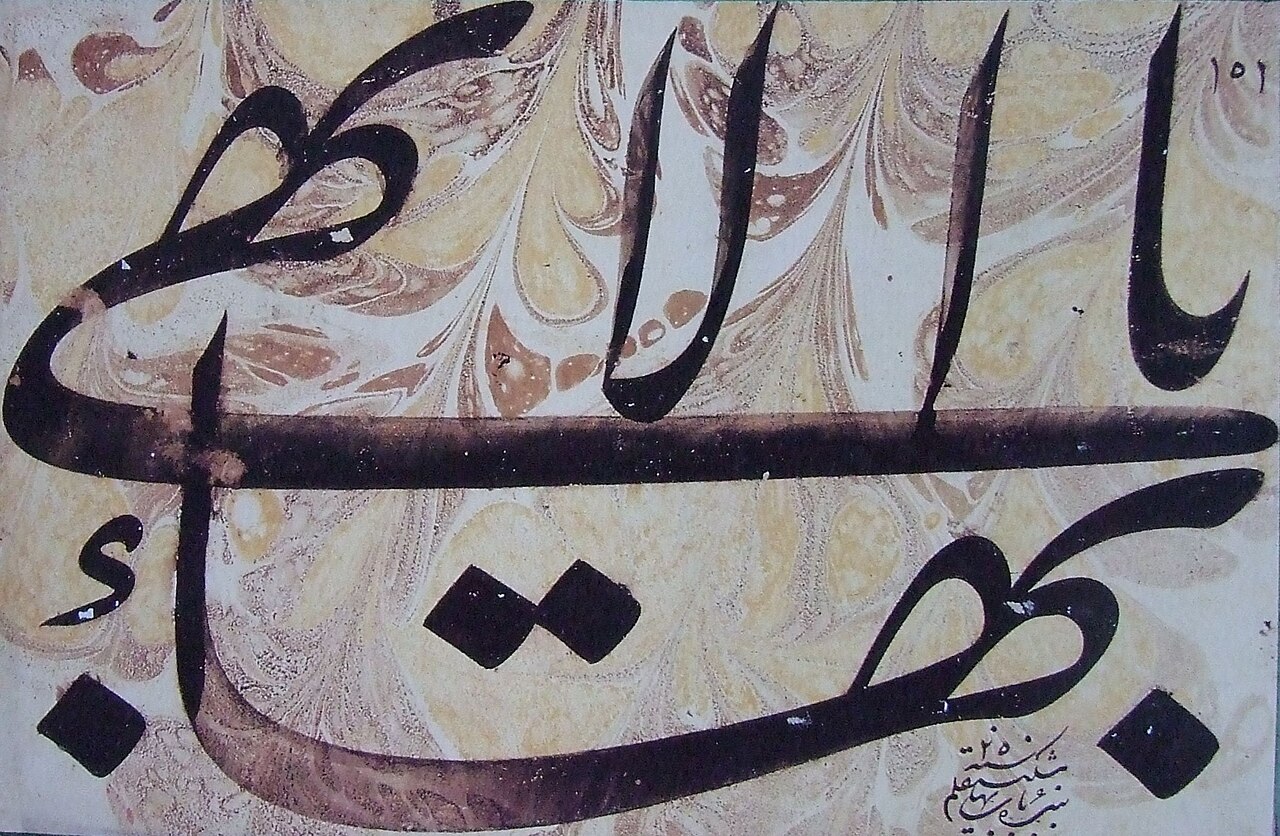
The Bahá'í invocation rendered as calligraphy by Mishkin-Qalam, the tradition's master penman — the sacred name made visible as pattern, in a faith that declines to depict its Manifestations.
Tagged: Calligraphy Private Collection Modern Devotional Aniconic (Calligraphic/Geometric) Extant Greatest Name Ringstone Symbol Bahá'í
Why It Stands Here
Where depiction is declined, calligraphy carries the devotional weight, and the Greatest Name is its supreme subject. Mishkin-Qalam's interlaced rendering, reproduced on rings, pendants, and the walls of Bahá'í homes, is to this tradition what the icon is to Orthodoxy — with the crucial difference that what it shows is a word.
Mishkin-Qalam (1826–1912), calligrapher at the court of Naser al-Din Shah before his exile as a Bahá'í, accompanied Bahá'u'lláh to Akka and became the faith's defining penman. His rendering of the Greatest Name — the invocation Ya Bahá'u'l-Abhá worked into a symmetrical calligraphic device — is the most reproduced Bahá'í image in existence.
The ringstone symbol, derived from his calligraphy, is worn by Bahá'ís worldwide. The tradition protects the Greatest Name from trivial use, and images of Bahá'u'lláh are not displayed; the name, beautifully written, is the permitted and sufficient representation.
Recorded Makers
- Mishkin-Qalam — 1826–1912
References
Related Across the Site
- A Kufic Qur'an Folio Art Entry — A parchment leaf of an Abbasid Qur'an in angular Kufic script, its verse endings touched with gold: the page as the supreme religious image of an aniconic faith.
- The Good Shepherd of the Catacombs Art Entry — A young shepherd carrying a lamb across his shoulders, painted and carved across the Roman catacombs: the earliest Christian image of Christ, chosen as a symbol before it was a portrait.
- The Lotus Temple Art Entry — A white marble lotus of twenty-seven petals, open to all, in which no sermon is preached and no image hangs — only the scriptures of the world's religions are read and sung.
- The Shiva Linga Art Entry — A polished stone shaft rising from its base, bathed daily in water, milk, and flowers: the aniconic murti of Shiva, worshipped not as a symbol of an absent god but as the god's own form.
- The Torah Ark and Its Ornaments Art Entry — The ark that houses the scroll, and the silver that dresses it — crown, shield, pointer, and finials: ceremonial art at the center of synagogue worship, governed by the principle of beautifying the commandment.
- The Yazd Fire Temple Art Entry — A temple in Yazd whose sacred fire has been kept burning, by the tradition's account, since about 470 CE — carried from shrine to shrine across fifteen centuries and tended daily behind glass.
- Ibn Muqla Artist — The Abbasid vizier who gave Arabic writing its proportional system — the calligrapher's geometry on which a thousand years of Qur'an copying rests.
- Mishkin-Qalam Artist — The Bahá'í master calligrapher whose rendering of the Greatest Name became the faith's most reproduced image — a word, beautifully written, in place of a face.