

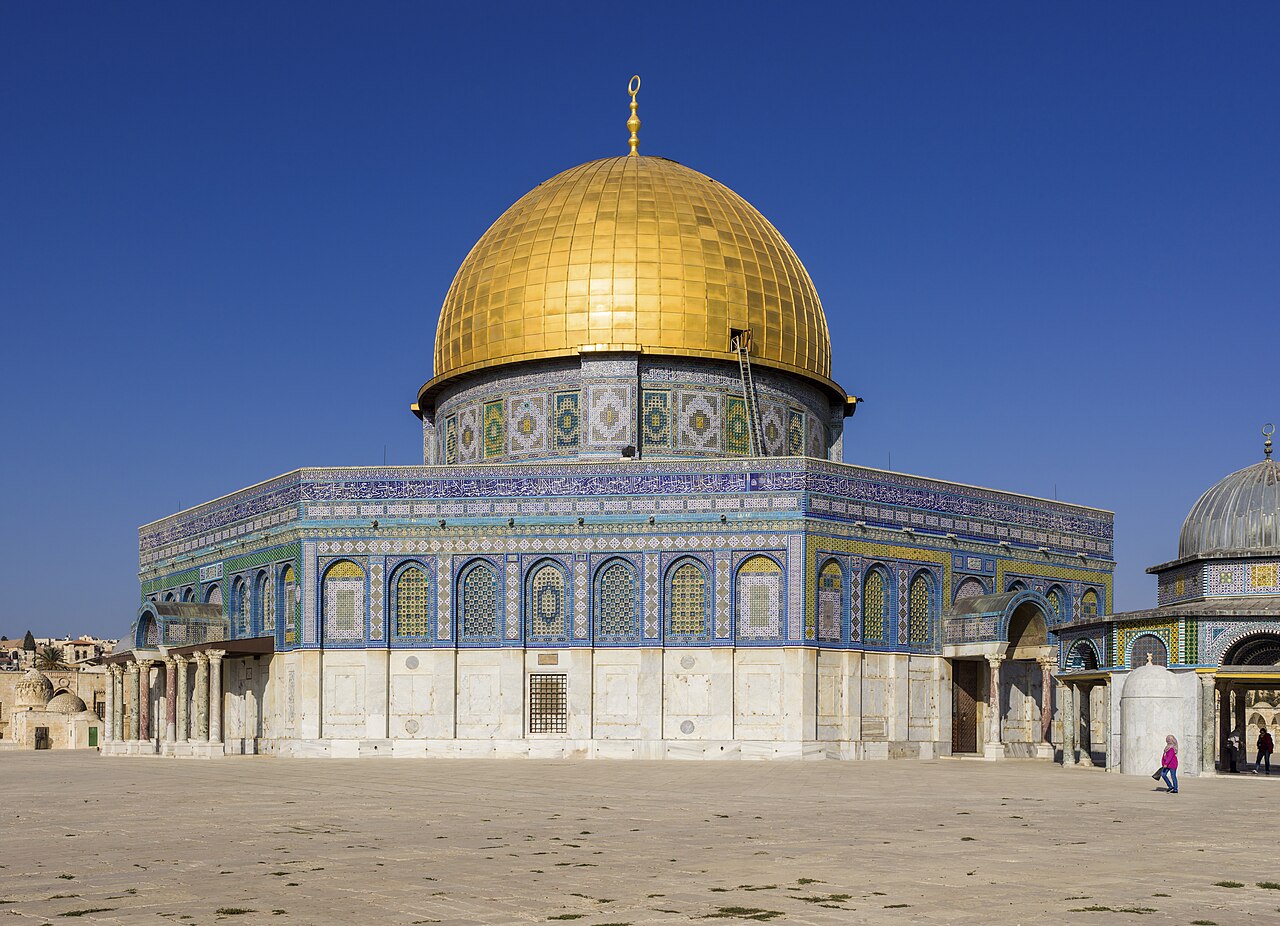
The oldest surviving monument of Islamic architecture (Jerusalem, 691–692): a shrine of mosaic, marble, and inscription, whose entire decorative program argues aniconism's positive case.
Tagged: Architecture Temple/Shrine Medieval Commemorative Aniconic (Calligraphic/Geometric) Extant Islamic Architecture Umayyad Art Muslim
Why It Stands Here
Built by the Umayyad caliph Abd al-Malik on the Rock from which, in Islamic tradition, Muhammad ascended, the Dome is aniconic art at monumental scale: 240 meters of mosaic inscription carry Qur'anic text around the arcade, and the mosaics themselves — jewels, crowns, vegetal scrolls — contain no living figure. The building is the norm of the Islam profile built in gold.
The octagon rises over the Rock at the center of Jerusalem's Haram al-Sharif, its wooden dome gilded, its walls revetted in marble and, since Suleiman's restoration, in the blue tile that now defines its silhouette. Inside, the Umayyad glass mosaics survive in extraordinary condition: acanthus scrolls, vases, and suspended royal jewels of the Byzantine and Sasanian courts, offered as trophies — the regalia of defeated empires hung in a shrine of the victorious faith, with no figure anywhere among them.
The inscription band, the earliest monumental Qur'an text anywhere, addresses the Christian visitor directly on the nature of Christ — an argument in calligraphy on the wall of the city's most contested sacred site. Architecture, text, and polemic in one program: the Dome has been read as the first great statement of Islamic visual theology.
References
Related Across the Site
- A Kufic Qur'an Folio Art Entry — A parchment leaf of an Abbasid Qur'an in angular Kufic script, its verse endings touched with gold: the page as the supreme religious image of an aniconic faith.
- Brihadeeswara Temple Art Entry — Rajaraja Chola's temple at Thanjavur (completed 1010): a granite mountain of sculpture raised over one of India's great lingas, and the Chola bronze tradition's home ground.
- Hagia Sophia Art Entry — Justinian's great church in Constantinople (532–537), whose dome seemed to contemporaries to hang from heaven — and whose mosaics record, in one building, icon, iconoclasm, conquest, museum, and mosque.
- The Dilwara Temples Art Entry — Five Jain temples on Mount Abu whose plain exteriors open into marble interiors carved to the thinness of lace — the summit of Jain temple art.
- The Golden Temple Art Entry — A gilded sanctum standing in the middle of a sacred pool, reached by one causeway and entered by doors on all four sides — open to every direction and every caste.
- The Great Stupa at Sanchi Art Entry — The oldest stone stupa in India, begun under Ashoka and crowned with four carved gateways: the reliquary mound as Buddhism's first monumental art, and its first aniconic center.
- The Hanging Temple Art Entry — A monastery of forty halls pinned to a cliff face on Mount Heng, holding altars to Confucius, Laozi, and the Buddha under one roof — the Three Teachings in a single building.
- The Tibetan Thangka Art Entry — A portable scroll painting of a Buddha or deity in exact iconometric proportion — a meditation support, a teaching diagram, and a presence, rolled for the road and unrolled for the rite.