

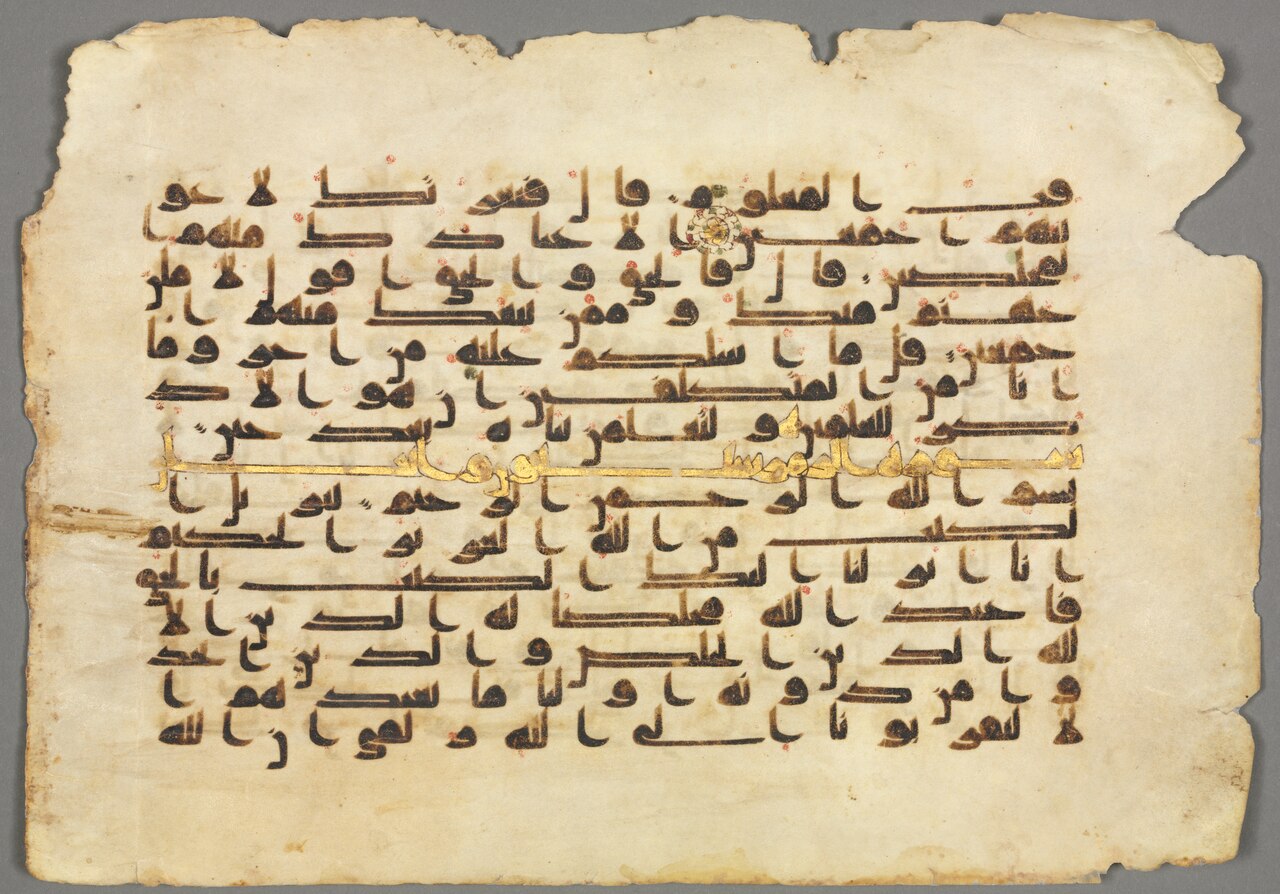
A parchment leaf of an Abbasid Qur'an in angular Kufic script, its verse endings touched with gold: the page as the supreme religious image of an aniconic faith.
Tagged: Calligraphy Manuscript Illumination Museum Medieval Devotional Aniconic (Calligraphic/Geometric) Extant Qur'an Manuscripts Muslim
Why It Stands Here
In a tradition where the figure is refused in sacred space, the written word takes the figure's place and its honor. The Kufic folio is that substitution in its purest form: revelation made visible as calligraphy, venerated as an object, and executed to the standard of an icon. Nothing on the page competes with the text, because the text is the image.
The great early Qur'ans were written on parchment in the angular script modern scholarship calls Kufic: horizontal in format, stretched letterforms, few diacritical marks, the verse divisions and sura headings picked out in gold. Such a book was a treasury object — hundreds of leaves for a single copy — commissioned by rulers and endowed to mosques, where its recitation and its presence were both acts of devotion.
Leaves from these manuscripts, dispersed in the twentieth century, now anchor Islamic collections worldwide. This entry's folio stands for the type: Abbasid, ninth or tenth century, the calligraphy itself the whole of the art.
References
Related Across the Site
- A Kalpasutra Folio Art Entry — One painted page from the most copied book in Jainism: the lives of the Tirthankaras in gold and ultramarine, read aloud and shown to the congregation during Paryushana.
- Hagia Sophia Art Entry — Justinian's great church in Constantinople (532–537), whose dome seemed to contemporaries to hang from heaven — and whose mosaics record, in one building, icon, iconoclasm, conquest, museum, and mosque.
- Rublev's Trinity Art Entry — Andrei Rublev's icon of the three angels at Abraham's table (c. 1411), painted for the Trinity Lavra of St. Sergius — the supreme achievement of Orthodox icon painting and its theology made visible.
- The Dome of the Rock Art Entry — The oldest surviving monument of Islamic architecture (Jerusalem, 691–692): a shrine of mosaic, marble, and inscription, whose entire decorative program argues aniconism's positive case.
- The Greatest Name in Calligraphy Art Entry — The Bahá'í invocation rendered as calligraphy by Mishkin-Qalam, the tradition's master penman — the sacred name made visible as pattern, in a faith that declines to depict its Manifestations.
- The Mughal Court Miniature Art Entry — The figural painting of the Mughal emperors' atelier — hunts, audiences, lovers, and saints in jewel-like detail — standing as the descriptive practice beside Islam's normative aniconism.
- The Sarajevo Haggadah Art Entry — A Passover Haggadah illuminated in Barcelona around 1350 — thirty-four miniatures of the biblical story in a Jewish book — treasured, hidden from Nazis and from war, and kept in Sarajevo as the city's emblem of itself.
- Ibn Muqla Artist — The Abbasid vizier who gave Arabic writing its proportional system — the calligrapher's geometry on which a thousand years of Qur'an copying rests.