

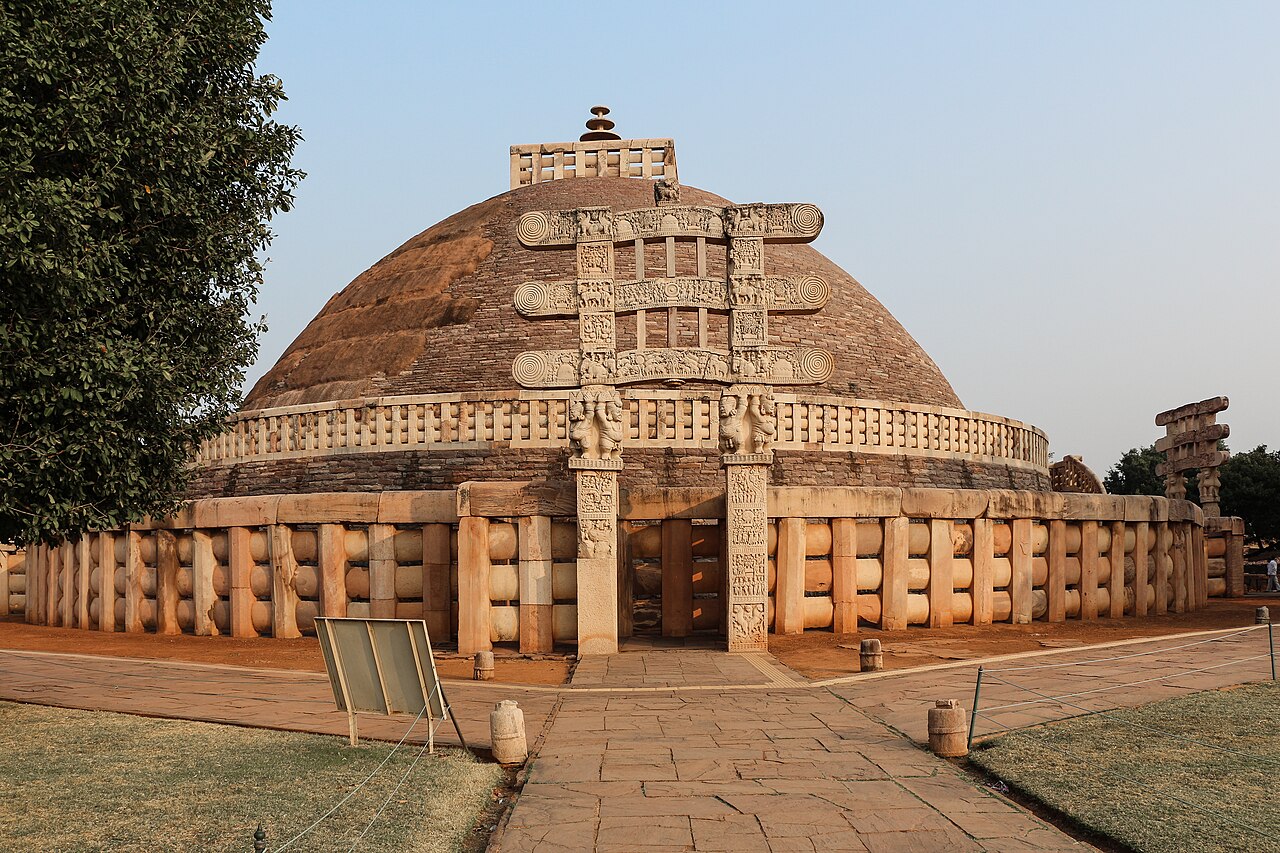
The oldest stone stupa in India, begun under Ashoka and crowned with four carved gateways: the reliquary mound as Buddhism's first monumental art, and its first aniconic center.
Tagged: Architecture Sculpture Temple/Shrine Ancient Commemorative Aniconic (Symbolic) Extant Aniconism Stupa Buddhist
Why It Stands Here
The stupa is the form before the figure: a mound housing relics, walked around clockwise, its meaning carried by circumambulation rather than depiction. At Sanchi the gateways explode into narrative carving — the life of the Buddha in teeming detail, the Buddha himself withheld. Architecture, sculpture, and the aniconism question meet in one monument.
Ashoka raised a brick stupa at Sanchi in the third century BCE; the Shungas encased it in stone at twice the size and added the railing; the Satavahanas, around the turn of the era, gave it the four torana gateways whose brackets and architraves carry the jatakas and the life scenes in some of the finest relief carving of the ancient world — salabhanjika yakshis swinging from the gateposts, processions, cities, and everywhere the symbols: wheel, tree, throne, footprint.
The site was lost to jungle and recovered in 1818; its museum holds the Ashokan lion capital from the pillar beside the gate. UNESCO lists Sanchi among the oldest and best preserved of Buddhist sanctuaries. Pilgrims still walk the pradakshina path the railing defines — the monument is used as it was designed to be used, around a center that shows nothing.
References
Related Across the Site
- A Gandhara Buddha Art Entry — The Buddha in human form from the workshops of Gandhara (1st–3rd century CE): Apollo's face, a Roman toga's folds, and the lakshanas of the Buddha — the image that changed Buddhist art forever.
- Brihadeeswara Temple Art Entry — Rajaraja Chola's temple at Thanjavur (completed 1010): a granite mountain of sculpture raised over one of India's great lingas, and the Chola bronze tradition's home ground.
- The Bharhut Railing Art Entry — The carved sandstone railing of the Bharhut stupa (c. 150–100 BCE), its medallions crowded with jataka tales and labeled in Brahmi — and the Buddha, in scene after scene, present only by symbol.
- The Dome of the Rock Art Entry — The oldest surviving monument of Islamic architecture (Jerusalem, 691–692): a shrine of mosaic, marble, and inscription, whose entire decorative program argues aniconism's positive case.
- The Fravahar Art Entry — A bearded figure in a winged disc, carved over temple doors and printed on calendars from Mumbai to Toronto — the Zoroastrian emblem whose original meaning scholars still argue about.
- The Ise Grand Shrine Art Entry — The most sacred shrine in Shinto is a plain cypress building that is torn down and rebuilt, identically, every twenty years — and has been for some thirteen centuries.
- The Shintai Mirror Art Entry — Behind the doors of a Shinto shrine sits an object no one looks at — a mirror, sword, or stone that is the seat of the kami. The pictured mirror is of the kind enshrined; the enshrined mirror itself has never been photographed.
- The Shiva Linga Art Entry — A polished stone shaft rising from its base, bathed daily in water, milk, and flowers: the aniconic murti of Shiva, worshipped not as a symbol of an absent god but as the god's own form.