

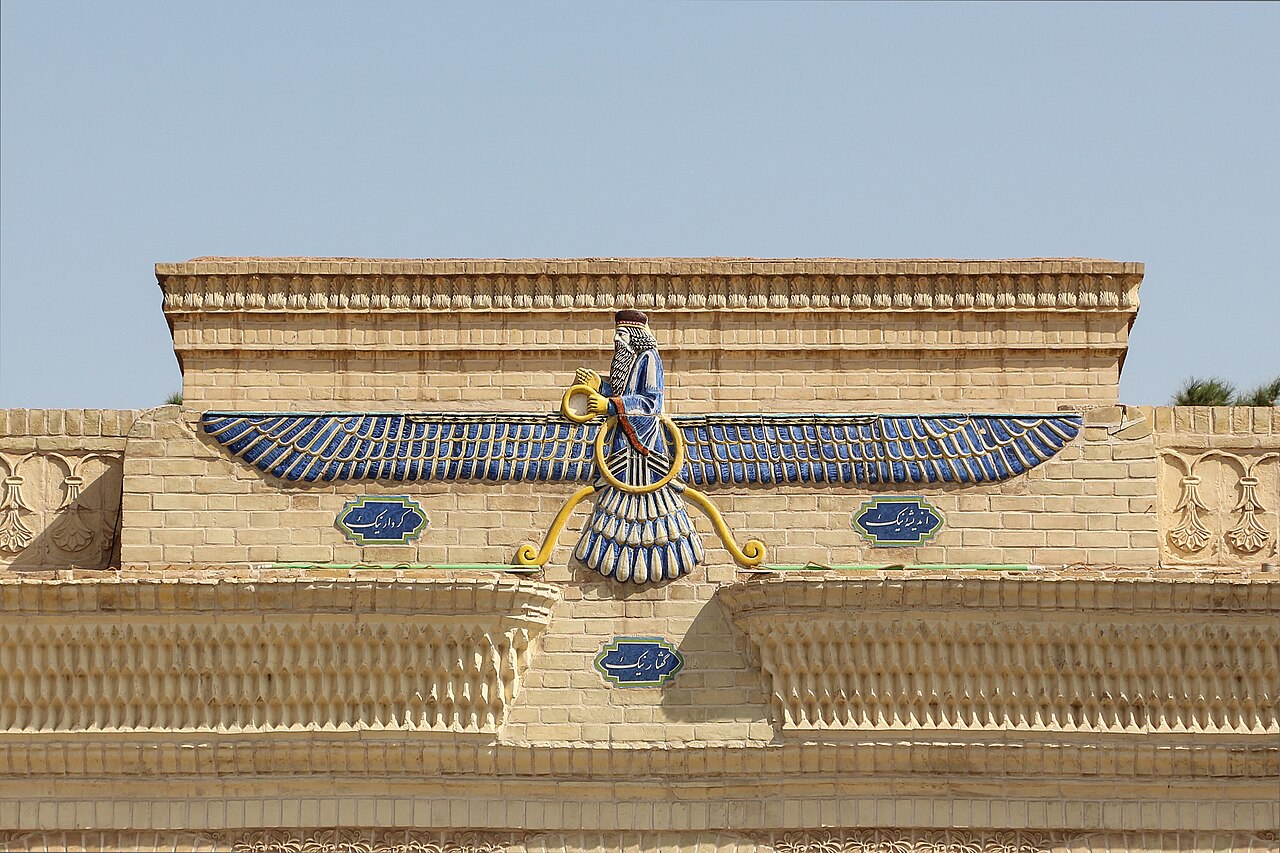
A bearded figure in a winged disc, carved over temple doors and printed on calendars from Mumbai to Toronto — the Zoroastrian emblem whose original meaning scholars still argue about.
Tagged: Sculpture Temple/Shrine Ancient Commemorative Aniconic (Symbolic) Extant Fravashi Sacred Emblem Zoroastrianism
Why It Stands Here
The fravahar is the rare sacred image whose meaning its own tradition reads several ways — the fravashi, the guardian spirit; the khvarenah, divine glory; the human soul choosing the good. This page presents the range and settles none of it, which is the honest state of the scholarship.
The motif descends from the winged disc of ancient Near Eastern art, given a human figure in Achaemenid carving at Persepolis and Behistun, where it hovers over the king. Zoroastrians adopted it widely in the 19th and 20th centuries — over fire-temple lintels, on tombstones, in homes — as the community's public emblem, and modern readings expound its details: the ring of covenant, the raised hand, the three rows of feathers for good thoughts, good words, good deeds.
Historians debate how much of that reading is ancient and how much is a modern community's self-interpretation. Both belong on the record: the carving is ancient, the emblem is living, and the two are not the same fact.
References
Related Across the Site
- Brihadeeswara Temple Art Entry — Rajaraja Chola's temple at Thanjavur (completed 1010): a granite mountain of sculpture raised over one of India's great lingas, and the Chola bronze tradition's home ground.
- The Bharhut Railing Art Entry — The carved sandstone railing of the Bharhut stupa (c. 150–100 BCE), its medallions crowded with jataka tales and labeled in Brahmi — and the Buddha, in scene after scene, present only by symbol.
- The Dome of the Rock Art Entry — The oldest surviving monument of Islamic architecture (Jerusalem, 691–692): a shrine of mosaic, marble, and inscription, whose entire decorative program argues aniconism's positive case.
- The Ganesh Chaturthi Murti Art Entry — A clay Ganesh, modeled and painted by neighborhood artisans, worshipped in streets and homes for up to eleven days, then carried in procession and immersed: the murti as a guest who is honored and bid farewell.
- The Great Stupa at Sanchi Art Entry — The oldest stone stupa in India, begun under Ashoka and crowned with four carved gateways: the reliquary mound as Buddhism's first monumental art, and its first aniconic center.
- The Shintai Mirror Art Entry — Behind the doors of a Shinto shrine sits an object no one looks at — a mirror, sword, or stone that is the seat of the kami. The pictured mirror is of the kind enshrined; the enshrined mirror itself has never been photographed.
- The Shiva Linga Art Entry — A polished stone shaft rising from its base, bathed daily in water, milk, and flowers: the aniconic murti of Shiva, worshipped not as a symbol of an absent god but as the god's own form.
- The Persepolis Carvers Artist — The imperial workshops of Darius and Xerxes — masons from across the empire whose Apadana reliefs process twenty-three nations up the stairs with their gifts.