

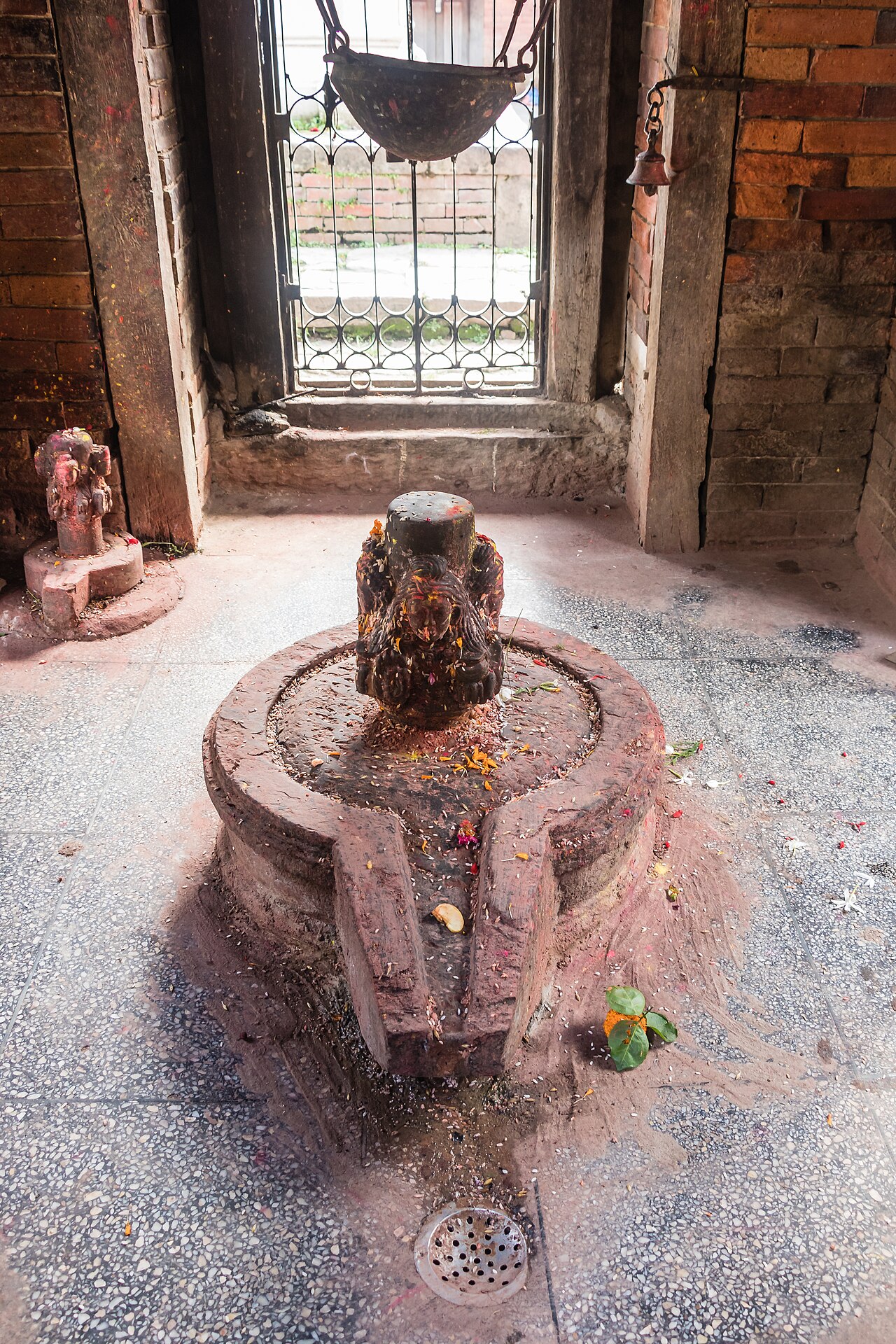
A polished stone shaft rising from its base, bathed daily in water, milk, and flowers: the aniconic murti of Shiva, worshipped not as a symbol of an absent god but as the god's own form.
Tagged: Sculpture Temple/Shrine Ancient Contemporary Devotional Liturgical Aniconic (Symbolic) Extant Murti Hindu Shaivism
Why It Stands Here
The linga disciplines the vocabulary of this whole section. It is called aniconic because it does not resemble a body, but to the worshipper it is not a substitute for a form — it is a form, the mark (the word means 'sign') of a God who is simultaneously formed and formless. Shaiva theology holds the iconic and aniconic together without ranking them, and the linga is where that holding is easiest to see.
The linga stands in the garbhagriha of every Shiva temple and in millions of home shrines: a cylindrical shaft, its top rounded, set in the yoni-pitha base that channels the offerings away. Priests pour water, milk, curd, and honey over it in abhisheka and dress it with bilva leaves and flowers. Some lingas are carved with faces (mukhalinga) or with a hundred small lingas in rows; the twelve jyotirlingas, the self-existent lingas of light, draw pilgrims across India.
The form is ancient — the Gudimallam linga, perhaps of the second century BCE, already joins the shaft to a standing figure of Shiva — and it is philosophically defended in the Shaiva Agamas as the nishkala, the partless form, complementing the sakala, the figured murti. Neither is a concession. Both are true.
References
Related Across the Site
- A Gandhara Buddha Art Entry — The Buddha in human form from the workshops of Gandhara (1st–3rd century CE): Apollo's face, a Roman toga's folds, and the lakshanas of the Buddha — the image that changed Buddhist art forever.
- Brihadeeswara Temple Art Entry — Rajaraja Chola's temple at Thanjavur (completed 1010): a granite mountain of sculpture raised over one of India's great lingas, and the Chola bronze tradition's home ground.
- The Bharhut Railing Art Entry — The carved sandstone railing of the Bharhut stupa (c. 150–100 BCE), its medallions crowded with jataka tales and labeled in Brahmi — and the Buddha, in scene after scene, present only by symbol.
- The Fravahar Art Entry — A bearded figure in a winged disc, carved over temple doors and printed on calendars from Mumbai to Toronto — the Zoroastrian emblem whose original meaning scholars still argue about.
- The Ganesh Chaturthi Murti Art Entry — A clay Ganesh, modeled and painted by neighborhood artisans, worshipped in streets and homes for up to eleven days, then carried in procession and immersed: the murti as a guest who is honored and bid farewell.
- The Great Stupa at Sanchi Art Entry — The oldest stone stupa in India, begun under Ashoka and crowned with four carved gateways: the reliquary mound as Buddhism's first monumental art, and its first aniconic center.
- The Sand Mandala Art Entry — Monks lay down a palace of the deities grain by grain in colored sand, contemplate it for days — and then sweep it away and pour it into running water.
- The Shintai Mirror Art Entry — Behind the doors of a Shinto shrine sits an object no one looks at — a mirror, sword, or stone that is the seat of the kami. The pictured mirror is of the kind enshrined; the enshrined mirror itself has never been photographed.