

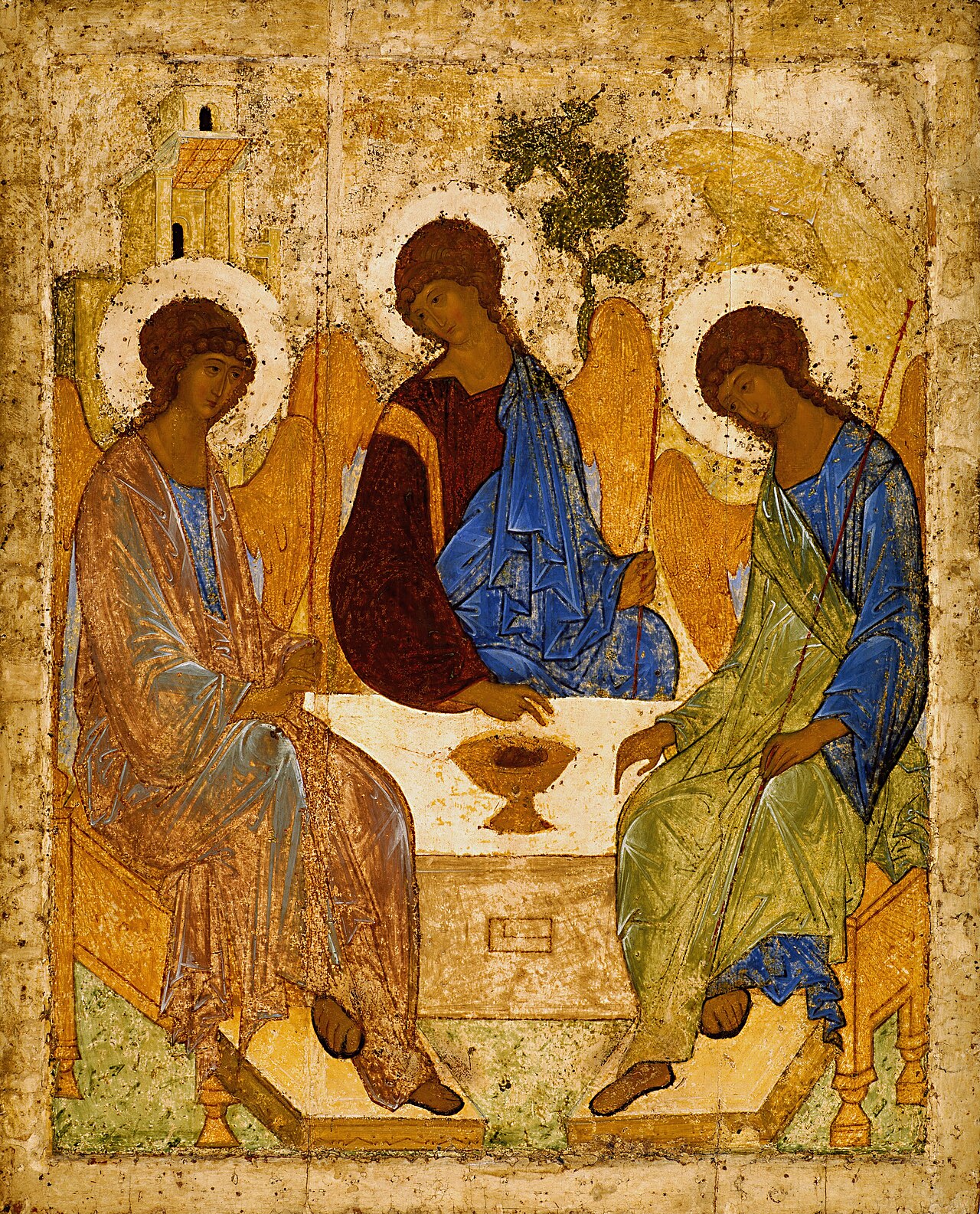
The distinctively Christian argument for visible art: the invisible God became visible flesh, so depiction is confession, not idolatry.
Tagged: Iconic Icons Incarnation
Every defense of Christian images returns to one claim: the Word became flesh. John of Damascus built the iconodule case on it during the Iconoclastic Controversy — God is the first image-maker, the Son is the living image of the Father, and because the invisible became visible, the visible may be depicted. Nicaea II ratified the argument in 787, and Orthodox theology has treated the icon ever since as a confession of the incarnation in pigment: to deny the image, on this account, is to edge toward denying that Christ was truly material, truly seen, truly touched.
The argument has edges, and the tradition knows them. It justifies depicting Christ; it does not by itself settle the depiction of the Father, whom no one has seen, and Orthodox practice handles that boundary with care — the Trinity is shown at Abraham's table, as the three angels, which is how Rublev paints it. It also does not settle how images are honored; Nicaea's distinction between veneration and worship does that work, and the Catholic latria–dulia framework refines it further.
Set beside the Islamic argument from tawhid, which begins from the same God and reasons to the opposite practice, the incarnation argument is the cleanest example on this site of a doctrine of God becoming, visibly, a doctrine of art.
References
Related Across the Site
- Brihadeeswara Temple Art Entry — Rajaraja Chola's temple at Thanjavur (completed 1010): a granite mountain of sculpture raised over one of India's great lingas, and the Chola bronze tradition's home ground.
- Rublev's Trinity Art Entry — Andrei Rublev's icon of the three angels at Abraham's table (c. 1411), painted for the Trinity Lavra of St. Sergius — the supreme achievement of Orthodox icon painting and its theology made visible.
- The Ganesh Chaturthi Murti Art Entry — A clay Ganesh, modeled and painted by neighborhood artisans, worshipped in streets and homes for up to eleven days, then carried in procession and immersed: the murti as a guest who is honored and bid farewell.
- The Good Shepherd of the Catacombs Art Entry — A young shepherd carrying a lamb across his shoulders, painted and carved across the Roman catacombs: the earliest Christian image of Christ, chosen as a symbol before it was a portrait.
- The Mughal Court Miniature Art Entry — The figural painting of the Mughal emperors' atelier — hunts, audiences, lovers, and saints in jewel-like detail — standing as the descriptive practice beside Islam's normative aniconism.
- The Sarajevo Haggadah Art Entry — A Passover Haggadah illuminated in Barcelona around 1350 — thirty-four miniatures of the biblical story in a Jewish book — treasured, hidden from Nazis and from war, and kept in Sarajevo as the city's emblem of itself.
- The Wittenberg Altarpiece Art Entry — Lucas Cranach the Elder's altarpiece for Wittenberg's town church (1547): the Last Supper with Luther among the apostles — proof that the Reformation's quarrel with images was a family quarrel, not a unanimous verdict.
- Christianity Art Tradition — Icons, altarpieces, cathedrals, and the argument over whether the visible Christ justifies visible art.