

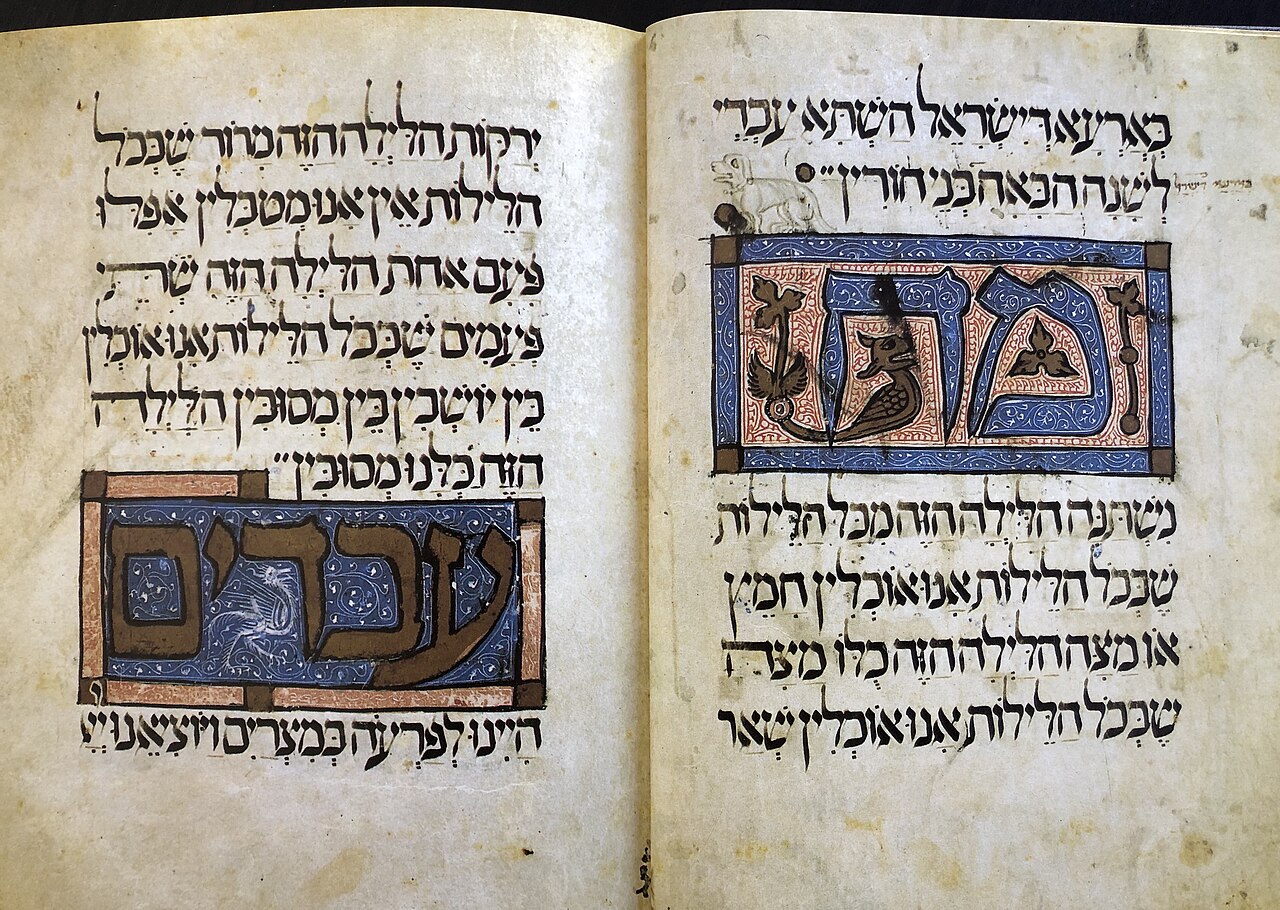
A Passover Haggadah illuminated in Barcelona around 1350 — thirty-four miniatures of the biblical story in a Jewish book — treasured, hidden from Nazis and from war, and kept in Sarajevo as the city's emblem of itself.
Tagged: Manuscript Illumination Museum Medieval Liturgical Pedagogical Iconic Extant Haggadah Hebrew Manuscripts Jewish
Why It Stands Here
The Haggadah is the Jewish profile's proof in one object: a lavishly figural book, made for the seder table, in a tradition whose commandment is so often misread as a ban on pictures. Its miniatures paint creation, Exodus, and the coming of the Messiah in the Gothic manner of Christian Spain — by Jewish patrons, for Jewish use, without recorded anxiety.
The manuscript was written and illuminated in Barcelona around 1350, probably as a wedding gift; its wine-stained pages record centuries of seders. It crossed Europe with the exiles of 1492, surfaced in Italy, and was sold to the National Museum in Sarajevo in 1894. In 1942 the museum's librarian, Derviš Korkut, hid it from the Gestapo in a mosque library; in the 1990s it survived the siege of Sarajevo in a bank vault. Muslim librarians twice saved the Jewish book, and Sarajevo tells the story as its own.
Liturgically it is a working Haggadah, its text the order of the Passover meal; artistically it is among the supreme Hebrew manuscripts, its full-page miniatures in tempera and gold on bleached calfskin. It is displayed in the National Museum of Bosnia and Herzegovina under permanent conservation conditions.
References
Related Across the Site
- A Kufic Qur'an Folio Art Entry — A parchment leaf of an Abbasid Qur'an in angular Kufic script, its verse endings touched with gold: the page as the supreme religious image of an aniconic faith.
- Brihadeeswara Temple Art Entry — Rajaraja Chola's temple at Thanjavur (completed 1010): a granite mountain of sculpture raised over one of India's great lingas, and the Chola bronze tradition's home ground.
- Hagia Sophia Art Entry — Justinian's great church in Constantinople (532–537), whose dome seemed to contemporaries to hang from heaven — and whose mosaics record, in one building, icon, iconoclasm, conquest, museum, and mosque.
- Rublev's Trinity Art Entry — Andrei Rublev's icon of the three angels at Abraham's table (c. 1411), painted for the Trinity Lavra of St. Sergius — the supreme achievement of Orthodox icon painting and its theology made visible.
- The Dura-Europos Synagogue Frescoes Art Entry — The walls of a synagogue on Rome's Euphrates frontier, painted around 244 CE with the whole biblical story in human figures — the standing disproof that ancient Judaism made no religious pictures.
- The Mughal Court Miniature Art Entry — The figural painting of the Mughal emperors' atelier — hunts, audiences, lovers, and saints in jewel-like detail — standing as the descriptive practice beside Islam's normative aniconism.
- The Torah Ark and Its Ornaments Art Entry — The ark that houses the scroll, and the silver that dresses it — crown, shield, pointer, and finials: ceremonial art at the center of synagogue worship, governed by the principle of beautifying the commandment.
- The Wittenberg Altarpiece Art Entry — Lucas Cranach the Elder's altarpiece for Wittenberg's town church (1547): the Last Supper with Luther among the apostles — proof that the Reformation's quarrel with images was a family quarrel, not a unanimous verdict.