

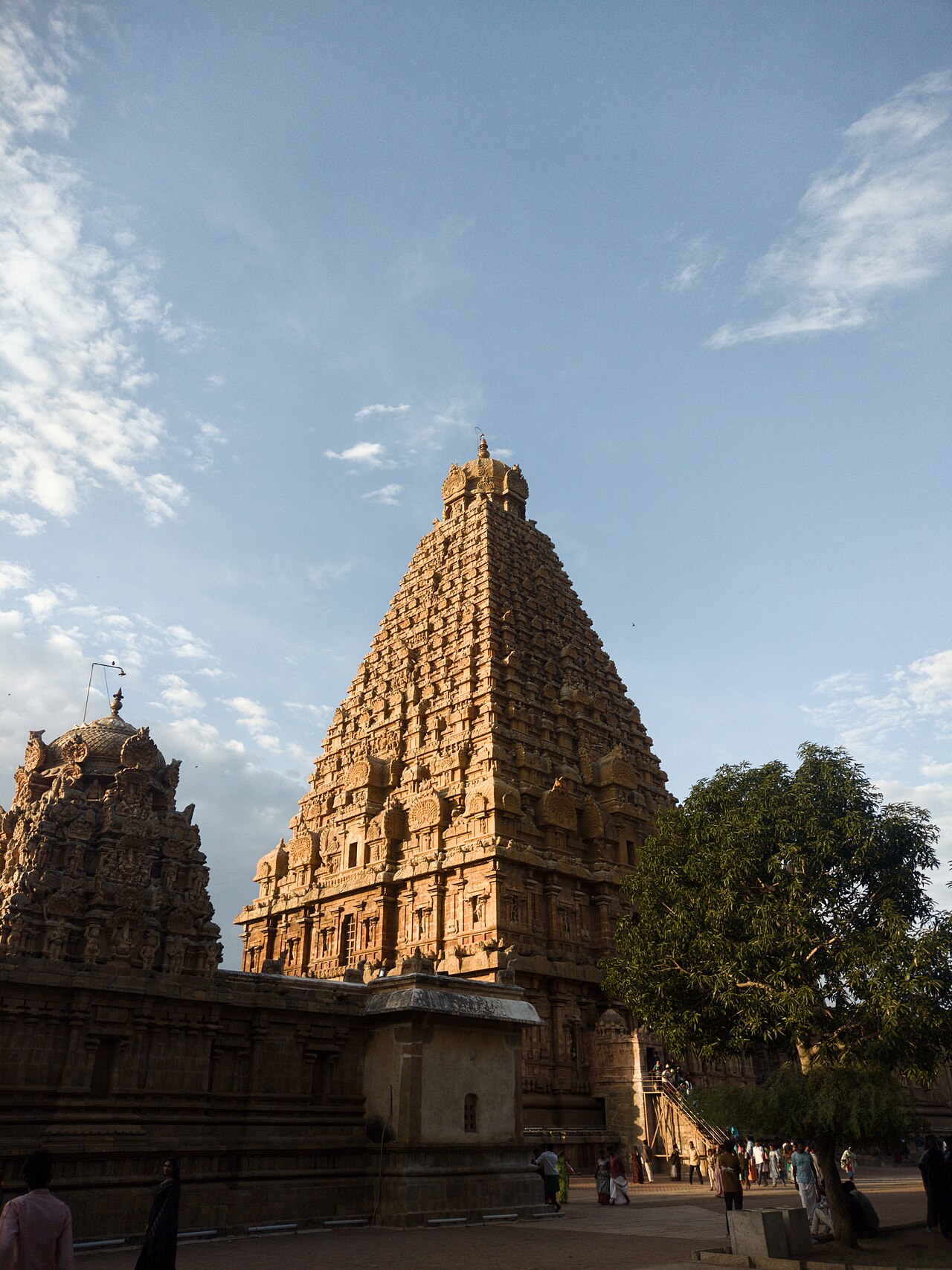
Rajaraja Chola's temple at Thanjavur (completed 1010): a granite mountain of sculpture raised over one of India's great lingas, and the Chola bronze tradition's home ground.
Tagged: Architecture Sculpture Temple/Shrine Medieval Liturgical Iconic Extant Chola Art Temple Architecture Hindu Shaivism
Why It Stands Here
The Big Temple is Hindu temple art at imperial scale: a 66-meter vimana over the sanctum, walls inscribed with the empire's records, and a sculpture program that turns the whole cosmic order into stone around the resident god. It is also the context of the Chola bronzes — the processional images cast to carry the deity out among the people when the temple's fixed murti stays home.
Rajaraja I completed the temple in 1010 and covered its walls with inscriptions recording endowments, dancers, musicians, and bronze images in bureaucratic detail — an archive of a temple economy in the stone itself. The vimana rises in thirteen tiers over the garbhagriha, crowned by a single capstone of some eighty tons; the Nandi before the shrine is carved from one rock. Frescoes of the Chola period survive beneath later Nayaka painting in the circumambulatory, including the famous portrait of Rajaraja with his guru.
UNESCO lists Thanjavur among the Great Living Chola Temples: living, because the worship Rajaraja endowed continues in the building he raised, and the bronzes cast in its tradition — Shiva as Nataraja above all — remain the standard against which Indian sculpture is judged.
Recorded Makers
- The Chola Bronze Workshops — 9th–13th centuries
References
Related Across the Site
- Hagia Sophia Art Entry — Justinian's great church in Constantinople (532–537), whose dome seemed to contemporaries to hang from heaven — and whose mosaics record, in one building, icon, iconoclasm, conquest, museum, and mosque.
- Rublev's Trinity Art Entry — Andrei Rublev's icon of the three angels at Abraham's table (c. 1411), painted for the Trinity Lavra of St. Sergius — the supreme achievement of Orthodox icon painting and its theology made visible.
- The Dome of the Rock Art Entry — The oldest surviving monument of Islamic architecture (Jerusalem, 691–692): a shrine of mosaic, marble, and inscription, whose entire decorative program argues aniconism's positive case.
- The Ganesh Chaturthi Murti Art Entry — A clay Ganesh, modeled and painted by neighborhood artisans, worshipped in streets and homes for up to eleven days, then carried in procession and immersed: the murti as a guest who is honored and bid farewell.
- The Great Stupa at Sanchi Art Entry — The oldest stone stupa in India, begun under Ashoka and crowned with four carved gateways: the reliquary mound as Buddhism's first monumental art, and its first aniconic center.
- The Sarajevo Haggadah Art Entry — A Passover Haggadah illuminated in Barcelona around 1350 — thirty-four miniatures of the biblical story in a Jewish book — treasured, hidden from Nazis and from war, and kept in Sarajevo as the city's emblem of itself.
- The Shiva Linga Art Entry — A polished stone shaft rising from its base, bathed daily in water, milk, and flowers: the aniconic murti of Shiva, worshipped not as a symbol of an absent god but as the god's own form.
- The Chola Bronze Workshops Artist — Anonymous Tamil caster lineages whose lost-wax bronzes — above all the dancing Shiva — are the summit of Indian sculpture.