

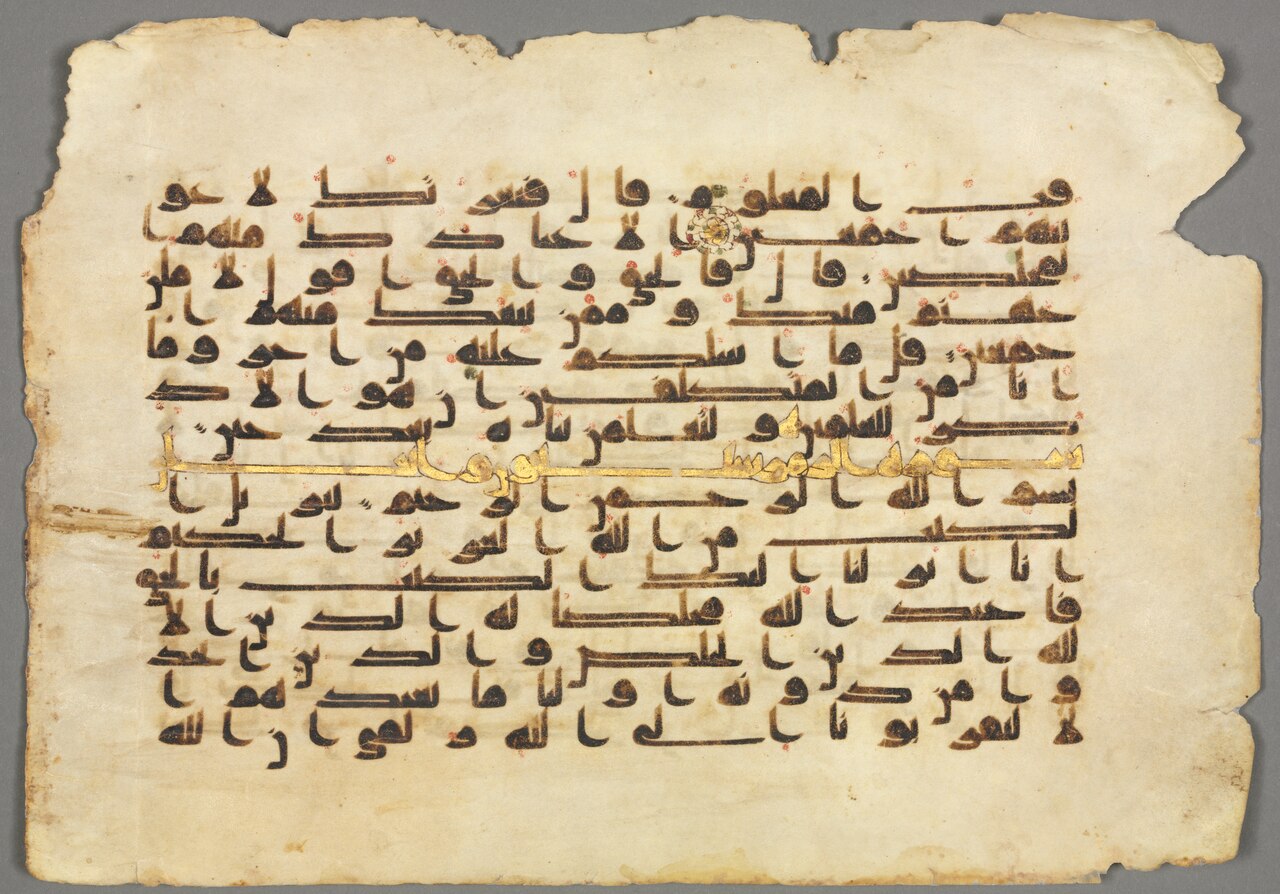
The Islamic argument from divine unity: because God is one and incomparable, representation risks shirk — and the word, not the figure, becomes the image.
Tagged: Aniconic (Calligraphic/Geometric) Aniconism Tawhid
Tawhid, the absolute unity and incomparability of God, is the doctrine from which Islamic aniconism reasons. A God who has no likeness cannot be pictured without the picture lying about him; and a picture of anything, set in a place of worship, risks drawing to itself the worship due to God alone — the sin of shirk, association, the one sin the Qur'an calls unforgivable if unrepented. The juristic tradition built from that reasoning a norm: no figures in sacred space, and above all no figure of a prophet.
The argument's fruit is visible everywhere in this section. Denied the figure, Islamic art perfected the word: calligraphy became the supreme religious image, the visible form of God's speech. Geometry gave tawhid a mathematics — the pattern without center or end that images divine unity by structure rather than by portrait. The arabesque filled the remaining space with the abundance of creation, stylized so that nothing in it competes for worship.
The record must stay double, as the Islam profile insists: the norm governed mosques and Qur'ans, while courts commissioned figural miniatures without sensing contradiction. Tawhid explains the sacred space. It was never a law over every wall in the civilization.
References
Related Across the Site
- A Kufic Qur'an Folio Art Entry — A parchment leaf of an Abbasid Qur'an in angular Kufic script, its verse endings touched with gold: the page as the supreme religious image of an aniconic faith.
- The Bharhut Railing Art Entry — The carved sandstone railing of the Bharhut stupa (c. 150–100 BCE), its medallions crowded with jataka tales and labeled in Brahmi — and the Buddha, in scene after scene, present only by symbol.
- The Dome of the Rock Art Entry — The oldest surviving monument of Islamic architecture (Jerusalem, 691–692): a shrine of mosaic, marble, and inscription, whose entire decorative program argues aniconism's positive case.
- The Great Stupa at Sanchi Art Entry — The oldest stone stupa in India, begun under Ashoka and crowned with four carved gateways: the reliquary mound as Buddhism's first monumental art, and its first aniconic center.
- The Greatest Name in Calligraphy Art Entry — The Bahá'í invocation rendered as calligraphy by Mishkin-Qalam, the tradition's master penman — the sacred name made visible as pattern, in a faith that declines to depict its Manifestations.
- Buddhism Art Tradition — Symbols before images, the Buddha image after Gandhara and Mathura, and a scholarly debate that is not settled.
- Islam Art Tradition — Calligraphy, geometry, and architecture under the norm of aniconism, with a figural courtly tradition beside it.
- Sikhism Art Tradition — An aniconic theology centered on the Guru Granth Sahib, with a contested tradition of Guru portraits.