

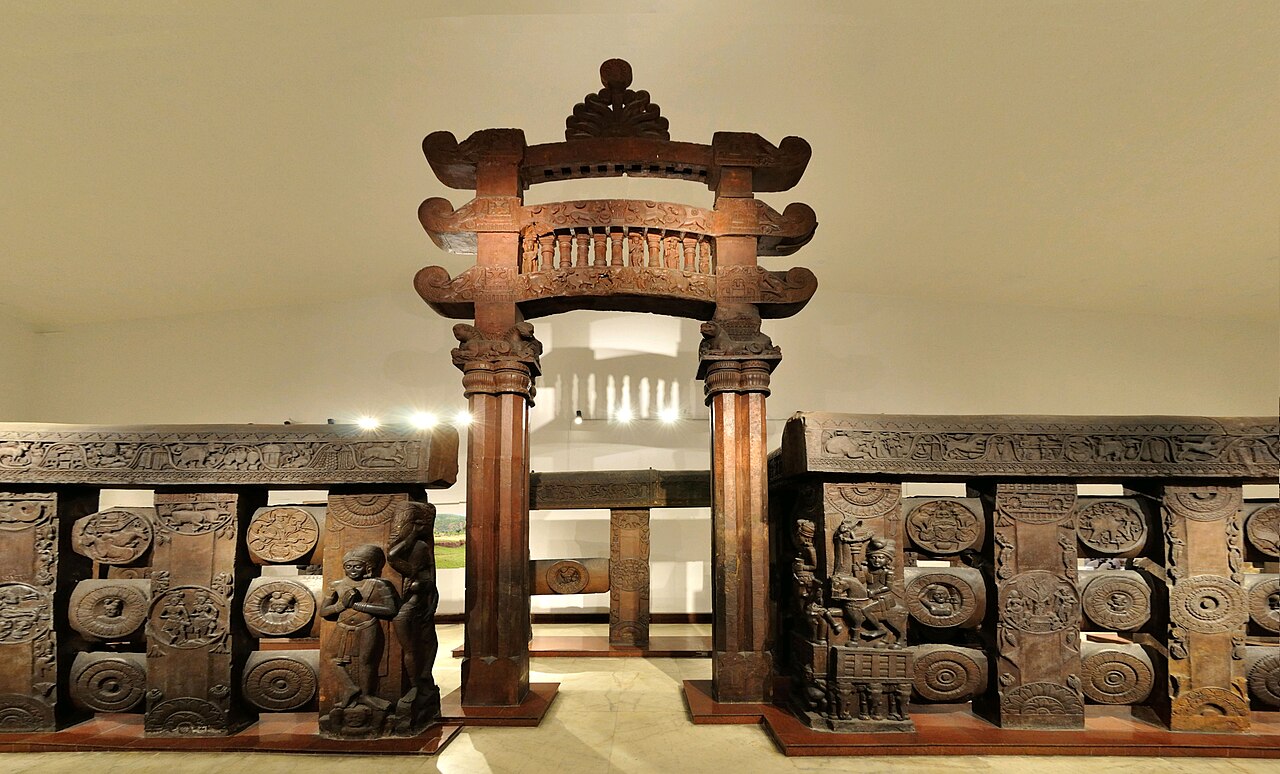
The carved sandstone railing of the Bharhut stupa (c. 150–100 BCE), its medallions crowded with jataka tales and labeled in Brahmi — and the Buddha, in scene after scene, present only by symbol.
Tagged: Sculpture Museum Ancient Pedagogical Aniconic (Symbolic) Extant Aniconism Jataka Tales Buddhist
Why It Stands Here
Bharhut is Exhibit A of the traditional aniconism thesis: hundreds of narrative reliefs of the Buddha's life and former lives, the protagonist of the central scenes never figured — a tree, a wheel, an empty seat, a footprint standing where he should be. It is also where the Huntington critique must be faced: were the carvers avoiding the Buddha, or worshipping the tree and the wheel as powers in themselves? This entry presents the stones and both readings.
The stupa at Bharhut in Madhya Pradesh was railed in red sandstone under the Shungas, its gateway donated, an inscription says, in the reign of the Shungas by Dhanabhuti. The railing's medallions and coping stones narrate the jatakas — the Buddha's previous lives — with a label carved under nearly every scene, an inscribed picture-book for circumambulating pilgrims. Donor inscriptions name monks, nuns, and laypeople from across northern India.
Alexander Cunningham excavated the site in 1873; the railing and gateway now stand reconstructed in the Indian Museum, Kolkata. The reliefs' style — flat, crowded, delighted with processions, animals, and yakshas at the posts — is the foundation document of Indian narrative sculpture, and the absence at its center is the most argued-over absence in Buddhist art history.
References
Related Across the Site
- A Gandhara Buddha Art Entry — The Buddha in human form from the workshops of Gandhara (1st–3rd century CE): Apollo's face, a Roman toga's folds, and the lakshanas of the Buddha — the image that changed Buddhist art forever.
- The Dura-Europos Synagogue Frescoes Art Entry — The walls of a synagogue on Rome's Euphrates frontier, painted around 244 CE with the whole biblical story in human figures — the standing disproof that ancient Judaism made no religious pictures.
- The Fravahar Art Entry — A bearded figure in a winged disc, carved over temple doors and printed on calendars from Mumbai to Toronto — the Zoroastrian emblem whose original meaning scholars still argue about.
- The Great Stupa at Sanchi Art Entry — The oldest stone stupa in India, begun under Ashoka and crowned with four carved gateways: the reliquary mound as Buddhism's first monumental art, and its first aniconic center.
- The Sarajevo Haggadah Art Entry — A Passover Haggadah illuminated in Barcelona around 1350 — thirty-four miniatures of the biblical story in a Jewish book — treasured, hidden from Nazis and from war, and kept in Sarajevo as the city's emblem of itself.
- The Shintai Mirror Art Entry — Behind the doors of a Shinto shrine sits an object no one looks at — a mirror, sword, or stone that is the seat of the kami. The pictured mirror is of the kind enshrined; the enshrined mirror itself has never been photographed.
- The Shiva Linga Art Entry — A polished stone shaft rising from its base, bathed daily in water, milk, and flowers: the aniconic murti of Shiva, worshipped not as a symbol of an absent god but as the god's own form.
- The Gandhara Workshops Artist — The stucco and schist ateliers of the Peshawar valley that gave the Buddha his first human face — Apollo's features, a monk's robe, a teacher's calm.