

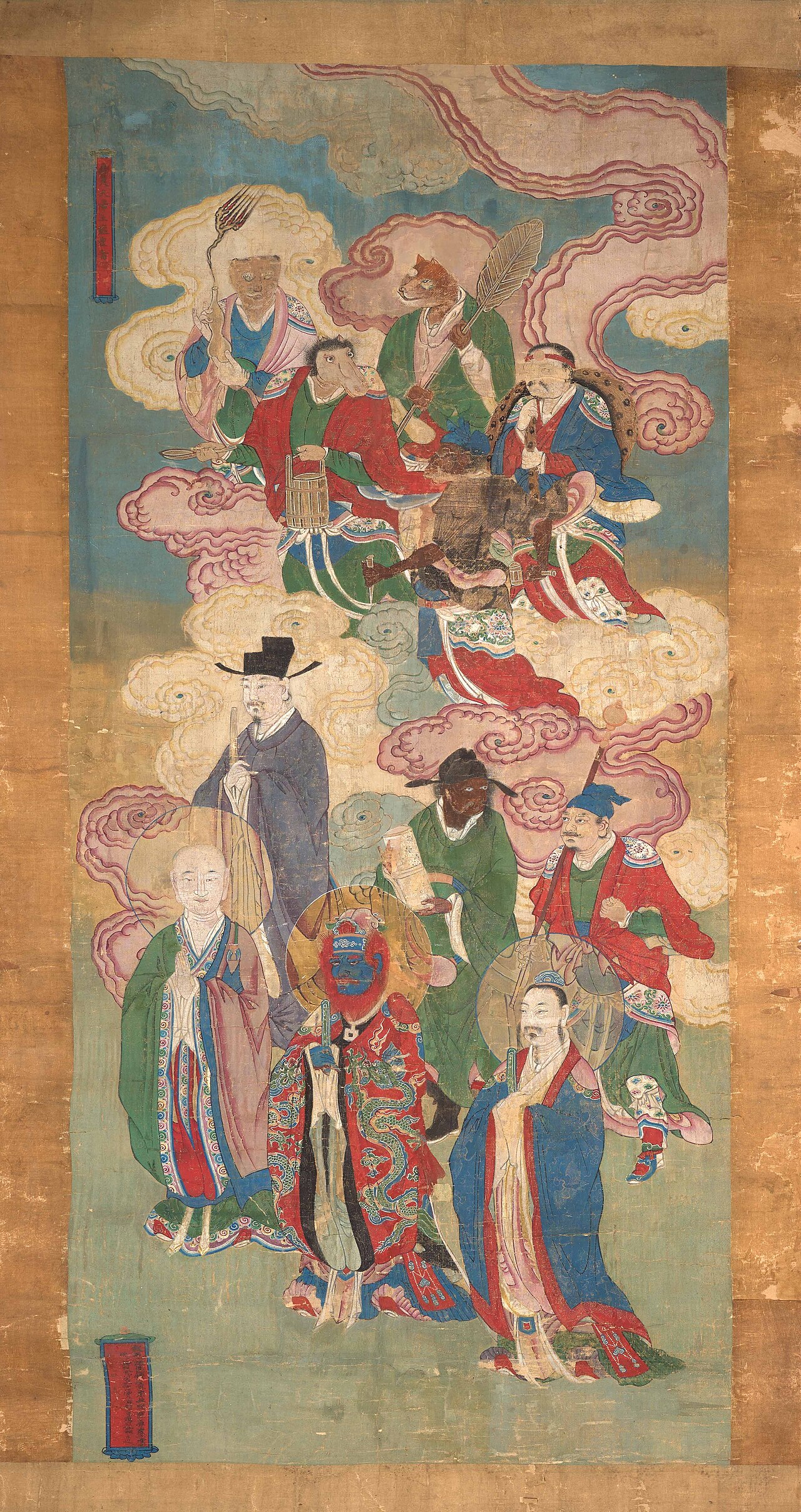
Sets of hanging scrolls that assemble the whole cosmos — Buddhas, Daoist gods, ancestors, and the hungry dead — for the Water-Land rite, Chinese religion's most inclusive ceremony of deliverance.
Tagged: Painting Temple/Shrine Medieval Liturgical Extant Universal Deliverance Water-Land Rite Daoism
Why It Stands Here
The Water-Land set is an altar you hang on walls: every rank of being, from the Buddhas down to the unclaimed dead, is painted, summoned, fed, and dismissed. Its iconography crosses Buddhist and Daoist lines because the rite's mercy is meant to cross them too.
The shuilu fahui, the Water-Land Dharma Assembly, is a multi-day ritual for the deliverance of all beings in water and on land, performed in Chinese Buddhist temples since the Song dynasty. Its altars are hung with painted sets — in the fullest form, over a hundred scrolls — depicting the assemblies of the Buddhas and bodhisattvas, the Daoist Three Officials, Confucian worthies, local gods, and the hungry ghosts the rite exists to save.
The most famous surviving set, 139 Ming-dynasty paintings from Baoning Temple in Shanxi, is a summit of Chinese religious art: court-quality figures in mineral color on silk, every deity named in a cartouche so the officiant can address the painted court by name. The scrolls are working liturgical instruments, stored rolled and hung only for the rite.
References
Related Across the Site
- Brihadeeswara Temple Art Entry — Rajaraja Chola's temple at Thanjavur (completed 1010): a granite mountain of sculpture raised over one of India's great lingas, and the Chola bronze tradition's home ground.
- Rublev's Trinity Art Entry — Andrei Rublev's icon of the three angels at Abraham's table (c. 1411), painted for the Trinity Lavra of St. Sergius — the supreme achievement of Orthodox icon painting and its theology made visible.
- The Hanging Temple Art Entry — A monastery of forty halls pinned to a cliff face on Mount Heng, holding altars to Confucius, Laozi, and the Buddha under one roof — the Three Teachings in a single building.
- The Sarajevo Haggadah Art Entry — A Passover Haggadah illuminated in Barcelona around 1350 — thirty-four miniatures of the biblical story in a Jewish book — treasured, hidden from Nazis and from war, and kept in Sarajevo as the city's emblem of itself.
- The Shiva Linga Art Entry — A polished stone shaft rising from its base, bathed daily in water, milk, and flowers: the aniconic murti of Shiva, worshipped not as a symbol of an absent god but as the god's own form.
- The Tibetan Thangka Art Entry — A portable scroll painting of a Buddha or deity in exact iconometric proportion — a meditation support, a teaching diagram, and a presence, rolled for the road and unrolled for the rite.
- The Torah Ark and Its Ornaments Art Entry — The ark that houses the scroll, and the silver that dresses it — crown, shield, pointer, and finials: ceremonial art at the center of synagogue worship, governed by the principle of beautifying the commandment.
- Wu Daozi Artist — The Tang muralist whose temple walls made crowds gasp — the sage of painting in Chinese tradition, whose work survives in copies and in legend.