

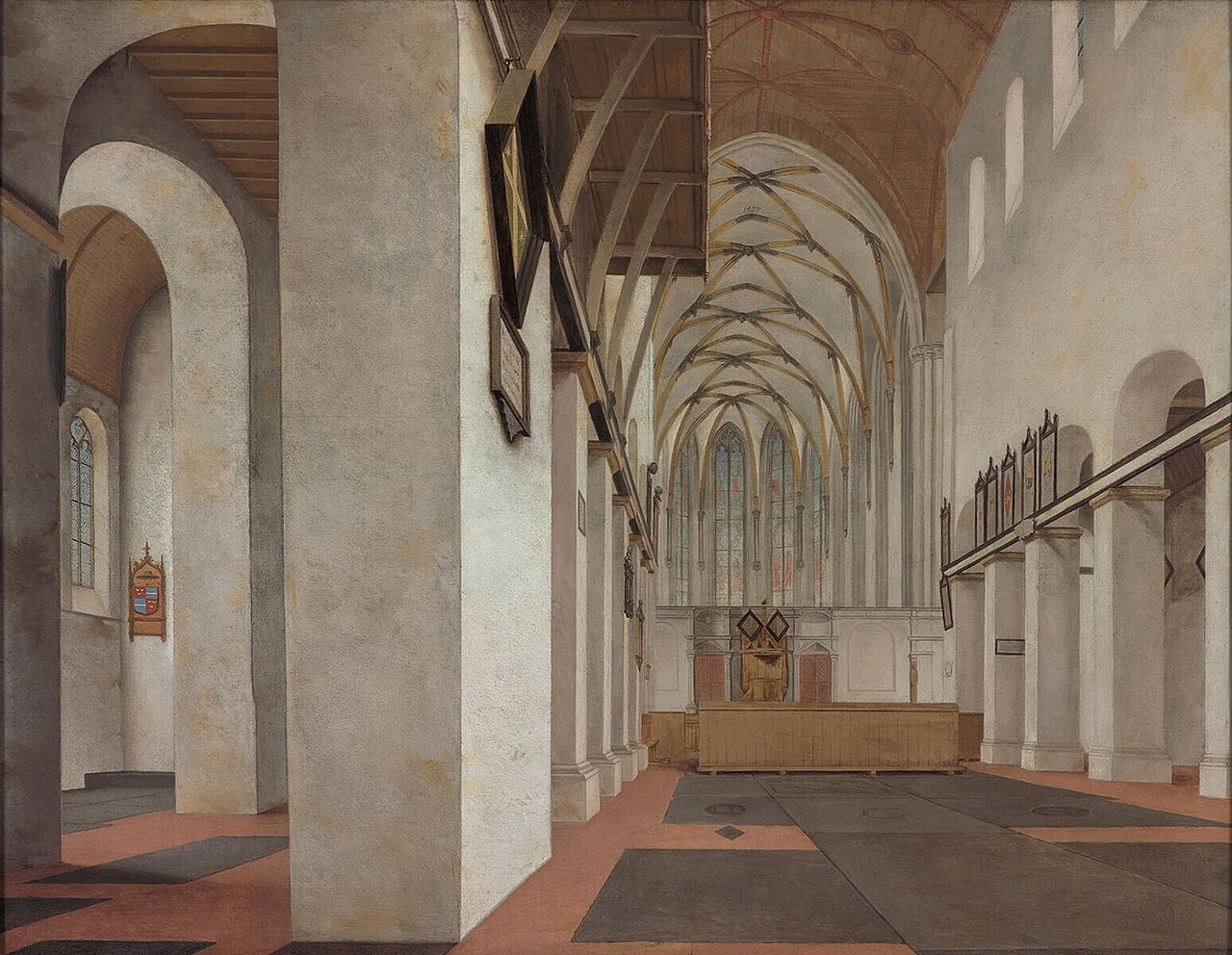
In the summer of 1566 a wave of image-breaking swept the churches of the Low Countries, and the Reformed territories of Europe methodically emptied their churches: the most sustained Christian iconoclasm since Byzantium.
Tagged: Painting Church Liturgical Iconoclastic Destroyed Iconoclasm Reformation Reformed and Presbyterian
Why It Stands Here
Zwingli and Calvin read the Second Commandment as a standing order against images in worship, and the Reformed acted on the reading — Zurich by council decision and workmen, the Netherlands by crowd and then by policy. The result, recorded here by Saenredam's painting of the emptied interior rather than by an image of the breaking itself, was a new sacred aesthetic: whitewash, light, the pulpit, and the Word.
The Beeldenstorm — the image storm — began at Steenvoorde in August 1566 and ran through the churches of Flanders and Holland in weeks: altarpieces smashed, statues beheaded, organs and stained glass destroyed. It was the violent edge of a policy that elsewhere proceeded by inventory and cart: Zurich had removed its images in 1524 under council order, and Geneva, Scotland, and the Huguenot towns each kept their own accounts of removal.
Within a generation the Reformed interior had become a recognisable art of its own — Saenredam and de Witte painted whitewashed naves of great serenity, in which architecture and light replaced the image program — and Dutch painting, expelled from the church, built its golden age in the house and the market instead. The destruction and the flowering are one event, and this entry records both.
Recorded Makers
- Pieter Saenredam — 1597–1665
References
Related Across the Site
- Hagia Sophia Art Entry — Justinian's great church in Constantinople (532–537), whose dome seemed to contemporaries to hang from heaven — and whose mosaics record, in one building, icon, iconoclasm, conquest, museum, and mosque.
- Rublev's Trinity Art Entry — Andrei Rublev's icon of the three angels at Abraham's table (c. 1411), painted for the Trinity Lavra of St. Sergius — the supreme achievement of Orthodox icon painting and its theology made visible.
- The Good Shepherd of the Catacombs Art Entry — A young shepherd carrying a lamb across his shoulders, painted and carved across the Roman catacombs: the earliest Christian image of Christ, chosen as a symbol before it was a portrait.
- The Shuilu (Water-Land) Paintings Art Entry — Sets of hanging scrolls that assemble the whole cosmos — Buddhas, Daoist gods, ancestors, and the hungry dead — for the Water-Land rite, Chinese religion's most inclusive ceremony of deliverance.
- The Wittenberg Altarpiece Art Entry — Lucas Cranach the Elder's altarpiece for Wittenberg's town church (1547): the Last Supper with Luther among the apostles — proof that the Reformation's quarrel with images was a family quarrel, not a unanimous verdict.
- Iconoclasm: The Theology of Breaking Images Art Theme — Image destruction recurs across traditions — Byzantine, Reformed, Islamic, Sikh, and secular-revolutionary — and it is never mere vandalism. It is a theology acted out.
- Lucas Cranach the Elder Artist — Luther's friend and the Reformation's image-maker, whose workshop put the evangelical message into altarpieces, portraits, and prints.
- Pieter Saenredam Artist — The Dutch painter of whitewashed church interiors — the Reformed interior, empty of images, made itself the picture.