

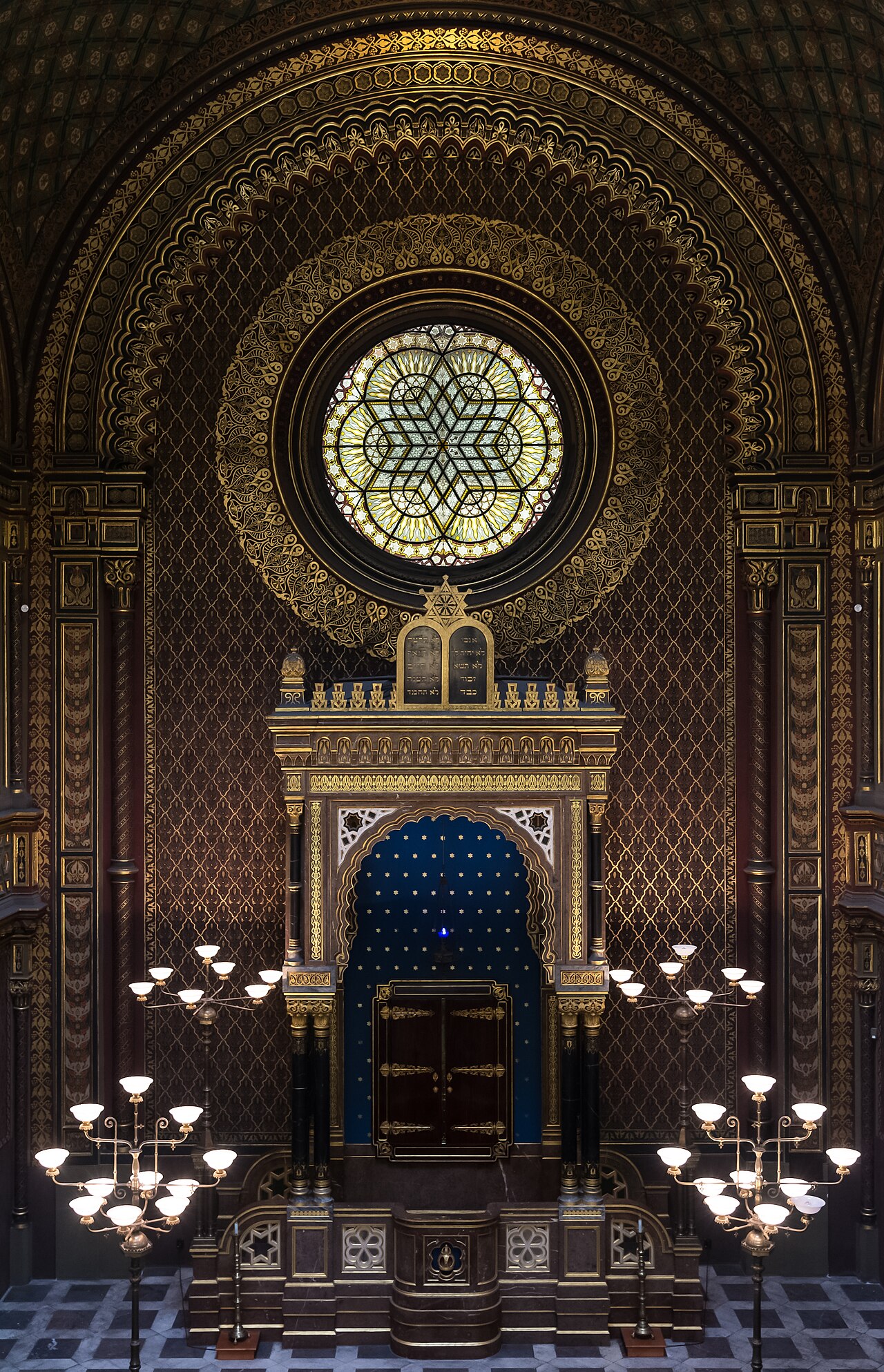
The ark that houses the scroll, and the silver that dresses it — crown, shield, pointer, and finials: ceremonial art at the center of synagogue worship, governed by the principle of beautifying the commandment.
Tagged: Ceremonial Object Synagogue Medieval Modern Liturgical Aniconic (Symbolic) Extant Ceremonial Objects Synagogue Art Jewish
Why It Stands Here
Hiddur mitzvah, the beautification of the commandment, is Judaism's own aesthetic doctrine: the scroll is dressed as royalty because the Torah deserves royal instruments. The ark and its ornaments show the Jewish stance at its most characteristic — no cult image anywhere, and craftsmanship lavished on every object that serves the word.
The ark (aron ha-kodesh) stands on the Jerusalem-facing wall of the synagogue, curtained by the embroidered parochet, and houses the Torah scrolls. The scroll itself wears the ornaments: the keter, a silver crown; the tas, a breastplate-like shield recalling the high priest's; rimonim, finials shaped as pomegranates, often belled; and the yad, the pointer with which the reader follows the text without touching the parchment. Crowns of Italian and German silver, finials from North Africa and Yemen, shields from Poland — the diaspora's whole geography is readable in its Torah silver.
Great historic arks survive as architecture in their own right: the carved wooden arks of the Polish wooden synagogues, the marble ark of Prague's Old-New Synagogue, the portable arks of Cochin and Kaifeng. Together with the menorah and the seder plate, they form the applied canon of Jewish ceremonial art.
References
Related Across the Site
- Brihadeeswara Temple Art Entry — Rajaraja Chola's temple at Thanjavur (completed 1010): a granite mountain of sculpture raised over one of India's great lingas, and the Chola bronze tradition's home ground.
- Hagia Sophia Art Entry — Justinian's great church in Constantinople (532–537), whose dome seemed to contemporaries to hang from heaven — and whose mosaics record, in one building, icon, iconoclasm, conquest, museum, and mosque.
- Rublev's Trinity Art Entry — Andrei Rublev's icon of the three angels at Abraham's table (c. 1411), painted for the Trinity Lavra of St. Sergius — the supreme achievement of Orthodox icon painting and its theology made visible.
- The Dura-Europos Synagogue Frescoes Art Entry — The walls of a synagogue on Rome's Euphrates frontier, painted around 244 CE with the whole biblical story in human figures — the standing disproof that ancient Judaism made no religious pictures.
- The Sarajevo Haggadah Art Entry — A Passover Haggadah illuminated in Barcelona around 1350 — thirty-four miniatures of the biblical story in a Jewish book — treasured, hidden from Nazis and from war, and kept in Sarajevo as the city's emblem of itself.
- The Shintai Mirror Art Entry — Behind the doors of a Shinto shrine sits an object no one looks at — a mirror, sword, or stone that is the seat of the kami. The pictured mirror is of the kind enshrined; the enshrined mirror itself has never been photographed.
- The Shiva Linga Art Entry — A polished stone shaft rising from its base, bathed daily in water, milk, and flowers: the aniconic murti of Shiva, worshipped not as a symbol of an absent god but as the god's own form.
- The Shuilu (Water-Land) Paintings Art Entry — Sets of hanging scrolls that assemble the whole cosmos — Buddhas, Daoist gods, ancestors, and the hungry dead — for the Water-Land rite, Chinese religion's most inclusive ceremony of deliverance.