

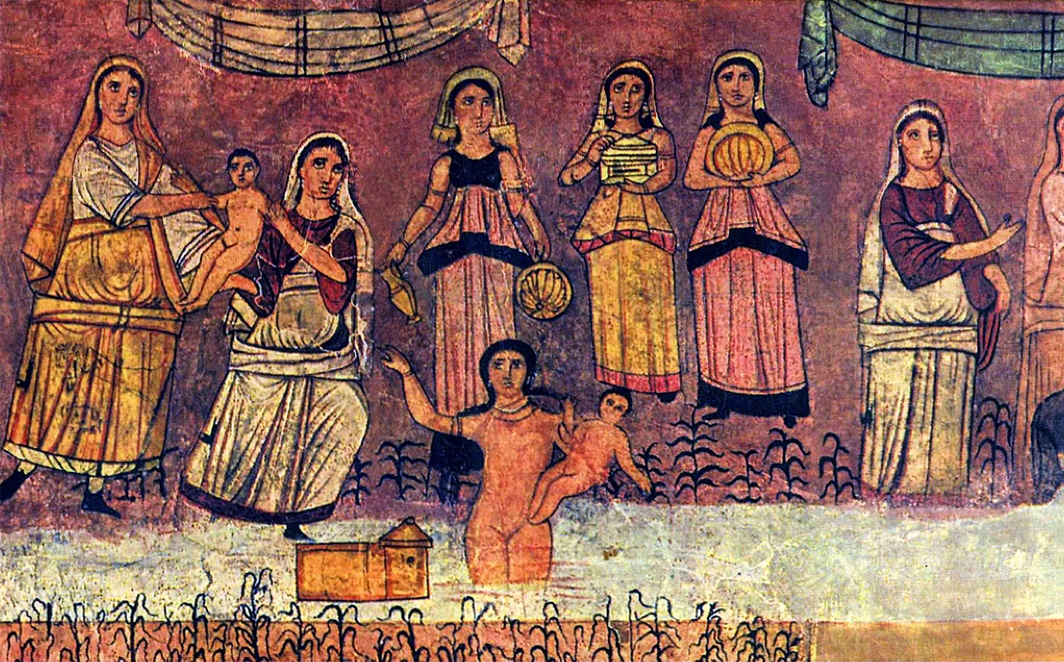
The walls of a synagogue on Rome's Euphrates frontier, painted around 244 CE with the whole biblical story in human figures — the standing disproof that ancient Judaism made no religious pictures.
Tagged: Painting Synagogue Ancient Pedagogical Historically Variable Extant Second Commandment Synagogue Art Jewish
Why It Stands Here
The frescoes matter because of the rule they are supposed to break. A community formed by the Second Commandment covered its prayer hall with figural scenes, because the commandment governed the worship of images, not the painting of them. The synagogue therefore anchors the Jewish position in this section: restraint on cult images, freedom for the narrative image.
Dura-Europos was a Roman garrison town on the Euphrates, and its synagogue, rebuilt in 244–245 CE, had its assembly hall painted on every wall: Moses striking the rock and receiving the law, the infant Moses in the Nile, the Exodus, Ezekiel in the valley of dry bones, the Temple and its implements, Esther before the king. The paintings survived because the town's defenders filled the building with earth against a Persian siege in 256, burying the frescoes in the dark for seventeen centuries.
The cycle is the most extensive body of Jewish narrative painting from antiquity, and its style — frontal figures, flat color, registers stacked like a scroll — became the reference point for every later account of Jewish and early Christian art. The frescoes are now in the National Museum in Damascus, with a reconstructed room at Yale.
References
Related Across the Site
- Hagia Sophia Art Entry — Justinian's great church in Constantinople (532–537), whose dome seemed to contemporaries to hang from heaven — and whose mosaics record, in one building, icon, iconoclasm, conquest, museum, and mosque.
- Rublev's Trinity Art Entry — Andrei Rublev's icon of the three angels at Abraham's table (c. 1411), painted for the Trinity Lavra of St. Sergius — the supreme achievement of Orthodox icon painting and its theology made visible.
- The Bharhut Railing Art Entry — The carved sandstone railing of the Bharhut stupa (c. 150–100 BCE), its medallions crowded with jataka tales and labeled in Brahmi — and the Buddha, in scene after scene, present only by symbol.
- The Good Shepherd of the Catacombs Art Entry — A young shepherd carrying a lamb across his shoulders, painted and carved across the Roman catacombs: the earliest Christian image of Christ, chosen as a symbol before it was a portrait.
- The Sarajevo Haggadah Art Entry — A Passover Haggadah illuminated in Barcelona around 1350 — thirty-four miniatures of the biblical story in a Jewish book — treasured, hidden from Nazis and from war, and kept in Sarajevo as the city's emblem of itself.
- The Shiva Linga Art Entry — A polished stone shaft rising from its base, bathed daily in water, milk, and flowers: the aniconic murti of Shiva, worshipped not as a symbol of an absent god but as the god's own form.
- The Torah Ark and Its Ornaments Art Entry — The ark that houses the scroll, and the silver that dresses it — crown, shield, pointer, and finials: ceremonial art at the center of synagogue worship, governed by the principle of beautifying the commandment.
- Judaism Art Tradition — Principled restraint on cult images, with synagogue art, ceremonial objects, and illuminated manuscripts flourishing inside it.