

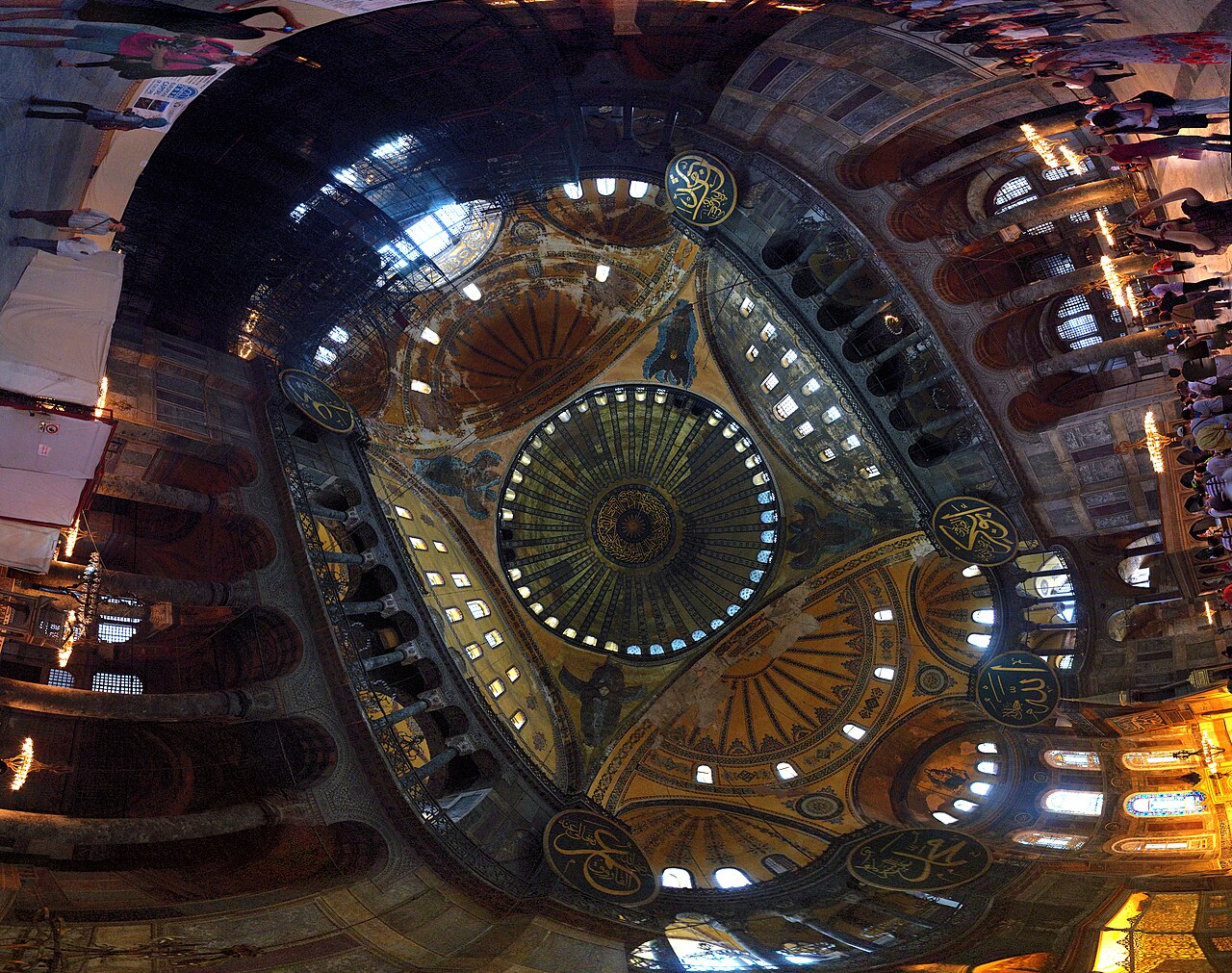
Justinian's great church in Constantinople (532–537), whose dome seemed to contemporaries to hang from heaven — and whose mosaics record, in one building, icon, iconoclasm, conquest, museum, and mosque.
Tagged: Architecture Mosque Museum Medieval Liturgical Historically Variable Extant Byzantine Art Iconoclasm Catholic Eastern Orthodox
Why It Stands Here
Hagia Sophia is the argument of this whole section in a single building. Its apse mosaic of the Theotokos, installed in 867, was preached at its unveiling as the victory of the icons; its figural mosaics were whitewashed under the Ottomans and uncovered under the republic; it has been cathedral, mosque, museum, and mosque again. Every position on images in this section has been held, at some point, about these walls.
Anthemius of Tralles and Isidore of Miletus raised the dome — 55 meters above the floor on a ring of windows — in under six years, and Procopius wrote that it seemed suspended from heaven by a golden chain. The interior was originally aniconic in the early Byzantine manner: gold ground, crosses, and pattern. The figural program came later and was repeatedly revised: the apse Theotokos of 867, the imperial portraits of the south gallery, the great Christ Pantocrator of the Deesis, uncovered in the 1930s.
After 1453 the mosaics were progressively covered as the building became a mosque, its minarets rising outside; in 1935 it opened as a museum and the mosaics were conserved; in 2020 it returned to use as a mosque, with the figural mosaics veiled during prayers. The building's image program is a palimpsest of the whole history this section records.
References
Related Across the Site
- A Kufic Qur'an Folio Art Entry — A parchment leaf of an Abbasid Qur'an in angular Kufic script, its verse endings touched with gold: the page as the supreme religious image of an aniconic faith.
- Brihadeeswara Temple Art Entry — Rajaraja Chola's temple at Thanjavur (completed 1010): a granite mountain of sculpture raised over one of India's great lingas, and the Chola bronze tradition's home ground.
- Rublev's Trinity Art Entry — Andrei Rublev's icon of the three angels at Abraham's table (c. 1411), painted for the Trinity Lavra of St. Sergius — the supreme achievement of Orthodox icon painting and its theology made visible.
- The Dilwara Temples Art Entry — Five Jain temples on Mount Abu whose plain exteriors open into marble interiors carved to the thinness of lace — the summit of Jain temple art.
- The Dome of the Rock Art Entry — The oldest surviving monument of Islamic architecture (Jerusalem, 691–692): a shrine of mosaic, marble, and inscription, whose entire decorative program argues aniconism's positive case.
- The Hanging Temple Art Entry — A monastery of forty halls pinned to a cliff face on Mount Heng, holding altars to Confucius, Laozi, and the Buddha under one roof — the Three Teachings in a single building.
- The Sarajevo Haggadah Art Entry — A Passover Haggadah illuminated in Barcelona around 1350 — thirty-four miniatures of the biblical story in a Jewish book — treasured, hidden from Nazis and from war, and kept in Sarajevo as the city's emblem of itself.
- The Torah Ark and Its Ornaments Art Entry — The ark that houses the scroll, and the silver that dresses it — crown, shield, pointer, and finials: ceremonial art at the center of synagogue worship, governed by the principle of beautifying the commandment.