

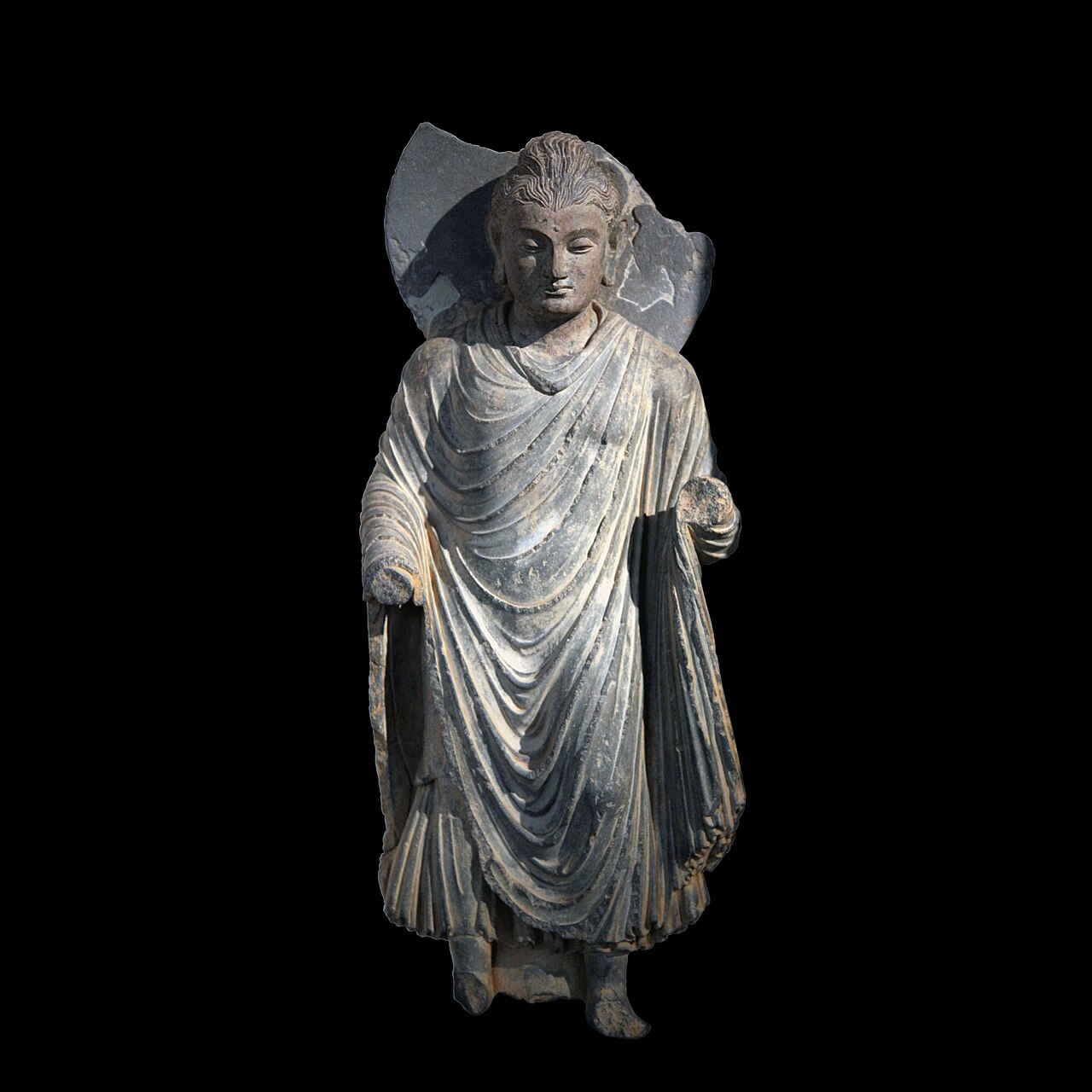
The Buddha in human form from the workshops of Gandhara (1st–3rd century CE): Apollo's face, a Roman toga's folds, and the lakshanas of the Buddha — the image that changed Buddhist art forever.
Tagged: Sculpture Museum Ancient Devotional Iconic Extant Buddha Image Gandhara Buddhist
Why It Stands Here
Whether the first Buddha images were a Gandharan invention, a Mathuran one, or arose in both at once is still argued. What is not argued is the result: the Buddha acquired a face, and Buddhist devotion reorganized itself around it. The Gandhara type — classical drapery over the monastic robe, wavy hair drawn up into the ushnisha — is the moment the aniconic centuries end.
Gandhara, in the Peshawar valley and the Swat hills of today's Pakistan, sat on the roads between India, Persia, and the Greco-Bactrian world, and its workshops carved in grey schist and modeled in stucco a Buddhism in classical dress. The standing Buddha wears his sanghati like a himation, heavy folds over both shoulders; the seated Buddha teaches with the wheel-turning mudra; narrative reliefs panel the stupas with the life, scene by classical scene.
The style has been called Greco-Buddhist since the nineteenth century, sometimes as praise and sometimes as a colonial-era slur implying the image needed Greek permission. Modern scholarship gives the synthesis back to its Gandharan makers. Either way, the type traveled the Silk Road and set the Buddha's features for half of Asia.
Recorded Makers
- The Gandhara Workshops — 1st–5th centuries
References
Related Across the Site
- Rublev's Trinity Art Entry — Andrei Rublev's icon of the three angels at Abraham's table (c. 1411), painted for the Trinity Lavra of St. Sergius — the supreme achievement of Orthodox icon painting and its theology made visible.
- The Bharhut Railing Art Entry — The carved sandstone railing of the Bharhut stupa (c. 150–100 BCE), its medallions crowded with jataka tales and labeled in Brahmi — and the Buddha, in scene after scene, present only by symbol.
- The Ganesh Chaturthi Murti Art Entry — A clay Ganesh, modeled and painted by neighborhood artisans, worshipped in streets and homes for up to eleven days, then carried in procession and immersed: the murti as a guest who is honored and bid farewell.
- The Good Shepherd of the Catacombs Art Entry — A young shepherd carrying a lamb across his shoulders, painted and carved across the Roman catacombs: the earliest Christian image of Christ, chosen as a symbol before it was a portrait.
- The Great Stupa at Sanchi Art Entry — The oldest stone stupa in India, begun under Ashoka and crowned with four carved gateways: the reliquary mound as Buddhism's first monumental art, and its first aniconic center.
- The Sarajevo Haggadah Art Entry — A Passover Haggadah illuminated in Barcelona around 1350 — thirty-four miniatures of the biblical story in a Jewish book — treasured, hidden from Nazis and from war, and kept in Sarajevo as the city's emblem of itself.
- The Shiva Linga Art Entry — A polished stone shaft rising from its base, bathed daily in water, milk, and flowers: the aniconic murti of Shiva, worshipped not as a symbol of an absent god but as the god's own form.
- The Gandhara Workshops Artist — The stucco and schist ateliers of the Peshawar valley that gave the Buddha his first human face — Apollo's features, a monk's robe, a teacher's calm.