

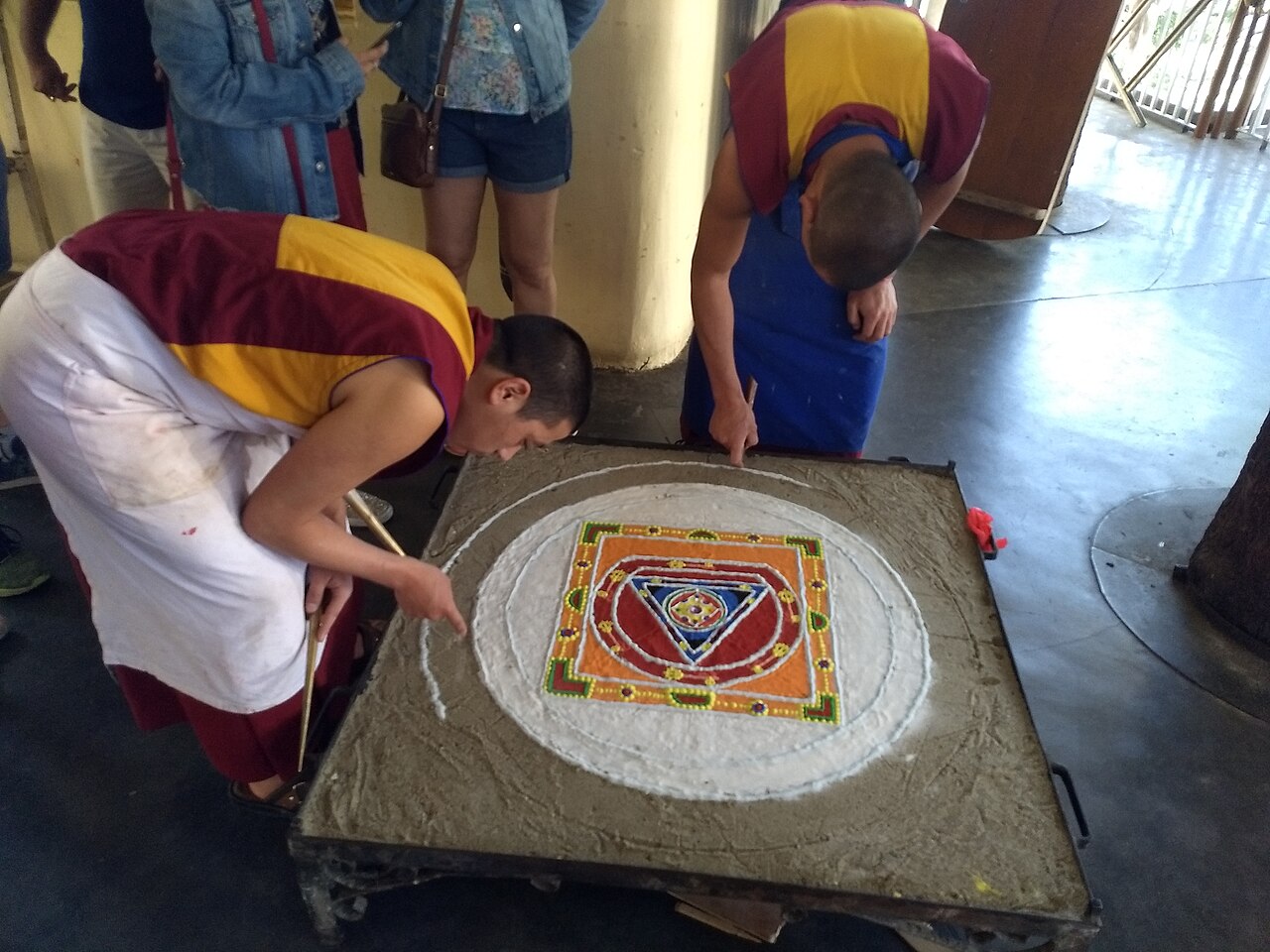
Monks lay down a palace of the deities grain by grain in colored sand, contemplate it for days — and then sweep it away and pour it into running water.
Tagged: Performance and Ritual Temple/Shrine Contemporary Devotional Extant Impermanence Ritual Art Buddhist Tibetan Buddhism
Why It Stands Here
The sand mandala is the tradition's doctrine of impermanence performed as art: weeks of exact, prayerful labor deliberately destroyed on completion. It is the clearest case on the site of a work whose meaning requires its own unmaking.
Working from the center outward with tapered metal funnels called chakpur, monks lay lines of colored sand — crushed stone and mineral pigment — into the geometric palace of a Buddha, following diagrams memorized over years of training. The finished mandala may be contemplated for days or weeks.
At the closing rite the mandala is swept up in a set order, the sand gathered into an urn, carried in procession, and poured into a river or lake, so the blessing the work embodied is carried into the world instead of kept. Photographs and museum residencies have made the practice famous; the rite itself is unchanged by the audience.
References
Related Across the Site
- A Gandhara Buddha Art Entry — The Buddha in human form from the workshops of Gandhara (1st–3rd century CE): Apollo's face, a Roman toga's folds, and the lakshanas of the Buddha — the image that changed Buddhist art forever.
- The Dilwara Temples Art Entry — Five Jain temples on Mount Abu whose plain exteriors open into marble interiors carved to the thinness of lace — the summit of Jain temple art.
- The Ganesh Chaturthi Murti Art Entry — A clay Ganesh, modeled and painted by neighborhood artisans, worshipped in streets and homes for up to eleven days, then carried in procession and immersed: the murti as a guest who is honored and bid farewell.
- The Great Stupa at Sanchi Art Entry — The oldest stone stupa in India, begun under Ashoka and crowned with four carved gateways: the reliquary mound as Buddhism's first monumental art, and its first aniconic center.
- The Guru Granth Sahib, Enthroned Art Entry — The Sikh scripture is not shelved but enthroned — installed under a canopy on a raised seat, fanned with the chaur, woken each morning and put to rest each night, because it is the Guru.
- The Hanging Temple Art Entry — A monastery of forty halls pinned to a cliff face on Mount Heng, holding altars to Confucius, Laozi, and the Buddha under one roof — the Three Teachings in a single building.
- The Shiva Linga Art Entry — A polished stone shaft rising from its base, bathed daily in water, milk, and flowers: the aniconic murti of Shiva, worshipped not as a symbol of an absent god but as the god's own form.
- The Tibetan Thangka Art Entry — A portable scroll painting of a Buddha or deity in exact iconometric proportion — a meditation support, a teaching diagram, and a presence, rolled for the road and unrolled for the rite.