

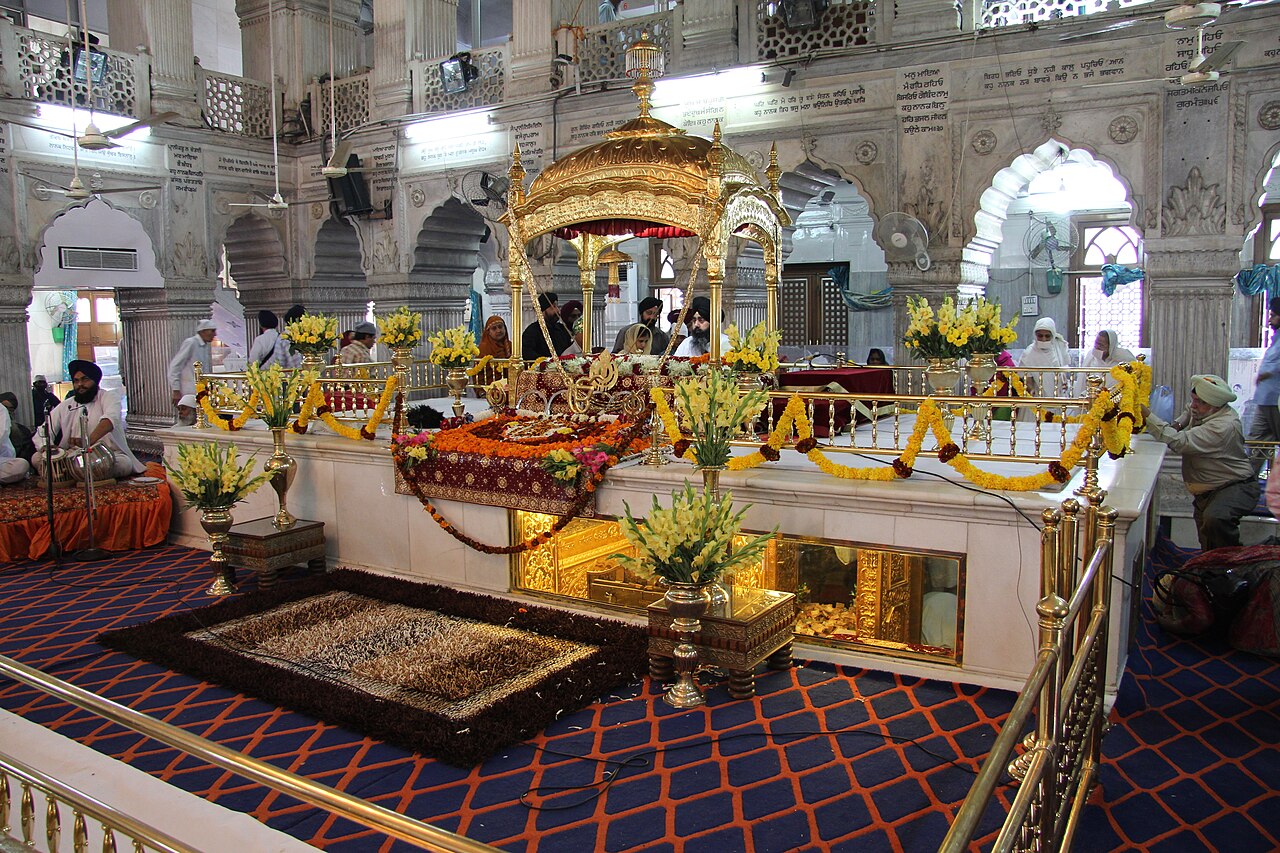
The Sikh scripture is not shelved but enthroned — installed under a canopy on a raised seat, fanned with the chaur, woken each morning and put to rest each night, because it is the Guru.
Tagged: Manuscript Illumination Temple/Shrine Early Modern Devotional Extant Chaur Scripture as Guru Sikh The Khalsa Panth
Why It Stands Here
No account of Sikh art can start anywhere else. Since 1708 the community's Guru is a book, and the arts that surround it — the canopy, the rumala cloths, the throne room of the gurdwara — are the arts of a court attending a sovereign.
Guru Gobind Singh ended the line of human Gurus and installed the Granth as his successor. In every gurdwara the volume rests on a manji sahib under a canopy, covered with embroidered rumalas, and an attendant waves the chaur — a whisk of yak hair set in a silver handle — over it as over a king. It is opened at random each morning for the day's hukamnama, the Guru's order, and ceremonially closed at night.
The pictured enthronement, at Gurdwara Sis Ganj Sahib in Delhi, shows the pattern exactly: canopy, cloths, chaur, attendants — and no image of any Guru, whose depiction Sikh guidance restricts. The book is the presence. That is the Sikh answer to the question this section asks every tradition.
References
Related Across the Site
- A Kalpasutra Folio Art Entry — One painted page from the most copied book in Jainism: the lives of the Tirthankaras in gold and ultramarine, read aloud and shown to the congregation during Paryushana.
- A Kufic Qur'an Folio Art Entry — A parchment leaf of an Abbasid Qur'an in angular Kufic script, its verse endings touched with gold: the page as the supreme religious image of an aniconic faith.
- The Ganesh Chaturthi Murti Art Entry — A clay Ganesh, modeled and painted by neighborhood artisans, worshipped in streets and homes for up to eleven days, then carried in procession and immersed: the murti as a guest who is honored and bid farewell.
- The Golden Temple Art Entry — A gilded sanctum standing in the middle of a sacred pool, reached by one causeway and entered by doors on all four sides — open to every direction and every caste.
- The Sand Mandala Art Entry — Monks lay down a palace of the deities grain by grain in colored sand, contemplate it for days — and then sweep it away and pour it into running water.
- The Shiva Linga Art Entry — A polished stone shaft rising from its base, bathed daily in water, milk, and flowers: the aniconic murti of Shiva, worshipped not as a symbol of an absent god but as the god's own form.
- The Tibetan Thangka Art Entry — A portable scroll painting of a Buddha or deity in exact iconometric proportion — a meditation support, a teaching diagram, and a presence, rolled for the road and unrolled for the rite.
- The Janamsakhi Ateliers Artist — The painters of the janamsakhis, the illustrated lives of Guru Nanak. This directory's image for them is a manuscript's opening folio of text — no figure of the Guru — by the community's guidance.