

Religious Art & Worldviews · Artists
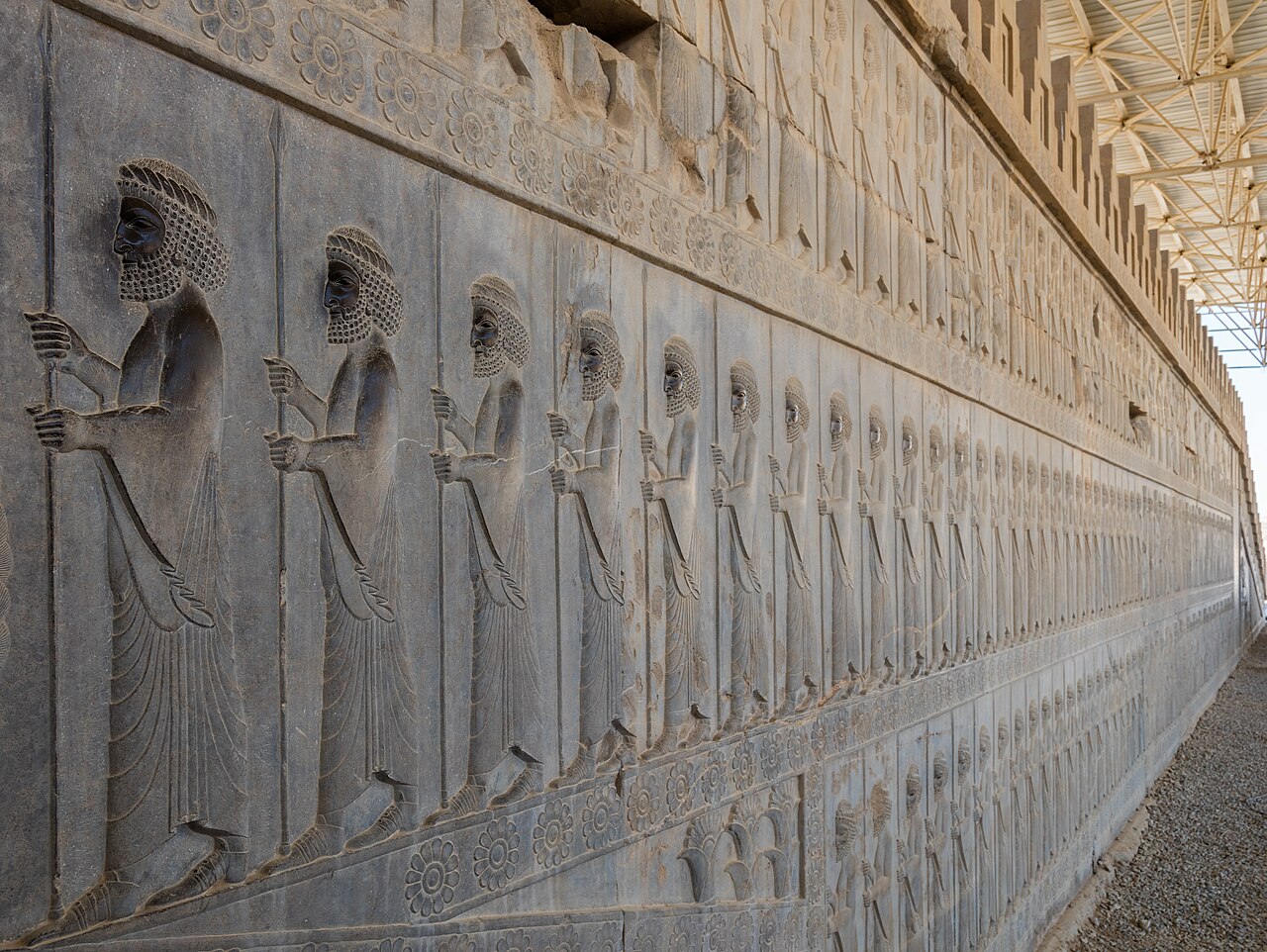
The imperial workshops of Darius and Xerxes — masons from across the empire whose Apadana reliefs process twenty-three nations up the stairs with their gifts.
Tagged: Sculpture Ancient Commemorative Political Achaemenid Art Zoroastrianism
Persepolis was built by paid craftsmen drawn from the whole Achaemenid world — Ionians, Egyptians, Medes, Indians — whose hands scholars can still sort in the stone. Their reliefs are the empire's census and its ideology: every nation ascending in order, unarmed, bearing tribute, under the winged figure of the fravahar.
The pictured Apadana wall runs the length of the audience hall's stair: the carving as constitution.
References
Related Across the Site
- A Gandhara Buddha Art Entry — The Buddha in human form from the workshops of Gandhara (1st–3rd century CE): Apollo's face, a Roman toga's folds, and the lakshanas of the Buddha — the image that changed Buddhist art forever.
- Northwest Coast Formline and the Crest Pole Art Entry — A visual grammar of ovoids and U-forms that writes family crests in cedar — the pole at Brockton Point, carved by Ellen Neel, stands in public where its predecessors have stood since the 1880s.
- The Bharhut Railing Art Entry — The carved sandstone railing of the Bharhut stupa (c. 150–100 BCE), its medallions crowded with jataka tales and labeled in Brahmi — and the Buddha, in scene after scene, present only by symbol.
- The Fravahar Art Entry — A bearded figure in a winged disc, carved over temple doors and printed on calendars from Mumbai to Toronto — the Zoroastrian emblem whose original meaning scholars still argue about.
- The Great Stupa at Sanchi Art Entry — The oldest stone stupa in India, begun under Ashoka and crowned with four carved gateways: the reliquary mound as Buddhism's first monumental art, and its first aniconic center.
- The Shiva Linga Art Entry — A polished stone shaft rising from its base, bathed daily in water, milk, and flowers: the aniconic murti of Shiva, worshipped not as a symbol of an absent god but as the god's own form.
- Bill Reid Artist — The Haida master carver and jeweler whose Raven and the First Men brought the monumental carving tradition back to full strength.
- Käthe Kollwitz Artist — The German artist of grief: her Pietà, enlarged in Berlin's Neue Wache, is Germany's central memorial to the victims of war — a mother holding her dead son, made by a mother who lost hers.