

Religious Art & Worldviews · Artists
The master of the Timurid miniature, head of the royal atelier at Herat, whose building sites, gardens, and crowds set the Persian standard.
Tagged: Manuscript Illumination Early Modern Decorative Iconic Persian Miniature Muslim
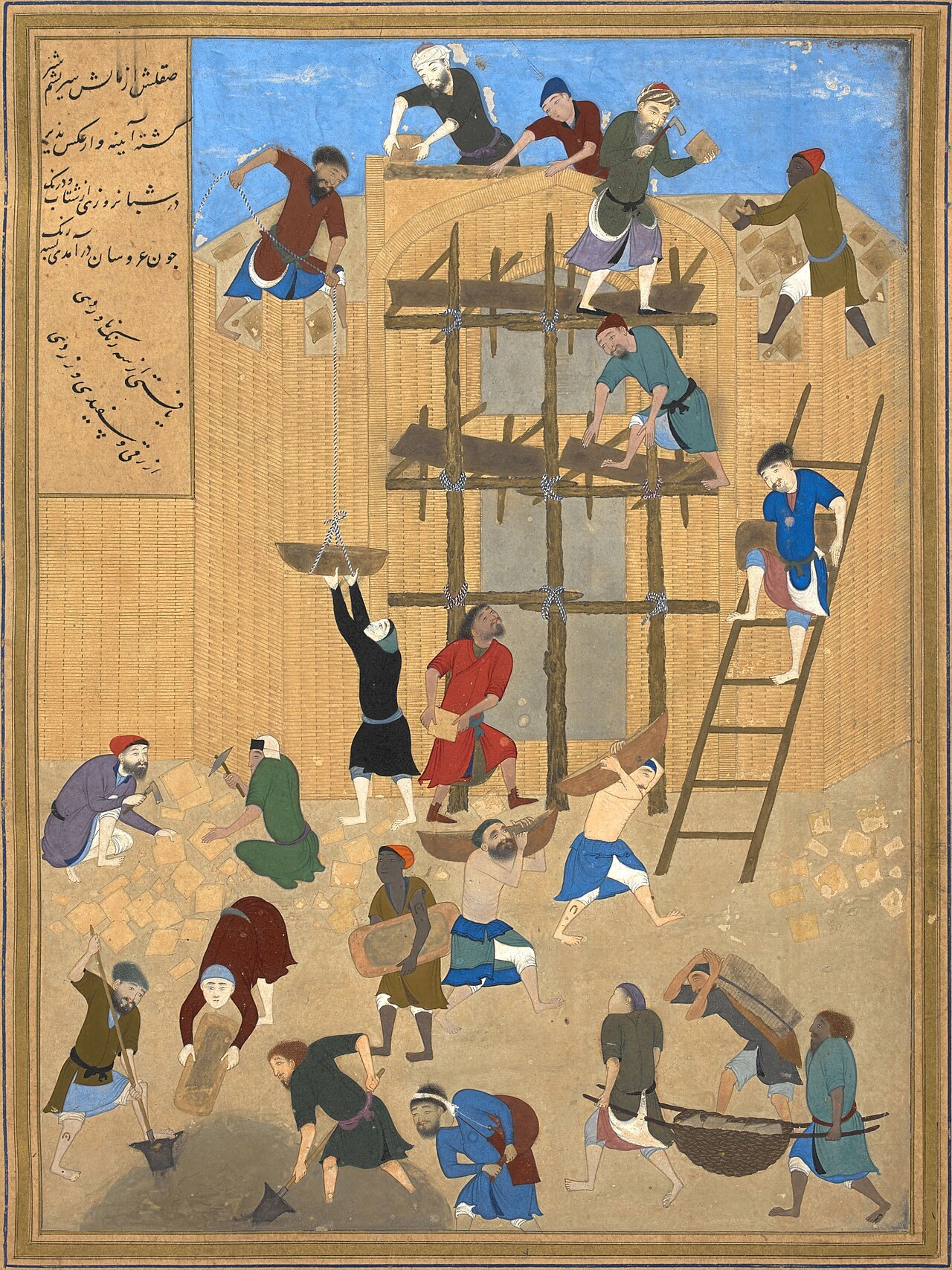
Behzad directed the kitabkhana of Sultan Husayn Bayqara at Herat and later the Safavid royal workshop at Tabriz. His miniatures people every corner of the page — masons on scaffolds, onlookers at gates — with architecture rendered like stage sets for human comedy.
The pictured Construction of the Fort of Kharnaq is attributed to him, and the attribution is stated as such: workshop practice makes certainty rare, and this directory does not invent it.
References
Related Across the Site
- A Kalpasutra Folio Art Entry — One painted page from the most copied book in Jainism: the lives of the Tirthankaras in gold and ultramarine, read aloud and shown to the congregation during Paryushana.
- A Kufic Qur'an Folio Art Entry — A parchment leaf of an Abbasid Qur'an in angular Kufic script, its verse endings touched with gold: the page as the supreme religious image of an aniconic faith.
- The Mughal Court Miniature Art Entry — The figural painting of the Mughal emperors' atelier — hunts, audiences, lovers, and saints in jewel-like detail — standing as the descriptive practice beside Islam's normative aniconism.
- The Sarajevo Haggadah Art Entry — A Passover Haggadah illuminated in Barcelona around 1350 — thirty-four miniatures of the biblical story in a Jewish book — treasured, hidden from Nazis and from war, and kept in Sarajevo as the city's emblem of itself.
- Riza-i Abbasi Artist — The Safavid court painter who turned the Persian miniature toward the single figure — youths, lovers, and readers alone on the page.
- Tawaraya Sotatsu Artist — Founder of the Rinpa school, painter of the Wind God and Thunder God screens — gold ground, divine weather, design as devotion.
- The Gujarat Manuscript Ateliers Artist — The family workshops of western India that painted the Kalpasutra and the Jain lives in gold, lapis, and red — hundreds of copies, one devotional economy.
- The Janamsakhi Ateliers Artist — The painters of the janamsakhis, the illustrated lives of Guru Nanak. This directory's image for them is a manuscript's opening folio of text — no figure of the Guru — by the community's guidance.