

Religious Art & Worldviews · Artists
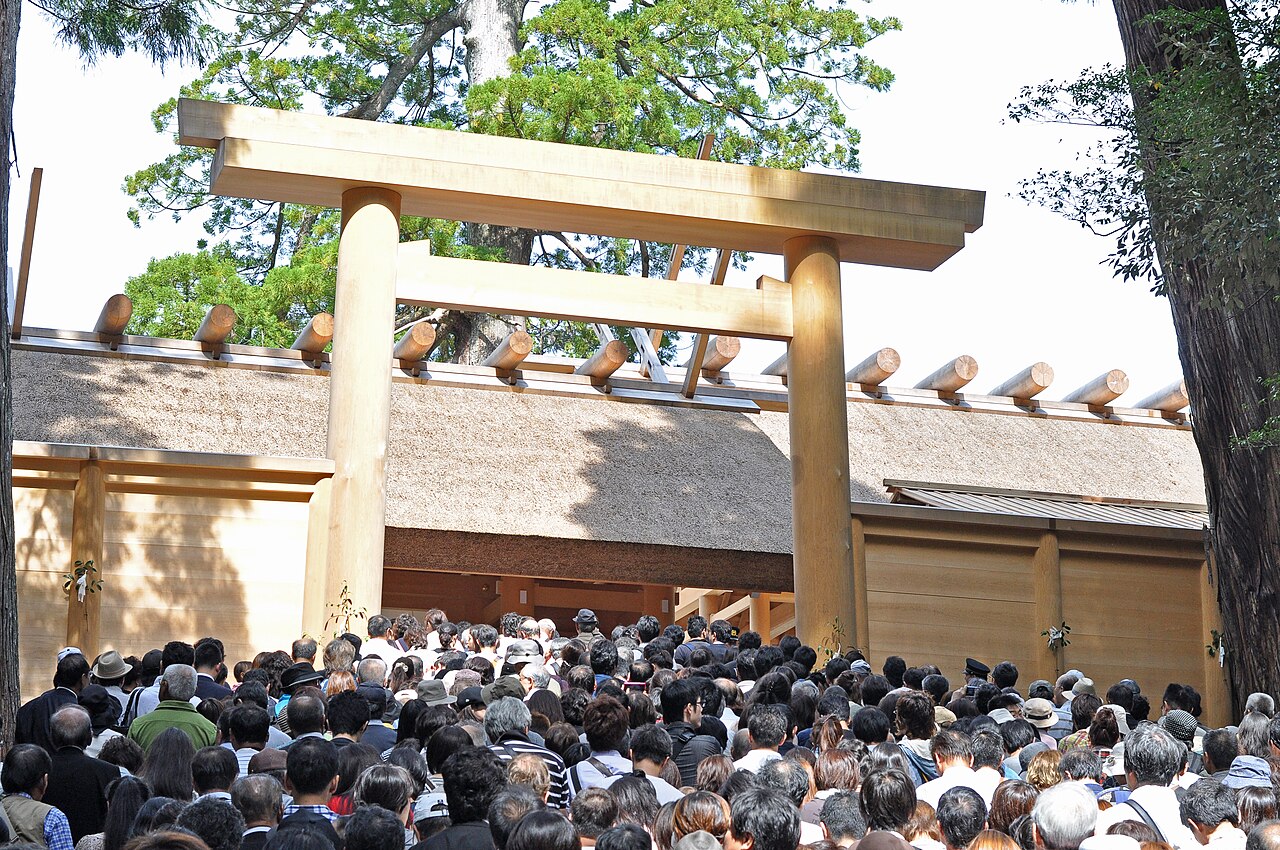
The master shrine carpenters who rebuild Ise Jingu every twenty years with hand tools and unjoined cypress — a craft transmitted by being performed.
Tagged: Architecture Sacred Landscape Ancient Devotional Sacred Carpentry Jinja Shinto Shinto
The miyadaiku, palace carpenters, are Japan's hereditary shrine builders. At Ise their knowledge has exactly one curriculum: the shikinen sengu, the twenty-year rebuilding, in which each generation of carpenters learns the joints by raising the shrine beside its elder copy.
No individual name leads this record because the tradition itself is collective: the pictured shrine is their work, rebuilt by their line in 2013 for the sixty-second time.
References
Related Across the Site
- A Gandhara Buddha Art Entry — The Buddha in human form from the workshops of Gandhara (1st–3rd century CE): Apollo's face, a Roman toga's folds, and the lakshanas of the Buddha — the image that changed Buddhist art forever.
- The Dilwara Temples Art Entry — Five Jain temples on Mount Abu whose plain exteriors open into marble interiors carved to the thinness of lace — the summit of Jain temple art.
- The Golden Temple Art Entry — A gilded sanctum standing in the middle of a sacred pool, reached by one causeway and entered by doors on all four sides — open to every direction and every caste.
- The Good Shepherd of the Catacombs Art Entry — A young shepherd carrying a lamb across his shoulders, painted and carved across the Roman catacombs: the earliest Christian image of Christ, chosen as a symbol before it was a portrait.
- The Great Stupa at Sanchi Art Entry — The oldest stone stupa in India, begun under Ashoka and crowned with four carved gateways: the reliquary mound as Buddhism's first monumental art, and its first aniconic center.
- The Ise Grand Shrine Art Entry — The most sacred shrine in Shinto is a plain cypress building that is torn down and rebuilt, identically, every twenty years — and has been for some thirteen centuries.
- The Shintai Mirror Art Entry — Behind the doors of a Shinto shrine sits an object no one looks at — a mirror, sword, or stone that is the seat of the kami. The pictured mirror is of the kind enshrined; the enshrined mirror itself has never been photographed.
- The Shiva Linga Art Entry — A polished stone shaft rising from its base, bathed daily in water, milk, and flowers: the aniconic murti of Shiva, worshipped not as a symbol of an absent god but as the god's own form.