

Religious Art & Worldviews · Artists
The Dominican friar whose frescoes for his brothers' cells at San Marco were painted as instruments of prayer, one mystery per monk.
Tagged: Painting Medieval Devotional Iconic Devotional Fresco Catholic
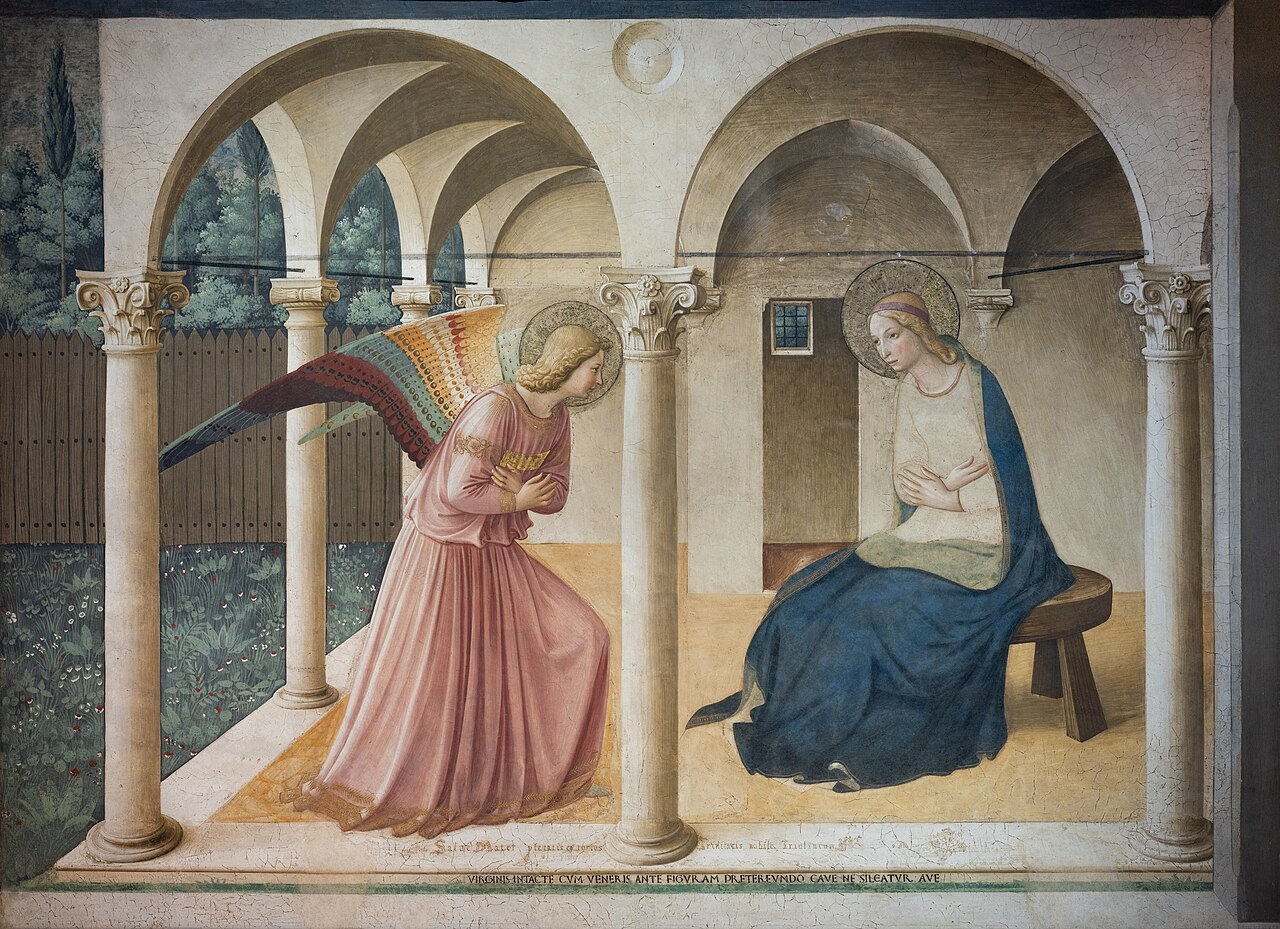
Guido di Pietro took vows and a painter's name the tradition turned into Fra Angelico, the Angelic Friar. At San Marco in Florence he frescoed each cell with a single scene from Christ's life, composed for the solitary prayer of the brother who slept there.
His Annunciation at the head of the dormitory stair — the pictured work — greets the friars as Gabriel greeted Mary: quietly, in a bare loggia, with nothing wasted.
References
Related Across the Site
- Rublev's Trinity Art Entry — Andrei Rublev's icon of the three angels at Abraham's table (c. 1411), painted for the Trinity Lavra of St. Sergius — the supreme achievement of Orthodox icon painting and its theology made visible.
- The Good Shepherd of the Catacombs Art Entry — A young shepherd carrying a lamb across his shoulders, painted and carved across the Roman catacombs: the earliest Christian image of Christ, chosen as a symbol before it was a portrait.
- The Tibetan Thangka Art Entry — A portable scroll painting of a Buddha or deity in exact iconometric proportion — a meditation support, a teaching diagram, and a presence, rolled for the road and unrolled for the rite.
- Andrei Rublev Artist — The monk-iconographer whose Trinity became the measure of the Russian icon: stillness, humility, and gold held in perfect balance.
- Caravaggio Artist — The painter who dragged sacred history into a Roman tavern's light — saints with dirty feet, apostles recruited from the street.
- Giotto di Bondone Artist — The Florentine who gave biblical figures weight, grief, and ground to stand on — the hinge between medieval symbol and Renaissance story.
- Liang Kai Artist — The court painter who walked away from the academy to become 'Madman Liang', inventor of the splashed-ink immortal.
- Michelangelo Buonarroti Artist — Sculptor of the Pietà and the David, painter of the Sistine ceiling — the Renaissance's defining sacred artist, shown here in del Conte's portrait.