

Religious Art & Worldviews · Artists
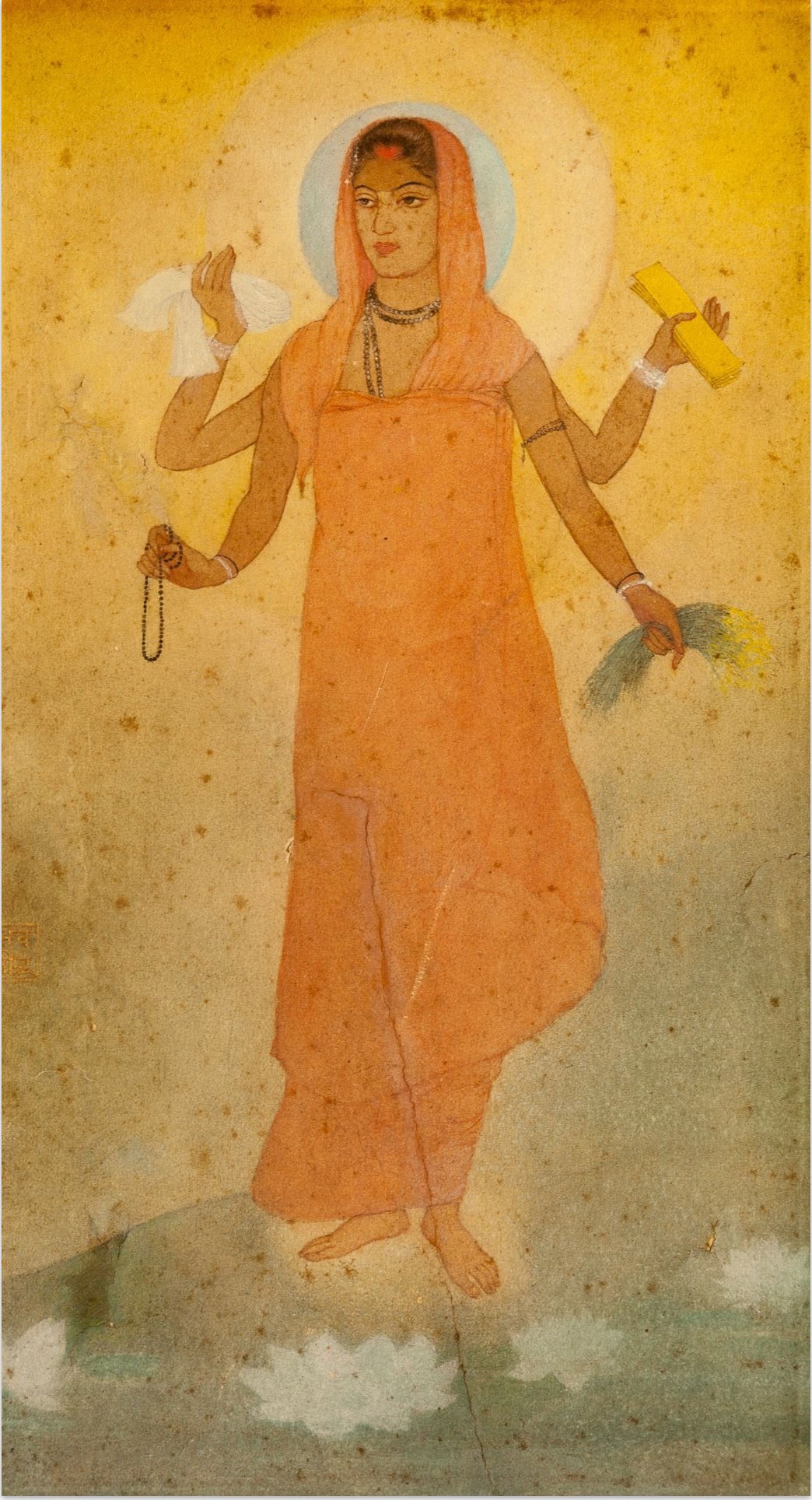
Founder of the Bengal School, whose Bharat Mata (1905) gave Indian nationalism a goddess's face — and swadeshi art its emblem.
Tagged: Painting Modern Political Iconic Bengal School Hindu
Tagore, nephew of the poet Rabindranath, rejected the oleograph's glossy naturalism for a wash technique drawn from Mughal and Japanese models, and taught a generation to paint India in India's own idioms. He founded the Bengal School around that conviction.
The pictured Bharat Mata — Mother India as a saffron-clad ascetic bearing food, cloth, learning, and prayer — was painted in the swadeshi agitation of 1905 and became its icon.
References
Related Across the Site
- Rublev's Trinity Art Entry — Andrei Rublev's icon of the three angels at Abraham's table (c. 1411), painted for the Trinity Lavra of St. Sergius — the supreme achievement of Orthodox icon painting and its theology made visible.
- The Good Shepherd of the Catacombs Art Entry — A young shepherd carrying a lamb across his shoulders, painted and carved across the Roman catacombs: the earliest Christian image of Christ, chosen as a symbol before it was a portrait.
- The Mughal Court Miniature Art Entry — The figural painting of the Mughal emperors' atelier — hunts, audiences, lovers, and saints in jewel-like detail — standing as the descriptive practice beside Islam's normative aniconism.
- The Wittenberg Altarpiece Art Entry — Lucas Cranach the Elder's altarpiece for Wittenberg's town church (1547): the Last Supper with Luther among the apostles — proof that the Reformation's quarrel with images was a family quarrel, not a unanimous verdict.
- Marc Chagall Artist — The Jewish painter of Vitebsk who carried the shtetl, the Torah, and the crucified Jesus of Jewish suffering into modern art. Shown in a 1941 photograph; his paintings remain in copyright.
- Moritz Daniel Oppenheim Artist — Called the first Jewish painter of the modern era: his Scenes from Traditional Jewish Family Life gave emancipated German Jewry its self-portrait.
- Raja Ravi Varma Artist — The painter who put the gods on the bazaar wall: his oleographs of Lakshmi, Saraswati, and the epics made divine images a part of every Indian home.
- Sobha Singh Artist — The Punjabi painter whose portraits of the Gurus hang in a million homes — shown here, by the rules of his own tradition's guidance, as himself: a 1985 photograph of the artist.